I Built a System for Remembering Everything
Based on Ali Alqaraghuli, PhD's video on YouTube. If you like this content, support the original creators by watching, liking and subscribing to their content.
C.A.S.T. is built on two rules: action causes results, and ideas have value only when implemented.
Briefing
Ali Alqaraghuli’s ADHD memory system, called C.A.S.T., is built around a blunt principle: ideas only matter when they’re converted into actions that trigger real-world results. The system’s value isn’t just remembering thoughts—it’s turning fleeting ADHD-driven ideas into scheduled, executable work so dreams translate into outcomes like landing a NASA job, graduating a PhD at 26, and growing an engineering YouTube channel.
The framework starts with two “rules of reality.” First, action causes reaction: getting the results people want—career growth, relationships, health, business—requires taking the right steps in the world, not merely imagining them. Second, ideas alone are meaningless; they become valuable only when someone implements them. That matters because even “brilliant” ideas can be delayed or outcompeted, and success often goes to the person who ships rather than the person who merely thinks.
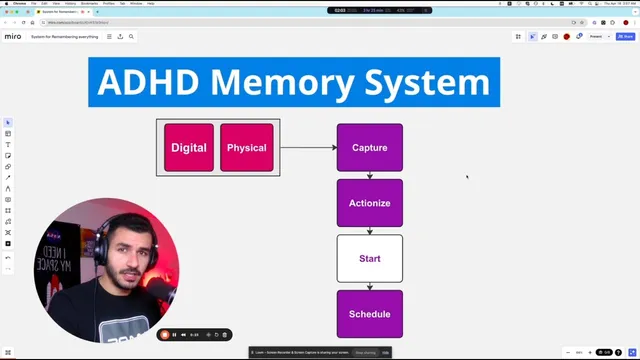
C.A.S.T. has four parts. The first is Capture: immediately grabbing ideas as they appear, especially for people whose brains generate thoughts rapidly. Capture can be done through physical tools like notebooks, sticky notes, or writing on a wall, or through digital tools like phone notes or apps. The key is speed and documentation—if ideas aren’t captured, they keep moving through the mind and vanish.
The second part is Actionize: converting captured notes into concrete tasks. Alqaraghuli treats “actionize” as a verb—turning something like “ad hook idea” into an executable plan such as “record a YouTube ad titled ‘Your brain is a popcorn machine,’” including sub-steps like outlining the ad body and CTA and checking for similar examples. The goal is to transform passive notes into multiple actionable steps (texting a friend, making a Loom, changing a landing page, adding more detail to a future video).
The third and fourth parts—Start and Schedule—flip conventional productivity logic. Instead of scheduling first and starting later, the system pushes an “opt-out” mindset: ask what’s stopping the work right now. If the answer is weak, start immediately. If it’s strong (fatigue, timing, constraints), then ask when it can be done sooner—one hour, two hours, later that day—by repeatedly drilling down on the real blocker. Alqaraghuli argues this approach prevents the common trap of scheduling arbitrary times that create gaps where social media and distractions take over.
On a phone, the same workflow appears in practice: review notes after finishing a task, actionize what’s feasible, and if energy is low, choose sleep rather than forcing inefficient work. Only when immediate action isn’t viable does scheduling come in—and it should be soon, not used as an excuse.
Overall, C.A.S.T. is a practical loop for ADHD brains: capture quickly, actionize relentlessly, start by removing friction, and schedule only as a last resort—so memory becomes momentum rather than a storage system for forgotten intentions.
Cornell Notes
Ali Alqaraghuli’s C.A.S.T. system turns ADHD-driven ideas into real outcomes by forcing a chain from thought to action. It begins with Capture—writing down ideas immediately using physical or digital tools—because unrecorded thoughts disappear. Next comes Actionize: rewriting notes as executable tasks and breaking them into steps (e.g., turning an ad hook into recording, outlining, and research). Start and Schedule work in reverse order: ask what’s stopping the task now, start if possible, and only schedule if a strong constraint exists, choosing the earliest workable time. The approach matters because it treats ideas as worthless until implemented, aligning memory with execution.
Why does the system insist that action comes before results, and ideas alone don’t count?
What does “Capture” mean in practice for an ADHD brain?
How does “Actionize” convert vague thoughts into work that can actually be done?
What’s the “opt-out” approach to Start and Schedule, and why does it speed things up?
When should scheduling happen in C.A.S.T.?
Review Questions
- How does C.A.S.T. define the difference between capturing an idea and actionizing it?
- What questions does the system use to decide between starting now versus scheduling later?
- Give one example of how you would convert a vague note into multiple actionable steps using the Actionize step.
Key Points
- 1
C.A.S.T. is built on two rules: action causes results, and ideas have value only when implemented.
- 2
Capture requires immediate note-dumping using physical or digital tools so ADHD-generated ideas don’t vanish.
- 3
Actionize converts notes into executable tasks and breaks them into concrete steps (not just reminders).
- 4
Start and Schedule run in reverse: ask what’s stopping the work now, start if possible, and schedule only if blocked.
- 5
Use “opt-out” reasoning to find the earliest workable time (e.g., one hour later) rather than waiting for an arbitrary slot.
- 6
Scheduling should be soon and specific; long gaps invite distraction and social media scrolling.
- 7
If energy is genuinely low, choose sleep and plan the next action for the morning instead of forcing low-efficiency work.