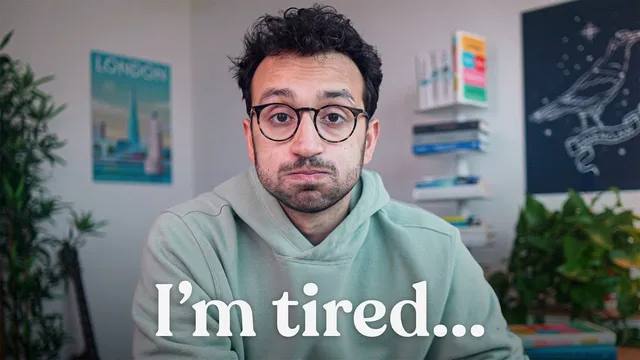
I didn't want to make this video...
Based on Ali Abdaal's video on YouTube. If you like this content, support the original creators by watching, liking and subscribing to their content.
He describes a persistent pattern: most of the time, he doesn’t feel like recording, yet he still hits record.
Briefing
Consistency doesn’t come from feeling motivated—it comes from acting while motivation and confidence are absent. The core message: thoughts and feelings can scream “don’t do it,” but actions don’t have to follow them. That separation—treating discomfort as a sensation with a story attached, rather than a command—helps explain how even long-time creators keep showing up week after week.
The talk opens with a blunt confession: for roughly 95% of his uploads, he doesn’t feel like hitting record. He describes the familiar mental loop—checking analytics, scrolling social apps, imagining better use of time—paired with a deeper internal barrier: imposter syndrome, overthinking, and the fear that the work won’t be “good enough” or valuable. Even after eight years of posting once or twice a week, the resistance remains. The surprising part isn’t that he struggles; it’s that he still records anyway, despite not wanting to.
Rather than framing the solution as brute-force discipline, he argues that “forcing” through discomfort tends to burn people out. Forcing looks like clenching through a painful internal fire, pushing past resistance through sheer willpower. That approach may work a few times, but it collapses under the weight of repeating the same uncomfortable task for years. The more sustainable alternative is to recognize that the mind’s narrative and the body’s feelings don’t have to determine behavior.
He offers a practical model: thoughts and feelings are one “hand,” actions are the other. They can move in synchrony, but they don’t have to. A person can feel tired or reluctant and still take the action required by the moment—like continuing a critical task rather than abandoning it for a coffee. At home, with a phone and endless feeds, it’s easier for thoughts and feelings to dictate scrolling. The key insight is that the correlation is optional: wanting to scroll doesn’t obligate scrolling; not wanting to film doesn’t obligate inaction.
He then breaks down what “discomfort” actually is: internal bodily sensations (often in the throat, stomach, chest) plus a mental story—“I hate public speaking,” “I’ll be laughed at,” “this is pointless.” Anxiety, he notes, often involves fear of something that hasn’t happened yet. These reactions evolved as protective mechanisms for vulnerability and social risk, which is why public-facing work—writing, posting, speaking, publishing—can feel far more threatening than private work.
The practical prescription is simple: start anyway, but start small. He repeatedly returns to a “5-minute rule,” setting a timer and committing to only five minutes of the task. In many cases, the initial hump of inertia is the hardest part; once the first minutes pass, enjoyment and momentum often kick in. He also argues that consistency is the engine behind freedom—financial, career, and personal—because the “work” is doing the uncomfortable thing when you don’t feel like it.
The closing takeaway is less motivational and more permission-based: even experienced people feel fear, overthinking, and rejection sensitivity at the start. The goal isn’t to eliminate those feelings; it’s to disregard them as instructions. Do the action for five minutes, focus on process, and let the separation between feeling and behavior do the heavy lifting.
Cornell Notes
The central claim is that consistency comes from separating feelings from actions. Even after years of posting, he says he rarely feels like recording; imposter syndrome and overthinking still show up. “Forcing” through discomfort may work briefly, but it often leads to burnout, so he recommends a different approach: treat discomfort as a bodily sensation plus a story, not as a command. He uses a “two hands” metaphor—thoughts/feelings on one side, actions on the other—to show they can operate independently. A practical tool is the 5-minute rule: start the task for five minutes and often the initial inertia hump passes, making continuation easier.
Why does he keep recording even when he doesn’t feel like it?
What’s wrong with the “forcing it” approach?
How does the “two hands” model work in practice?
What does he mean by discomfort, and why does it show up more in public?
What is the 5-minute rule and why does it help?
How does he connect this to “freedom” and long-term goals?
Review Questions
- How does the “two hands” metaphor change the way you interpret thoughts and feelings before starting a task?
- Why does he argue that forcing through discomfort tends to fail over the long term?
- What situations in your life resemble the “hump of inertia,” and how could a 5-minute rule help you start anyway?
Key Points
- 1
He describes a persistent pattern: most of the time, he doesn’t feel like recording, yet he still hits record.
- 2
Sustainable consistency isn’t about forcing yourself through pain; it’s about not treating feelings as instructions.
- 3
Thoughts and feelings can be separated from actions—wanting to avoid something doesn’t obligate avoidance.
- 4
Discomfort is bodily sensation plus a story; public tasks feel harder because they involve vulnerability and social risk.
- 5
The initial barrier is often inertia at the start; a 5-minute timer can help you cross that threshold.
- 6
Consistency with uncomfortable actions is positioned as the engine behind freedom—financial, career, and personal.