I found a note-taking method in the waiting room of a hospital! (Heptabase Tutorial)
Based on Greg Wheeler's video on YouTube. If you like this content, support the original creators by watching, liking and subscribing to their content.
A hospital “reflection room” concept reframes storytelling as a structured way to process emotions, including grief.
Briefing
A hospital waiting-room sign sparked a “reflection room” idea that turned into a practical note-taking method: use structured reflection to process emotions, generate insights, and make knowledge connections visible. The trigger was an unusual navigation listing for a “reflection room,” a concept tied to participatory art installations where people write stories about experiences and read others’ accounts. Those spaces are designed to support calm reflection—remembering, celebrating, teaching, learning, and connecting—so the environment itself nudges people toward meaning-making.
A key insight followed from research on reflection rooms and storytelling. Studies cited in the article linked storytelling to witnessing loss and processing grief and other emotions. That evidence reframed writing as more than self-expression: bringing an experience to mind and writing it down can help someone process what’s happening internally. The same mechanism can work privately, without sharing—writing functions as a way to “turn toward” difficult feelings instead of pushing them down.
From that emotional-processing insight, the method expanded into a chain of idea-building moves. First came a personal “reflection room” metaphor: nature as an already-designed space for calm, gratitude, learning, and connection. Next, the word “reflect” prompted a definition study—reflecting means thinking deeply or carefully. Then a synonym (“turn over in one’s mind”) became the engine for a repeatable thinking technique: sit with an idea like a geologist studying a rock, then flip it to examine another side. This “turning over” approach is meant to produce fresh angles and new perspectives rather than settling for the first interpretation.
Two related prompts reinforced the practice. “Build your St strategy from your stare” came from a preacher who stares at Bible verses until details surface through sustained attention. “Look at your fish” referenced a teaching story where a professor challenges students to write after staring at a fish for a set time—forcing observation of overlooked details.
The framework then leaned on the idea of “space.” A remembered quote—“space is where miracles happen”—paired with a word-study definition of space as a continuous, unoccupied area. That combination produced another insight: miracles and thought breakthroughs are “all around us” when someone makes room—being “available and free” to notice them.
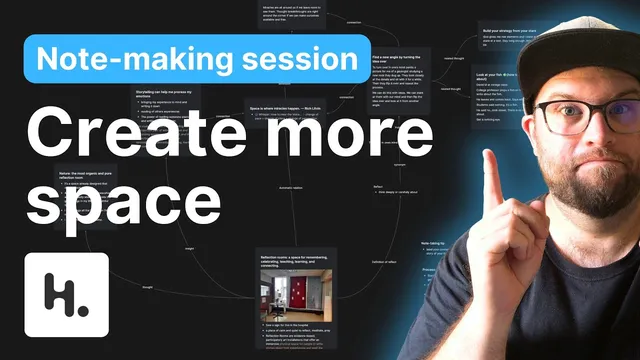
Finally, the practical system: label connection lines in a knowledge app (Heptabase) to reveal the reasoning behind links. Instead of only drawing lines between notes, labels distinguish why ideas connect—such as a line stemming from a definition leading to a synonym leading to an insight, versus an “automatic relation” where the mind connects ideas without seeing them side-by-side. The result is a visible narrative of thought, making reflection and learning easier to review and reuse.
Cornell Notes
A hospital waiting-room sign led to the concept of “reflection rooms,” participatory spaces where people write and read stories designed for calm, meaning-making. Research tied storytelling to processing grief and other emotions, inspiring a personal method: bring experiences to mind and write them down to help emotions move through. The approach then becomes a repeatable insight engine—define key words, turn synonyms “over in one’s mind,” and stare long enough at an idea to notice new details (like “look at your fish”). To make the process retrievable, connection lines in Heptabase are labeled so the reasoning behind each link—step-by-step or “automatic relation”—is visible later.
How did “reflection rooms” shift writing from journaling into emotional processing?
What is the core technique behind “turn over in one’s mind”?
Why do “stare” and “look closer” show up as recurring prompts?
How does the concept of “space” become a thinking tool?
What does labeling connection lines add to Heptabase note-taking?
Review Questions
- What evidence linked storytelling to processing grief, and how did that change the purpose of writing for the note-taker?
- Describe the “turn over in one’s mind” method using the geologist/rock analogy and explain how it would apply to a new idea.
- How do labeled connection lines help differentiate deliberate reasoning from “automatic relation” when revisiting notes?
Key Points
- 1
A hospital “reflection room” concept reframes storytelling as a structured way to process emotions, including grief.
- 2
Writing can function as emotional processing even without sharing—bringing experiences to mind and recording them helps move through feelings.
- 3
Use word studies (definition + synonym) as an idea engine to generate new angles rather than stopping at the first interpretation.
- 4
Apply sustained attention prompts like “stare” and “look at your fish” to uncover details that appear only after time.
- 5
Treat “space” as both mental availability and an observational condition—breakthroughs are more likely when room is made to notice them.
- 6
In Heptabase, label connection lines to preserve the reasoning behind links, separating step-by-step chains from “automatic relation.”