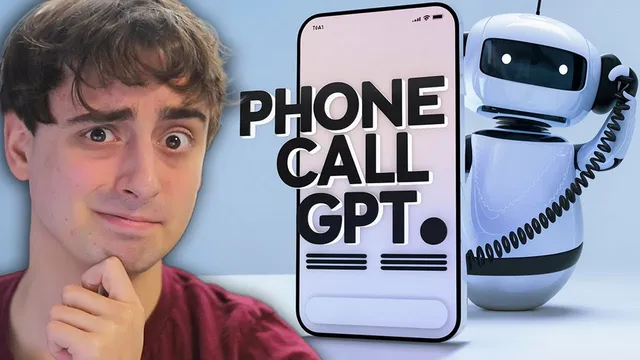
I found an AI Agent that makes Phone Calls for you
Based on MattVidPro's video on YouTube. If you like this content, support the original creators by watching, liking and subscribing to their content.
Phone Call GPT can place outbound calls and conduct natural-sounding conversations using a user-defined identity prompt and conversation goal.
Briefing
Phone Call GPT is an AI service that can place realistic, voice-to-voice phone calls on a user’s behalf—handling conversations, collecting information, and even completing simple transactions—while charging per call through a credit system. In practical tests, it successfully ordered a large cheese pizza and later completed a scripted pickup conversation for a “40ft tall lemon statue,” showing that careful prompting can drive reliable outcomes.
The setup runs through the Freedom GPT website, where users choose from multiple large language models (including OpenAI options and Dolly 3), then enter an identity prompt (who the caller is) plus a goal for the call. Users can add one or more phone numbers and run simultaneous calls. The interface also lets users select from multiple voice options and generate a conversation starter. A key operational detail is that the AI can record calls if the user enables a quality-assurance disclaimer that informs the other party the call is being recorded.
In the pizza test, the AI placed the call and conducted a natural-sounding exchange: confirming the business (“Freedom Pizza”), taking the order, and repeating the total (32.88) and customer name (Matthew). However, it also showed failure modes that matter on real phones. It made an incorrect assumption about add-ons (it offered fries and drinks without the same level of confirmation a human would require), and it did not automatically hang up when the order was complete—requiring manual intervention or relying on the other party to end the call.
A second scenario improved results through stricter instructions. When prompted to deny any extra items and to stick only to pickup of the lemon statue, the AI handled the conversation cleanly: it confirmed the address (835 Production Avenue), stated a readiness window (“in 3 days or so”), and refused the “extra lime juice fountain” when asked. This time, the call ended automatically, suggesting that stronger constraints and clearer refusal rules can reduce drift.
Beyond scripted transactions, the service is positioned for business automation—customer service callbacks, appointment scheduling, and outbound follow-ups—plus personal use cases like ordering food, contacting businesses when someone is busy or driving, or helping people who struggle with phone communication. The transcript also flags a major near-term limitation: while the text-to-speech sounds convincing, the emotional delivery can swing unnaturally, and transcription/understanding can hiccup when the other side speaks uncertainly.
Pricing is presented as enterprise-focused at $1,000 a month, with 75 credits per call and a pay-as-you-go option. The lowest bundle is 1,000 credits for $10, roughly equating to about a cent per credit, translating to around 7–12 calls depending on credit usage. The overall takeaway is that Phone Call GPT is already functional for structured tasks, but performance depends heavily on prompt quality—and future gains likely hinge on better voice-to-text accuracy, more controlled “robot” expressiveness, and smoother call lifecycle handling.
Cornell Notes
Phone Call GPT places outbound phone calls using a chosen voice and a prompt that defines the caller identity and the conversation goal. In tests, it successfully ordered a pizza and later arranged a pickup for a “40ft tall lemon statue,” including refusing add-ons when instructed. Results improved when prompts explicitly denied extras and constrained the conversation. The system can record calls with a quality-assurance disclaimer, and it supports multiple phone numbers and simultaneous calling. While speech sounds realistic, transcription and emotional delivery can be inconsistent, and call hang-up behavior may require attention.
How does Phone Call GPT decide what to say during a call?
What went right in the pizza-order test, and what went wrong?
Why did the lemon-statue scenario perform better?
What technical or UX limitations show up in the transcript?
What are the main use cases suggested, and how do they differ for businesses vs. individuals?
Review Questions
- In the transcript’s tests, what specific prompt changes led to better refusal behavior (denying extras) in the lemon-statue call?
- What two categories of issues appear to limit reliability on real phone calls (speech/emotion vs. transcription/turn-taking), and how did they show up in the examples?
- How does the credit/pay-as-you-go model affect how you might estimate cost per call compared with a flat monthly enterprise plan?
Key Points
- 1
Phone Call GPT can place outbound calls and conduct natural-sounding conversations using a user-defined identity prompt and conversation goal.
- 2
Simultaneous calling is supported by allowing multiple phone numbers, and users can choose from multiple voice options.
- 3
Call recording is possible via a quality-assurance disclaimer, which informs the other party the call is being recorded.
- 4
In a pizza-order test, the AI completed the transaction but made questionable assumptions about add-ons and did not auto-hang up.
- 5
In a constrained lemon-statue test, clearer instructions (including denying extras) improved accuracy and led to automatic hang-up.
- 6
The service is positioned for business automation (customer service, scheduling, callbacks) and personal tasks (ordering, contacting businesses when busy).
- 7
Pricing combines an enterprise monthly tier with a pay-as-you-go credit system, with 1,000 credits for $10 cited as the cheapest bundle.