I gave away $1,000 to prove UUIDs are secure
Based on Theo - t3․gg's video on YouTube. If you like this content, support the original creators by watching, liking and subscribing to their content.
UUID v4 is designed for ~2^128 possibilities, making guessing infeasible when UUIDs are generated with cryptographically secure randomness.
Briefing
A public argument about whether UUIDs can be “brute forced” spiraled into a $1,000 cryptography challenge—and the outcome was a blunt demonstration that UUID v4’s randomness is not realistically guessable in practice when implemented correctly. The dispute began with a design question: if access to data is gated by a public URL containing a “super unique” UUID, does that make the data effectively private, or merely public because anyone can copy the URL? One commenter—Charlie—insisted UUIDs could be brute-forced by trying “all variations,” claiming the search space was far smaller than UUID v4’s real size.
UUID v4 is built to be “universally unique,” with an astronomically large space: about 2^128 possibilities (often cited as ~5.3 × 10^36). The odds of collisions in properly random generation are so low they’re compared to extremely unlikely physical events. The core technical point in the thread is that UUIDs only become guessable if randomness is badly implemented—such as using non-cryptographic randomness or reusing predictable state. The challenge’s back-and-forth hinged on Charlie’s numbers and assumptions. He floated a smaller exponent (2^32) and suggested a brute-force could succeed within hours under optimistic request rates. Theo pushed back that the math didn’t match UUID v4 at all, and that the “attack” Charlie referenced relied on outdated, narrow, and largely mitigated conditions—like specific historical Java randomness behavior—plus browser fixes years ago.
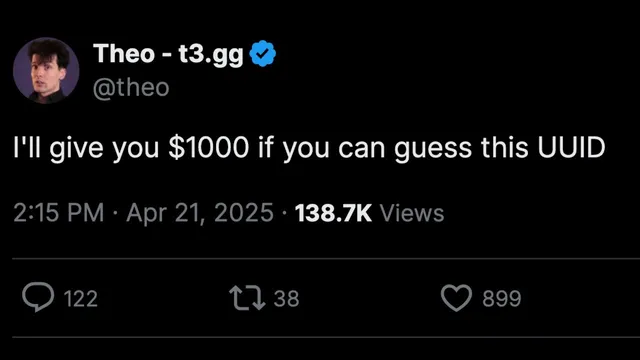
To settle the claim with something testable, Theo created a local decryption challenge. He generated two UUIDs in Node using crypto-random functions, encrypted a file using AES-256 (with a noted mistake: the chosen method could sometimes decrypt into garbage without the correct key), and offered $1,000 to anyone who could “crack this UUID”—meaning identify the exact UUID that produced the meaningful plaintext, not merely trigger a successful-looking decryption. The file was downloadable, and the intended workflow required no network requests: download, then decrypt locally. Charlie declined, arguing the prize wasn’t worth the server costs and raising questions about “proxy detection,” which Theo said were irrelevant because the attack didn’t require hitting an endpoint.
The thread then escalated into a public, interactive “every UUID” site built by developer Nolan. The site lets users scroll through UUIDs and attempts to decrypt the payload for each candidate, effectively turning the brute-force claim into a visible, hands-on experiment. Even with this tooling, no one found the correct UUID. Decryptions with wrong UUIDs produced nonsense or misleading partial results, and Theo added a hint (the first two letters are “th” and the plaintext is a valid English sentence) to filter out obvious garbage. After the challenge window, Theo revealed the plaintext: “There’s a literal 0% chance you are able to get into this file.”
The final takeaway is less about UUIDs being “secure forever” and more about engineering reality: UUID v4’s security depends on using proper cryptographic randomness and not confusing “possible in theory under broken randomness” with “feasible in real systems.” The chaos ended with Theo framing the whole episode as a cautionary tale about misunderstanding randomness, uniqueness, and what brute forcing actually costs in the real world.
Cornell Notes
The dispute centered on whether UUID v4 values embedded in public URLs can be brute-forced. UUID v4 is designed for ~2^128 possibilities, making guessing infeasible when UUIDs are generated with proper cryptographic randomness. Theo challenged a commenter’s claim by encrypting a file with a UUID-derived key and offering $1,000 for the exact UUID that yields the correct plaintext—not just any decryption that “doesn’t error.” A separate developer built an “every UUID” scrolling site that tried decryptions for many candidates, but wrong UUIDs produced nonsense and no one found the correct value. The revealed plaintext was “There’s a literal 0% chance you are able to get into this file,” underscoring that the practical attack path doesn’t match the confident but incorrect math from the thread.
Why does UUID v4 resist brute forcing in practice?
What was wrong with the brute-force math claim in the thread?
How did Theo structure the $1,000 challenge to test the claim fairly?
What role did Nolan’s “every UUID” site play?
Why did Theo add hints like “the first two letters are th”?
Review Questions
- What practical conditions would have to fail for UUID v4 to become guessable, and how does the thread distinguish “theoretical possibility” from “real-world feasibility”?
- Why is “successful decryption” not the same as “correct UUID” in Theo’s challenge setup?
- How does the size of the UUID v4 search space (2^128) change the expected time-to-guess compared with much smaller exponents like 2^32?
Key Points
- 1
UUID v4 is designed for ~2^128 possibilities, making guessing infeasible when UUIDs are generated with cryptographically secure randomness.
- 2
Claims that UUIDs can be brute-forced often rely on incorrect search-space math or on outdated scenarios involving broken randomness implementations.
- 3
Theo’s $1,000 challenge required finding the exact UUID that yields the correct plaintext, not merely producing any decryptable output.
- 4
The challenge was intentionally local (download then decrypt), so “proxy detection” arguments were largely irrelevant to the attack workflow.
- 5
An interactive “every UUID” scrolling site demonstrated that even with tooling and hints, wrong UUIDs produce nonsense rather than the target message.
- 6
The episode highlights a common security misunderstanding: confusing “possible under bad randomness” with “practically attackable in properly implemented systems.”