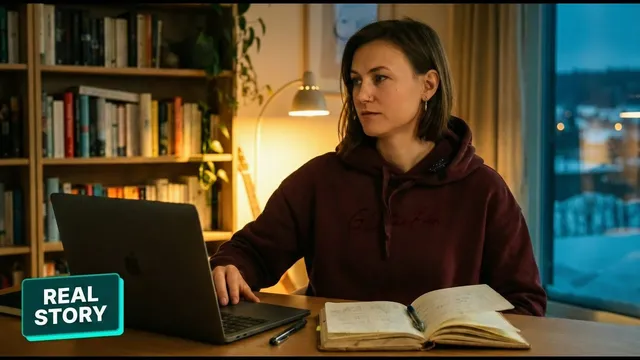
I Gave My Diary to Al (A Second Brain Case Study)
Based on Tiago Forte's video on YouTube. If you like this content, support the original creators by watching, liking and subscribing to their content.
Handwritten journals can become usable for AI by replacing unreliable OCR with a voice-based transcription workflow.
Briefing
Alysia’s annual review stalled for years because four notebooks of handwritten journal entries contained “data about my own life” that never turned into usable knowledge. The breakthrough came from treating her diary like second-brain material—externalizing it, making it searchable, then running structured analysis with AI to surface patterns she couldn’t see while living inside them.
The first obstacle was technical: hundreds of messy handwritten pages were not reliably usable for AI. OCR was a non-starter because her handwriting—described as “messy Russian handwriting”—would break transcription quality. Instead, she chose a workflow built around voice. She read the journals out loud and recorded the entire process, turning handwritten pages into spoken audio. After five hours of recording, the raw output was processed through Da Vinci Resolve, which transcribed roughly 3 GB of video into 317 kilobytes of text—small enough to work with, but detailed enough to preserve her inner-life content.
She notes that alternatives exist: Google Docs voice typing and, on Mac, Whisper Flow (priced at $15/month) that adapts to what she’s writing. Still, transcription alone didn’t solve the deeper problem. The text needed structure—especially psychological structure—so she moved to Claude and used its deep research feature to study psychoanalysis frameworks, with a focus on “Yian approach.” From that research, she built a web page describing how to run a psychoanalytical session.
In Claude, she created a new project, attached the psychoanalysis-session document as project knowledge, and added custom instructions positioning Claude as her psychoanalyst. The instruction set was procedural and specific: request journal entries, ask for her goal, analyze entries for recurring patterns, conduct a Q&A one question at a time, build a chronological archive of main events, and then produce a comprehensive analysis document.
The uncomfortable payoff arrived when the generated analysis quoted her entries in chronological order—highlighting repeated moments where she created something and then devalued herself before others could see it. That recurring behavior, traced across time, condensed into a single core insight she hadn’t recognized “probably for years.” Her takeaway is that distilling isn’t magic; it’s the result of externalizing thinking and forcing it into a structured form. With the diary organized and analyzed, she could finally see what had remained invisible from inside her own perspective.
The final message reframes journaling and visibility: she described hiding behind work and behind screens, while the process of being “witnessed” through AI analysis (and even through recording herself reading the journals) pushed her toward expressiveness rather than self-protection. The case study ends by pointing viewers to another journaling story for additional techniques.
Cornell Notes
Alysia used AI to turn a year of handwritten journal entries into actionable self-insight. She couldn’t rely on OCR for her handwriting, so she read the notebooks out loud, recorded the sessions, and used Da Vinci Resolve to transcribe hours of video into a compact text file. She then fed the text into Claude, using deep research to ground a psychoanalysis-session framework and custom instructions to guide pattern-finding, Q&A, and a chronological archive. The analysis surfaced a repeated self-protection cycle—creating work and then devaluing herself before others could see—culminating in a core insight she hadn’t noticed for years. The practical lesson: externalize, structure, then distill to reduce “digital clutter” into knowledge.
Why did OCR fail, and what workaround made the diary usable for AI?
How did she convert hours of recordings into text that AI could process?
What role did Claude play beyond transcription?
What did the AI analysis reveal that she couldn’t see on her own?
What does “distilling” mean in her workflow and takeaway?
How does the case study connect journaling to visibility and self-protection?
Review Questions
- What specific technical limitation forced her to abandon OCR, and what alternative method replaced it?
- List the main steps she gave Claude to perform during the psychoanalysis session.
- What recurring self-protection pattern did the chronological quotes reveal, and how did it lead to a core insight?
Key Points
- 1
Handwritten journals can become usable for AI by replacing unreliable OCR with a voice-based transcription workflow.
- 2
Reading entries out loud and recording them can preserve messy handwriting content while producing clean text for analysis.
- 3
Transcription alone isn’t enough; structured prompts and a framework are needed to turn text into insight.
- 4
Claude can be guided with custom instructions to run a repeatable process: pattern detection, Q&A, chronological archiving, and synthesis.
- 5
Grounding analysis in a psychoanalysis framework helps the AI produce more coherent, session-like outputs.
- 6
Chronological quoting of recurring themes can surface long-term self-avoidance patterns that are hard to notice from inside daily life.
- 7
Externalizing and structuring personal writing can transform “digital clutter” into distilled knowledge.