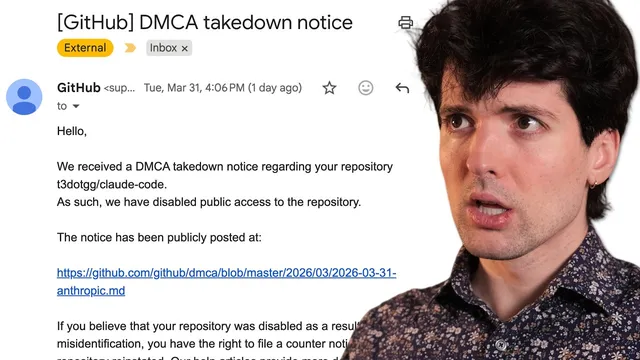
I got DMCA'd by Anthropic (not a joke)
Based on Theo - t3․gg's video on YouTube. If you like this content, support the original creators by watching, liking and subscribing to their content.
A GitHub DMCA takedown hit a Claude Code fork after a one-word change in a skill file, according to the creator.
Briefing
A GitHub DMCA takedown tied to Anthropic landed on a developer’s fork of Claude Code after a single-word change—then was partially retracted within hours. The episode matters because it highlights how DMCA enforcement, especially at scale across thousands of repositories, can misfire badly enough to punish lawful or non-infringing work, and how quickly platforms and rights-holders can correct course once the scope is understood.
The creator says the DMCA notice arrived while he was filming, but he only noticed it after checking email. The takedown was filed on GitHub and, crucially, targeted his fork of the “official Claude Code repo” that contains skills and markdown but not the leaked source itself. He emphasizes the change that triggered the strike: one word in one file within a skill. In his view, that makes the enforcement “absurd,” and he argues it reflects an erroneous DMCA application rather than a legitimate claim of copyright infringement.
To explain why the takedown could have hit so many repositories, he points to the notice’s stated coverage: a network of roughly 8,100 repositories, far more than the number of forks he expected from the Claude Code leak community. GitHub’s public listing shows only up to 100 affected repos in the notice, but the mismatch suggests the rights-holder’s targeting may have gone wrong—either by flagging the wrong set of repositories or by GitHub applying the request more broadly than intended.
The situation then flips. A retraction was filed the next morning, restoring the takedown for all repos except those mirroring the specific Claude Code leak and its 96 forks. He contrasts his repo—which was reinstated—with other projects that remain online, including a Rust rewrite of Claude Code built from the original source. That kind of derivative work, he notes, is protected by copyright and therefore not something Anthropic can simply erase through DMCA.
Still, the creator doesn’t fully pin blame on Anthropic. He describes follow-up messages from Anthropic employees (including claims of “communication mistake” and debugging on GitHub’s side). He also raises multiple plausible failure points: Anthropic may have provided the wrong repository list to GitHub, GitHub may have misunderstood the request, or the notice may have been drafted in a way that caused over-enforcement. He argues that enforcing a DMCA against content that never infringed is illegal in the U.S., and he frames the incident as a case where process and automation failures—rather than individual wrongdoing—may have driven the damage.
Beyond the legal mechanics, the episode becomes a reputational and policy argument. He credits Anthropic for engaging openly on social media during the crisis, including “blameless” internal responses that treat the failure as a process/infrastructure issue. But he returns to a broader claim: keeping Claude Code closed source created more harm than open-sourcing would have, and sending DMCA requests at all signals a deeper strategic problem. The result is a story about both legal procedure and product governance—where a single-word change can trigger a large-scale takedown, and where rapid retractions reveal how fragile DMCA enforcement can be when thousands of repos are in play.
Cornell Notes
A DMCA takedown on GitHub hit a developer’s Claude Code fork after a one-word change in a skill file. The notice arrived while he was filming, and he says it targeted his fork rather than the leaked source itself. He argues the scope—about 8,100 repositories—suggests the enforcement went rogue and flagged far more repos than the leak community likely created. Within hours, Anthropic filed a retraction restoring most affected repos, leaving only those mirroring the specific leak and its 96 forks. The incident underscores that DMCA enforcement can misfire at scale, and that rights-holders and platforms may need fast correction when targeting is wrong.
Why did a one-word change in a Claude Code fork trigger a DMCA strike?
What does the “8,100 repositories” detail suggest about how the takedown happened?
How did the situation change after the initial takedown?
Why does the creator argue some repos are “safe” from DMCA even if they use the leaked source?
What legal principle does the creator use to frame the enforcement as potentially unlawful?
How did Anthropic’s public responses factor into the creator’s assessment?
Review Questions
- What evidence does the creator cite to argue the DMCA strike was mis-targeted (and not based on actual infringing source code)?
- How does the retraction’s narrowed scope (leak mirror plus 96 forks) change the interpretation of what went wrong?
- Why does the creator distinguish between direct mirrors of leaked code and derivative works like a Rust rewrite?
Key Points
- 1
A GitHub DMCA takedown hit a Claude Code fork after a one-word change in a skill file, according to the creator.
- 2
The DMCA notice reportedly targeted an unusually large set of repositories (~8,100), suggesting over-enforcement or incorrect targeting.
- 3
GitHub’s public listing shows only up to 100 affected repos, making the true scope of the initial enforcement hard to verify.
- 4
Anthropic later retracted the DMCA notice for most repos, leaving takedowns in place only for the specific leak mirror and its 96 forks.
- 5
The creator argues enforcing DMCA against content that never infringed is illegal under U.S. law and should be countered via process or litigation.
- 6
Public follow-ups from Anthropic employees framed the incident as a communication/tooling breakdown and emphasized blameless process improvements.
- 7
The broader takeaway is that keeping Claude Code closed source increased downstream harm, and DMCA enforcement at this scale can create collateral damage.