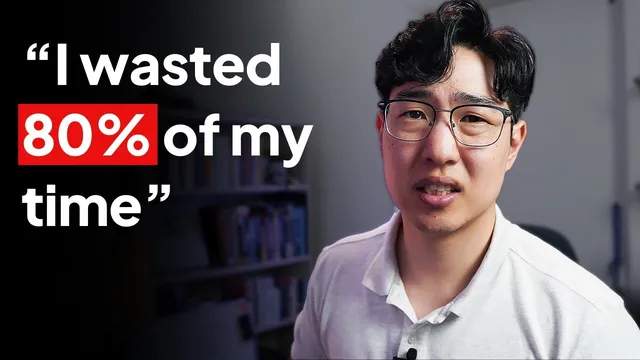
I’m A Doctor. If You’re In Med School, Please Watch This Video
Based on Justin Sung's video on YouTube. If you like this content, support the original creators by watching, liking and subscribing to their content.
Optimize for clinical reasoning, not just exam recall, by organizing learning around symptoms, signs, and differentials.
Briefing
Medical training gets dramatically harder when study habits optimize for passing exams instead of building usable clinical reasoning. Dr Justin Sung describes how he over-engineered a learning system for preclinical tests, then entered major hospital rotations and failed his first internal medicine attachment—because the knowledge he had memorized didn’t translate into real patient care. He says the deeper problem wasn’t just forgetting; it was building a short-term, exam-focused memory that never created durable, foundational understanding. As a result, he kept relearning the same material year after year, and clinical placements felt confusing because patients rarely fit textbook patterns.
A second failure mode was studying “everything” at a granular level without a coherent big-picture structure. Sung contrasts the way he approached diseases—collecting copious, technically accurate details—with the way clinicians synthesized messy, atypical presentations. When patients arrived with older age, comorbidities, medication effects, unclear histories, and overlapping conditions, his knowledge felt fragmented. He realized experienced doctors didn’t simply know more facts; they processed information through a different lens, using context to connect symptoms, differential diagnoses, and management decisions.
Much of the wasted time, he adds, came from underusing clinical attachment days. He often arrived to “show face,” then left to study because he felt unprepared. That approach produced a knowledge deficit in context: academic studying lacked the patient-specific relevance that makes medicine make sense. He argues some learning is impossible without seeing real cases—because clinical reasoning depends on how information interacts in the moment.
Sung’s turnaround centers on changing the order of learning. Instead of disease-first memorization, he recommends starting from clinical scenarios: symptom and sign perspective first, then building differentials, and only afterward reinforcing with pathophysiology. He gives examples like chest pain: rather than thinking from a disease list, he learned to work backward from the presentation—considering sources ranging from skin and bones to pleura, myocardium, and neurogenic causes. For diabetes, he notes he tested himself on microvascular complications but not macrovascular ones until he reframed the topic through patient presentations.
He also highlights the value of simplifying complex topics into intuitive frameworks. His story about shock is illustrative: handwritten flashcards helped him pass exams but didn’t create recall. A senior’s “pump, pipes, container, fluid” model made shock faster to reason through by mapping clinical questions to the underlying system failure. Sung says the same principle applies to anatomy: learning it for operating—where consequences and context matter—made it stick.
In his final recommendations, he urges students to make topics simpler and more intuitive, search for the “clinical core,” and learn from clinical perspective before diving into details. He warns against treating oneself as merely a memorizing medical student when the goal is to become a doctor who must apply knowledge. He also advises “picking your losses” because no one can learn everything, and using clinical placements strategically by studying the common conditions and likely procedures that will be encountered the next day or week. The payoff, he says, is less draining ward time, better engagement, and more effective learning that compounds over the long run.
Cornell Notes
Dr Justin Sung recounts how exam-optimized studying left him unprepared for hospital rotations, leading to repeated relearning and confusion when patients didn’t match textbook patterns. His key fix is changing the learning order: start from symptoms and signs, build differential diagnoses, and only then reinforce with pathophysiology and disease details. He also argues for simplifying overwhelming topics into intuitive frameworks (like shock as a “pump, pipes, container, fluid” system) so clinical questions become easier to answer. Finally, he stresses that clinical placements should drive study: prepare for the common cases and procedures likely to appear, so ward rounds become relevant rather than draining.
Why did exam performance fail to translate into clinical success during early rotations?
What does “disease-first” studying miss when patients present with complex, real-world symptoms?
How should a student approach chest pain differently, according to Sung’s method?
What is the learning value of simplifying shock into an intuitive framework?
Why does he argue anatomy becomes easier when studied through operative context?
How can students use clinical placements to reduce wasted time?
Review Questions
- What specific mechanisms made Sung’s exam-focused learning system break down during clinical attachments?
- How does symptom-first differential reasoning change the way a student should study a topic like diabetes or chest pain?
- What are the practical steps Sung recommends for preparing before a clinical placement to maximize learning from ward rounds and theater time?
Key Points
- 1
Optimize for clinical reasoning, not just exam recall, by organizing learning around symptoms, signs, and differentials.
- 2
Build durable understanding by reinforcing pathophysiology after clinical context—not before it.
- 3
Use simplification frameworks for complex topics so clinical questions map to a small number of underlying systems.
- 4
Treat clinical placements as the driver of study: prepare for the common cases and procedures likely to occur next.
- 5
Make anatomy actionable by studying it through operative or patient-context scenarios, not only lecture-level correlations.
- 6
Avoid “learn everything” behavior by picking high-yield losses tied to clinical application and exam relevance.
- 7
Reframe yourself as a doctor in training: the goal is applying knowledge, so memorization-only strategies often create later relearning costs.