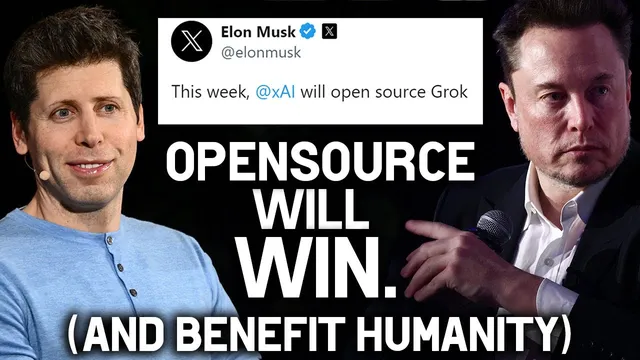
I really think open source has it in the bag.
Based on MattVidPro's video on YouTube. If you like this content, support the original creators by watching, liking and subscribing to their content.
XAI’s planned open-source release of Grok is positioned as a response to criticism tied to Musk’s lawsuit against OpenAI over openness.
Briefing
Elon Musk’s XAI is set to open source “Grok” this week, a move framed as a direct response to criticism that Musk’s own AI efforts weren’t meaningfully open while he pursued legal action against OpenAI over openness. The timing matters because it lands amid a broader public dispute: Musk sued OpenAI after arguing the company abandoned its original mission of sharing key research behind advanced AI systems. OpenAI countered with a blog post and “email receipts” suggesting Musk had agreed it was acceptable not to disclose the underlying science for advanced AI.
Even with that legal backdrop, the Grok announcement shifts the spotlight from courtroom language to licensing reality. The transcript stresses that “open source” can mean different things—ranging from research-only releases to fully open licensing—and raises practical questions: will model weights arrive immediately, what documentation will be provided, and under which specific open-source terms? Still, the move is treated as a symbolic “put your money where your mouth is” moment, especially after calls for Musk to demonstrate openness if he believes OpenAI is failing.
That dispute feeds into a larger thesis: open models are portrayed as the most durable path for AI progress because they prevent any single actor from controlling the “all-powerful” technology. The argument is economic as much as philosophical. If strong general language models are open, they become cheaper, easier to customize, and more accessible—making closed models harder to justify. Stability AI CEO Emad Mostaque is cited for a related point: general language models are rising toward commoditization, and major players could end up with “hundreds of thousands of H100 equivalents” over the next few years, so open approaches can undercut competitors by reducing the value of proprietary alternatives. The recurring refrain is “where is your moat?”—the claim being that open source offers better value by default because competition forces improvement.
The transcript then pivots to signals around OpenAI’s next leap. Hints about “GPT 5” are interpreted through a tweet from Greg Brockman: a scenario of trying four ideas that fail, then succeeding on the fifth. That “four and five” framing is taken as evidence that GPT 5 may be fundamentally different rather than just a marginal upgrade over GPT-4. The expectation is that OpenAI must deliver a generational jump to maintain leadership—potentially involving capabilities like multi-agent access, agent creation and dispatch, and tighter integration of those systems.
Finally, OpenAI’s governance changes are covered. OpenAI announced new board members—Dr. Sue Desmond-Hellmann, Nicole Seligman, and Fidji Simo—with Sam Altman returning to the board. The transcript notes that board turmoil previously nearly destabilized the company, so the new appointments are treated as consequential, though the available rationale is described as mostly high-level background rather than specific reasons for each selection. Overall, the throughline remains the same: legal and corporate moves are expected to resolve in the context of a competitive market where open releases and rapid capability gains push the industry forward—potentially benefiting humanity broadly rather than any single company.
Cornell Notes
XAI plans to open source Grok this week, a move positioned as a response to criticism and a lawsuit involving OpenAI’s openness. The transcript treats “open source” as more than a slogan, emphasizing that licensing terms, whether weights ship immediately, and the level of documentation will determine how meaningful the release is. It argues open models will win because they reduce the value of closed systems, drive customization and lower costs, and limit any single entity’s control over advanced AI. At the same time, OpenAI’s next step—GPT 5—is hinted at as potentially “fundamentally different,” not just a better GPT-4, and OpenAI also announced new board members to guide growth and regulation. The stakes are framed as both technical (capabilities) and structural (who controls the future models).
Why does XAI’s planned open-source release of Grok carry extra weight in the ongoing OpenAI/Musk dispute?
What does “open source will win” mean in concrete market terms, not just ideology?
How is the “four ideas fail, fifth works” hint interpreted for GPT 5?
What capabilities does the transcript suggest GPT 5 must deliver to justify a “generational increase”?
Why are OpenAI’s new board appointments treated as more than routine corporate housekeeping?
What does the transcript imply about how legal disputes might resolve?
Review Questions
- What specific details would determine whether Grok’s open-source release is genuinely impactful (as opposed to symbolic)?
- According to the transcript, what would make GPT 5 a “generational increase” rather than a better GPT-4?
- How does the transcript connect open-source releases to the idea of reducing a company’s “moat”?
Key Points
- 1
XAI’s planned open-source release of Grok is positioned as a response to criticism tied to Musk’s lawsuit against OpenAI over openness.
- 2
The practical meaning of “open source” depends on licensing scope, whether weights ship immediately, and how much documentation is provided.
- 3
Open models are argued to win because they lower costs, increase accessibility, and enable customization that weakens the pricing power of closed models.
- 4
Emad Mostaque’s comments are used to support a commoditization thesis: large-scale compute growth can make model capabilities converge across competitors.
- 5
Hints about GPT 5 are interpreted through a “four failures, fifth success” framing, implying a potentially fundamental shift rather than a minor upgrade.
- 6
OpenAI’s new board appointments—Dr. Sue Desmond-Hellmann, Nicole Seligman, and Fidji Simo, with Sam Altman returning—are treated as strategically important given prior board turmoil.
- 7
The transcript’s overarching expectation is that competition and open releases will shape AI’s future more than legal outcomes alone.