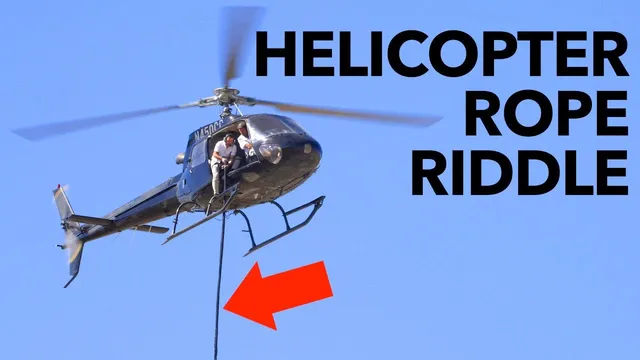
I Rented A Helicopter To Settle A Physics Debate
Based on Veritasium's video on YouTube. If you like this content, support the original creators by watching, liking and subscribing to their content.
A uniform flexible cable suspended beneath a helicopter at constant speed forms a straight diagonal line (option B) when rotor wash effects on the cable are negligible.
Briefing
A helicopter’s rotor wash doesn’t meaningfully reach the suspended cable, so a uniform, flexible cable flying at constant speed settles into a straight diagonal line—making the correct multiple-choice answer B. The result settles a long-running physics-debate tied to a 2014 qualifying exam for the US Physics Team, where students argued over whether the cable should hang straight down, tilt, form a hook, invert into a different hook, or develop an S-bend.
To test the competing predictions, the experiment team rented a helicopter and suspended a long, heavy battle rope beneath it while flying nearly 100 km/h. The rope initially “whipped” as rotor wash interacted with it during deployment, but once the rotor wash stopped affecting the rope and the motion stabilized, the cable hung diagonally to the left—matching option B. The team also noted a practical constraint: the pilot kept the rope on the helicopter’s right side to monitor it and avoid any risk of the rope drifting into the rotors or tail rotor.
The physics behind the diagonal shape comes from balancing forces along the cable. Gravity pulls each segment downward, while air resistance pushes sideways. At constant speed, tension in the cable must counter the combined weight of the segments below plus the air drag acting on them. Because each small segment has the same weight and experiences the same drag per unit length (same cross-sectional area and same speed through air), the tension grows from near zero at the bottom to a maximum at the top, but its direction stays consistent. That constant ratio of air resistance to weight along the cable is what keeps the cable from curving into a hook or S-shape; it remains a straight diagonal line.
The team then varied what hung from the rope’s end to show why other answer choices can appear. Adding a heavy kettlebell at the bottom changes the boundary condition: the bottom tension must be nearly vertical to support the large weight, and as air resistance becomes more important higher up, the cable shifts toward a more horizontal orientation near the bottom. During a high-speed run with the kettlebell, the rope formed an inverted J shape consistent with option D.
Finally, the experiment replaced the end weight with a Veritasium flag to introduce drag without much mass, and then added a small parachute. With extra air resistance at the end but relatively little weight, the rope became a J shape—matching option C. The takeaway is that the “correct” diagram depends on the end condition: a uniform cable with no special end load gives B, while heavy loads or draggy end attachments can produce C or D.
Overall, the helicopter test ties the exam controversy to a clear rule: for a uniform flexible cable at constant speed, the diagonal straight-line shape follows from local force balance and a constant drag-to-weight ratio along the length, not from rotor wash reaching far below the aircraft.
Cornell Notes
A uniform flexible cable suspended beneath a helicopter at constant speed hangs in a straight diagonal line (option B). The key reason is local force balance: each small segment of cable has the same weight and experiences the same sideways air resistance per unit length, so tension increases upward but keeps the same direction. The rotor wash was found to dissipate quickly enough that the cable’s drag can be treated as motion through still air. Changing the end attachment alters the boundary condition: a heavy kettlebell produces an inverted J (option D), while adding significant drag with little weight (flag/parachute) produces a J shape (option C).
Why does a uniform flexible cable hang diagonally instead of curving into a hook or S-bend?
What role does rotor wash play in the cable’s shape?
How does adding a heavy kettlebell change the cable’s geometry?
How does adding drag with little weight change the cable’s shape?
Why did the original exam question generate controversy?
Review Questions
- If tension direction stays constant along a uniform cable, what specific physical ratio must remain constant, and what assumptions make that ratio constant?
- How would the cable shape change if the helicopter speed increased from constant speed to a rapidly accelerating regime (qualitatively, not with equations)?
- Which end condition—heavy weight or high drag with low weight—tends to produce a J versus an inverted J, and why does the tension orientation near the bottom differ?
Key Points
- 1
A uniform flexible cable suspended beneath a helicopter at constant speed forms a straight diagonal line (option B) when rotor wash effects on the cable are negligible.
- 2
The diagonal shape follows from segment-by-segment force balance: gravity downward and air resistance sideways are balanced by cable tension.
- 3
Uniformity matters: equal segment weight and equal drag per unit length keep the drag-to-weight ratio constant along the cable, so tension direction stays the same.
- 4
Rotor wash dissipates quickly enough that the cable can be modeled as moving through essentially still air for the steady-state shape.
- 5
A heavy end load (kettlebell) forces near-vertical tension at the bottom and produces an inverted J shape (option D).
- 6
A draggy end attachment with little weight (flag/parachute) forces near-horizontal tension at the bottom and produces a J shape (option C).
- 7
The “correct” multiple-choice diagram depends on the boundary condition at the cable’s end, not just on helicopter motion.