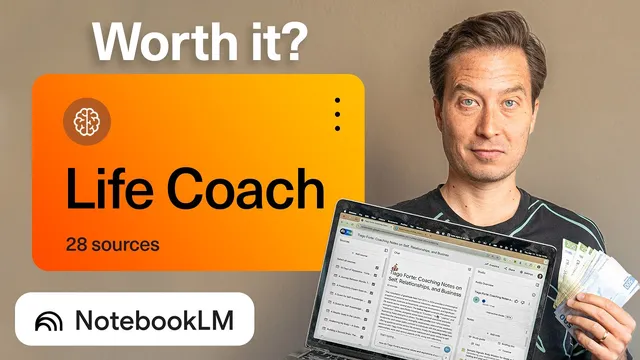
I Replaced My $700/Hour Coach with NotebookLM – Here’s What Happened
Based on Tiago Forte's video on YouTube. If you like this content, support the original creators by watching, liking and subscribing to their content.
Load AI with a structured personal archive (private notes, public writing, and year-end reviews) to enable genuinely specific coaching-style feedback.
Briefing
AI can function as a highly effective “context coach” when it’s fed a large, personal knowledge base—delivering fast, specific pattern recognition and actionable self-reflection—while still falling short on the emotional, relational read that skilled human coaching provides.
The core test centers on Tiago Forte loading NotebookLM Plus with roughly 40 documents totaling nearly 150,000 words of his own work and life context. The materials are organized into three buckets: private notes (including coaching-session notes, a yearly life-goals mind map, Big Five traits, a time-perspective framework from Zambardo, strengths compiled from customer testimonials, gratitude lists, and a Myers-Briggs profile), public writing (course takeaways, Burning Man experiences, book summaries, autobiographical writing, and open questions), and annual year-end reviews spanning the last five years. After about 17 minutes of source setup, he runs a set of coaching-style prompts—many drawn from prior AI conversations—to see whether the system can do more than summarize.
Early outputs focus on strengths and weaknesses. Strengths are described in broad, recognizable terms—knowledgeable, visionary, creative, innovative, insightful, and perspective-shifting. Weaknesses are more granular and feel psychologically “on target,” including self-criticism and perfectionism, sensitivity to criticism and conflict, idealism that can overlook details, perceived social-skill challenges, emotional vulnerability and resistance to emotional processing, and tendencies toward being overly private. He’s particularly struck by the thoroughness and the way the weaknesses align with his Myers-Briggs type (INFJ), which makes the feedback feel less generic.
The more consequential section comes when NotebookLM is asked to identify contradictions between stated intentions and actual behavior. The system highlights a recurring tension: he frequently signals work-life balance in annual reviews, yet his actions and results prioritize business growth and achievement, often at the expense of personal time and well-being. It also flags control issues that complicate delegation, a push-pull between financial prudence and free spending (including a reaction against his father’s frugality), and a cycle of chasing novelty (“shiny objects”) alongside burnout and distraction from family life. The output frames these as persistent themes rather than isolated mistakes.
When asked for blind spots and limiting beliefs, the AI surfaces second-order insights—such as avoiding disappointment, which paradoxically can intensify disappointment. It then pivots to future-oriented coaching: what he might regret at life’s end (overemphasizing work and external achievements over meaningful relationships and balance) and what best advice he should follow (prioritize self-knowledge and authenticity, integrate emotional intelligence, move toward integration rather than compartmentalization, value relationships and community, embrace vulnerability, define “enough,” and prioritize balance).
The most novel and practical moment arrives with a question he didn’t previously ask: which physical sensations might be signaling unacknowledged goals, challenges, or desires. The AI links specific bodily experiences—tightness, racing heart, heavy chest, warmth/expansion, breathing changes, recurring aches—to emotional states and recommends a practice called active body awareness: pausing during the day to notice sensations without judgment and using targeted questions to explore what they mean.
In the closing assessment, NotebookLM’s advantage is speed and depth of recall: it can jump from big-picture patterns to fine-grained details from any sentence in his notes. Its limitation is emotional nuance—especially micro-expressions, body language, and subtle reactions that a human coach detects in real time. The takeaway is not replacement but complementarity: AI as a powerful adjunct for context, patterning, and structured reflection, paired with human coaching for relational and intuitive emotional reading.
Cornell Notes
NotebookLM Plus can act as a “context coach” when it’s loaded with a large, personal archive—about 40 documents and nearly 150,000 words. With that material, it produces detailed strengths/weaknesses, identifies contradictions between stated goals (like work-life balance) and actual outcomes (work prioritization), and surfaces recurring tensions (control vs delegation, spending vs prudence, burnout vs sustainable growth). The most distinctive insight comes from linking unacknowledged inner states to specific physical sensations, then recommending active body awareness as a practical daily practice. The system’s main gap is emotional, relational reading—micro-expressions and body language that skilled human coaching captures in real time. Used together, AI and human coaching strengthen each other.
How does NotebookLM’s “coaching” performance change once it has access to deep personal context?
What contradiction between intentions and actions stands out most?
Which recurring tensions does the AI identify beyond the work-life mismatch?
What “blind spot” does the AI surface that he hadn’t highlighted before?
Why is the physical-sensation question considered the most actionable new insight?
Where does human coaching still outperform AI in this test?
Review Questions
- Which specific contradictions did the AI identify between stated intentions and observed behavior, and what evidence from the loaded sources supported them?
- How would you apply active body awareness to one recurring physical sensation—what questions would you ask yourself, and what would you look for in the response?
- What would a “complementary” coaching plan look like if AI handles context and patterning while a human coach handles emotional reading?
Key Points
- 1
Load AI with a structured personal archive (private notes, public writing, and year-end reviews) to enable genuinely specific coaching-style feedback.
- 2
Use targeted prompts that go beyond summaries—ask for contradictions, blind spots, and future-oriented advice to elicit higher-value insights.
- 3
Treat recurring tensions as systems (e.g., control vs delegation, novelty vs burnout) rather than isolated personality flaws.
- 4
When feedback feels repetitive, switch to questions that force new angles—like linking bodily sensations to emotions and goals.
- 5
Active body awareness can turn introspection into a daily practice by noticing sensations without judgment and asking what they might mean.
- 6
AI’s strength is rapid synthesis across years of context; human coaching remains crucial for real-time emotional and relational cues like micro-expressions and body language.
- 7
Pair AI and human coaching rather than choosing one: each covers different parts of the coaching job.