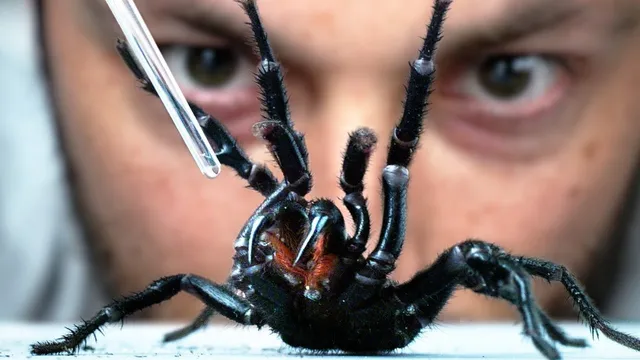
I Vacuum Venom from the World's Deadliest Spider
Based on Veritasium's video on YouTube. If you like this content, support the original creators by watching, liking and subscribing to their content.
Funnel-web venom’s delta hexatoxin disrupts sodium ion channels in primate neurons by preventing them from closing, causing uncontrolled neurotransmitter release.
Briefing
Funnel-web spiders deliver one of the fastest, most dangerous venoms in the world—yet Australia has prevented deaths for decades by turning careful “milking” into a reliable anti-venom pipeline. The key is delta hexatoxin, a venom protein that disrupts how nerve cells shut down sodium ion channels, flooding the nervous system with neurotransmitters and triggering chaotic muscle spasms. In humans, that cascade can quickly overwhelm the heart and breathing; without treatment, paralysis can progress until vital functions fail.
The danger often starts with ordinary morning routines. Male funnel-web spiders leave their underground burrows during the breeding season and roam at night, but if they stray too far they can’t return by morning. They then hide in dark, sheltered places—piles of clothing, shoes, or other human-adjacent spots—leading to bites that are typically painful and can be life-threatening. Their fangs can reach about one centimeter, and the venom acts rapidly. A common local habit—banging shoes together before putting them on—exists because these spiders frequently end up in footwear.
Why the venom is so lethal to people comes down to biology and “species specificity.” Delta hexatoxin binds to a particular site on sodium ion channels found in primates, including humans, where it prevents ion channels from closing. That keeps neurons firing and forces muscles to receive uncontrolled signals, raising blood pressure and spreading venom through the body. The same binding site isn’t present in most other mammals, which is why the venom is far less deadly to animals like dogs, cats, or rabbits—though they can still be bitten and may show few symptoms.
The anti-venom effort depends on extracting venom from the right spiders. Australian Reptile Park staff collect venom primarily from adult male funnel-webs because their venom is about six times more toxic, producing higher-quality anti-venom. Each vial requires milking roughly 150 spiders by hand, a process that takes around 12 hours. The venom is frozen and shipped to a lab in Melbourne, where rabbits are injected with gradually increasing doses over six months until their blood can withstand about six times the lethal dose. Antibodies harvested from the rabbits are then separated and formulated into anti-venom that can neutralize the venom inside human bodies.
The operation also relies on public participation: many spiders are handed in after being found in backyards or even swimming pools. Funnel-web spiders can survive underwater for up to 30 hours by trapping air bubbles in abdominal hairs, which helps explain why they sometimes turn up in pool bottoms. Despite the intensity of the work—“milking a spider to save one person”—the payoff is measurable: since 1981, no deaths from funnel-web bites have been recorded, even though about 40 people are bitten each year.
Cornell Notes
Funnel-web spider venom is dangerous because delta hexatoxin interferes with sodium ion channels in primate nerve cells, preventing them from shutting down. That causes a flood of neurotransmitters, leading to chaotic muscle spasms, rising blood pressure, and eventual paralysis that can stop the heart or lungs without treatment. The venom is far less lethal to most mammals because the key binding site on sodium channels is not present. Australia’s anti-venom program works by milking adult male funnel-webs (more toxic, higher-quality venom), freezing the venom, and immunizing rabbits with gradually increasing doses over six months to harvest neutralizing antibodies. Since 1981, no deaths from funnel-web bites have been reported despite frequent bites.
What does delta hexatoxin do to nerve cells, and why does that translate into life-threatening symptoms?
Why are funnel-web bites so much more dangerous to humans than to many other mammals?
How does the breeding-season behavior of male funnel-web spiders increase the odds of human encounters?
What makes adult male venom especially valuable for anti-venom production?
How do rabbits become the source of anti-venom, and what does the immunization timeline look like?
Why do funnel-web spiders sometimes show up in swimming pools, and what does that imply for safety?
Review Questions
- How does blocking sodium ion channel closure change neuron behavior, and what downstream effects does that create in the body?
- What biological reason explains why funnel-web venom is highly lethal to humans but not to most mammals?
- Describe the anti-venom production chain from spider milking to rabbit immunization to antibody harvesting.
Key Points
- 1
Funnel-web venom’s delta hexatoxin disrupts sodium ion channels in primate neurons by preventing them from closing, causing uncontrolled neurotransmitter release.
- 2
The resulting surge in nerve signaling drives chaotic muscle spasms, with major strain on the heart and breathing that can lead to paralysis and death without treatment.
- 3
Male funnel-web spiders roam at night during breeding season; if they stray too far, they hide in dark places like shoes and clothing, increasing morning bite risk.
- 4
Anti-venom production relies on milking adult male funnel-webs because their venom is about six times more toxic and yields higher-quality anti-venom.
- 5
One anti-venom vial requires milking about 150 spiders by hand (around 12 hours), then freezing and shipping venom to a lab for rabbit immunization.
- 6
Rabbits are immunized with gradually increasing venom doses over about six months until they tolerate six times the lethal dose; harvested antibodies neutralize venom in humans.
- 7
Since 1981, no deaths from funnel-web bites have been recorded, even though roughly 40 people are bitten each year.