I Walked Away From Wall Street at My Peak – Here’s Why
Based on Tiago Forte's video on YouTube. If you like this content, support the original creators by watching, liking and subscribing to their content.
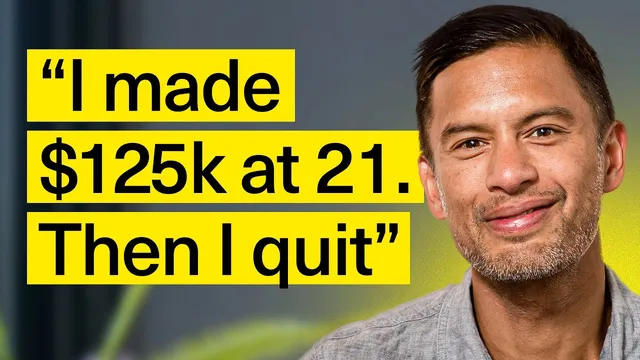
Khee quit a long Wall Street career at 35 in 2015 despite strong earnings, arguing that identity and coherence—not just money—ultimately determine whether a trajectory fits.
Briefing
A high-achieving Wall Street career didn’t just end—it was actively rejected at the peak, after years of financial momentum and a long runway that made quitting possible. At 35, Khee walked away from investment banking and a fund-of-hedge-funds track, despite strong earnings, because the life he was building no longer matched the identity and creative energy he wanted to live from. The decision mattered less as a “risk” and more as a forced reckoning: once money and status stop being the organizing principle, career choices become questions of self, coherence, and alignment with a spouse and a deeper sense of purpose.
Khee’s path to that moment started early. Born in 1979 to Cambodian and French immigrant parents in New York City, he credits a mix of outsider insecurity and intense self-reliance for his drive. In high school he taught himself HTML and built websites for friends’ networks, earning cash that he later invested aggressively. He sold a Magic the Gathering card collection on an Usenet news group for $5,000 and put the proceeds into the S&P 500 in the early 1990s, letting the investment compound for decades. College—Yale undergrad—was largely covered by his father’s employer, including benefits like paying for 80% of tuition and “home leave” travel every two years.
After graduating in 2001 with majors in PR and computer science (plus a minor in economics), he struggled to land tech jobs because he couldn’t pass early coding interviews. Investment banking became the escape hatch: elite banks recruited broadly and trained on the job, valuing “smart” over specific academic fit. But the timing was rough—after the dot-com crash, hiring was scaled back. Khee accepted a deal that effectively delayed full entry while still securing a base salary, then later took another job while planning to quit the second one after the year.
He worked on Wall Street for 14 years, first in investment banking and then in fund-of-hedge-funds, describing the grind as intense but eventually shifting to a more structured 60-hour week with fewer weekends and less travel. By 35, with an 18-month-old and a wife who is an artist, he finally “ripped the Band-Aid off” in 2015. He frames the years after quitting as phases: an initial stretch of creative “flailing,” followed by a turning point in 2018 when he embraced money, productivity, and packaging his interests into a course—an approach he credits to Thiago Forte’s advice.
The business side brought its own identity shocks. Marketing support helped, but the course’s momentum later collapsed—January 2023 brought an 85% sales drop, to the point Khee couldn’t make payroll. That volatility fed into his coaching focus: identity shifts are often violent, triggered by moments that remove someone from a known category. He describes how status “containers” shape social life, kids’ networks, and even access to elite institutions, making pivots feel like social exile. Coaching centers on questions like whether a spouse is truly aligned, how much time is spent on non-outcome activities, and what happens if leisure is allowed—often surfacing guilt, shame, and fear of becoming an outsider. The throughline is clear: career change isn’t just planning; it’s a soul-level decision about coherence, belonging, and what lights someone up.
Cornell Notes
Khee built a Wall Street career from an early mix of entrepreneurial hustle and long-term investing, then quit at 35 despite strong financial momentum. After leaving, he went through a period of creative uncertainty before turning his interests into a course, only to face a major business downturn in January 2023 that threatened payroll. His coaching framework treats career pivots as identity shifts—often “violent” changes triggered when someone loses a known social category and the status networks that come with it. The key to making the move, he says, is alignment at the spouse level, confronting fear of outsiderhood, and reconnecting with what actually creates energy rather than chasing a familiar trajectory.
What early factors gave Khee both financial runway and the confidence to eventually quit?
Why did investment banking become Khee’s entry point when tech recruiting didn’t work out?
What does Khee mean by “identity shift,” and why does it feel so destabilizing?
How does Khee connect pivot fear to status networks and everyday consequences?
What coaching questions and tools does Khee use to help people through pivots?
Why does spouse alignment come up so often in Khee’s coaching?
Review Questions
- What specific early investments and benefits reduced Khee’s financial risk when he later quit Wall Street?
- How does Khee distinguish between planning a career change and navigating an identity shift?
- Which coaching questions are designed to surface guilt/shame or misalignment, and what do they aim to change?
Key Points
- 1
Khee quit a long Wall Street career at 35 in 2015 despite strong earnings, arguing that identity and coherence—not just money—ultimately determine whether a trajectory fits.
- 2
Entrepreneurial hustle in high school and long-term investing (including S&P 500 compounding from early proceeds) helped create the runway that made quitting feasible.
- 3
Investment banking became his entry point because elite banks valued trainability and intelligence over specific tech interview performance.
- 4
After leaving, Khee’s post-Wall Street path moved from creative uncertainty to packaging his interests into a course, then faced a sharp revenue collapse in January 2023 that threatened payroll.
- 5
Khee treats career pivots as “identity shifts” that can be socially destabilizing because status categories shape belonging, kids’ networks, and access to institutions.
- 6
Coaching centers on spouse alignment, confronting fear of outsiderhood, and reconnecting with what creates energy—using frameworks like the “ideal ordinary day/week” and questions about leisure and non-outcome time.