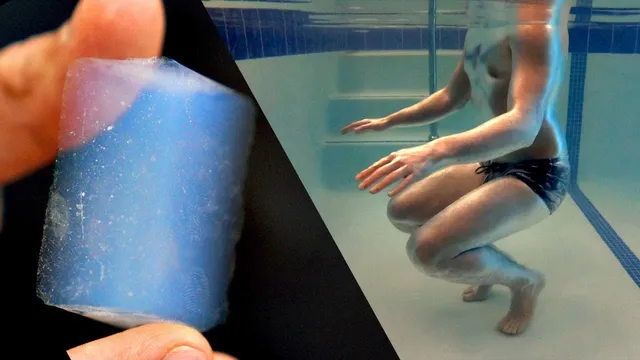
I Waterproofed Myself With Aerogel!
Based on Veritasium's video on YouTube. If you like this content, support the original creators by watching, liking and subscribing to their content.
Aerogel’s thermal insulation comes from its nano-porous, high-surface-area structure that strongly limits heat transfer through the material.
Briefing
Aerogel’s defining trick—its ability to block heat while remaining extremely light—can be turned into something practical by changing how the material is bound and how its surface interacts with water. In a live demonstration, aerogel particles mixed with a non-flammable binder are applied to skin and then exposed to a blowtorch flame. The finger feels only warm, while thermal imaging indicates the aerogel layer sits far above typical skin-safe temperature thresholds, showing how effectively the material slows heat transfer.
The key to aerogel’s performance is its structure: it’s a nano-porous, sponge-like solid with enormous surface area. That internal architecture makes aerogel an excellent thermal insulator, because heat has fewer effective pathways through the material. But aerogel also has a second, equally important property—its surface chemistry. Standard silica aerogel is hydrophilic, meaning it readily absorbs water. When the transcript shifts from heat protection to water protection, the method changes: a hydrophilic aerogel coating absorbs liquid and collapses its structure, which can be used to create a “waterproof” effect in a controlled way.
The waterproofing demonstration works because a thin layer of air is trapped next to the skin, producing a silvery look from certain angles. That optical effect is tied to total internal reflection at the water–air interface, while the practical outcome is that the skin doesn’t feel wet after stepping into the pool. The chemistry behind the hydrophilic behavior is detailed: aerogel contains many surface -OH (hydroxyl) groups that attract water molecules. The same absorption strength that enables water uptake also explains why aerogel is useful beyond insulation.
Aerogel’s absorption has been exploited in several real-world applications. A “physical insecticide” concept uses aerogel’s ability to bind moisture and oils from insects’ outer surfaces, effectively drying them out rather than relying on neurotoxins like cholinesterase inhibitors. In museums, aerogel can act as a passive moisture regulator inside display cases, absorbing excess humidity and releasing it when conditions dry out—useful for protecting artifacts such as the Mona Lisa’s display case. In space science, aerogel has been used in NASA’s Insight mission: moisture-absorbing aerogel helps maintain the exceptional vacuum needed for seismometers by reducing outgassing.
Still, absorption can be a drawback. To make aerogel truly water-repellent, the transcript describes chemically modifying the surface: replacing about 30% of the -OH groups with hydrophobic groups that rearrange into non-polar chemistry. The result is aerogel that water bounces off, can sit on water for months, and resists penetration.
Finally, the material’s brittleness and fire behavior shape engineering choices. Aerogel can be made into composites—such as fiberglass-infused aerogel blankets—so it can be cut, sewn, and flexed, opening paths toward astronaut suits or protective apparel. Across these examples, the central message is that aerogel’s extreme properties aren’t just inherent; they’re tuned through binders, surface chemistry, and composite design to meet specific thermal, moisture, and mechanical needs.
Cornell Notes
Aerogel’s extreme insulation comes from its nano-structured, high-surface-area solid network, which limits heat flow. In demonstrations, aerogel mixed with a non-flammable binder can protect skin from a blowtorch flame, with thermal imaging showing the aerogel layer reaching very high temperatures while the finger remains only warm. Aerogel’s interaction with water depends on surface chemistry: standard silica aerogel is hydrophilic due to -OH groups that absorb water and can collapse the structure. For waterproofing and long-term water resistance, hydrophobic chemical modification can replace roughly 30% of -OH groups so water beads and doesn’t penetrate. Aerogel’s absorption also powers applications like passive museum humidity control, physical insecticide concepts, and vacuum maintenance for NASA Insight seismometers.
Why does aerogel insulate so well even though it’s a solid?
How can aerogel be made to protect skin from a blowtorch?
What makes silica aerogel hydrophilic, and why does that matter?
How does the transcript turn aerogel from water-absorbing to water-repelling?
Where does aerogel’s moisture absorption show up in real applications?
Why do engineers combine aerogel with other materials like fiberglass?
Review Questions
- What structural and chemical features of aerogel determine whether it insulates heat versus absorbs water?
- How does replacing -OH groups with hydrophobic groups change aerogel’s interaction with liquid water?
- Why is aerogel often incorporated into composites, and what practical advantages does that provide?
Key Points
- 1
Aerogel’s thermal insulation comes from its nano-porous, high-surface-area structure that strongly limits heat transfer through the material.
- 2
A practical heat-protection layer can be made by mixing aerogel particles with a non-flammable binder so it can be applied to skin.
- 3
Silica aerogel is naturally hydrophilic because -OH groups attract water, which can absorb liquid and collapse the aerogel structure.
- 4
Water repellence can be engineered by chemically replacing about 30% of -OH groups with hydrophobic, non-polar groups so water beads and doesn’t penetrate.
- 5
Aerogel’s moisture absorption enables real uses such as passive humidity regulation in museum cases and vacuum maintenance for NASA Insight seismometers.
- 6
Aerogel can function as a “physical insecticide” by binding moisture and oils on insects’ surfaces, drying them out rather than relying on neurotoxins.
- 7
Because aerogel is brittle, composites like fiberglass-infused aerogel blankets make it workable for insulation and apparel-like applications.