If Everyone Believes It, It's Probably Wrong - The Philosophy of Socrates (& Plato)
Based on Pursuit of Wonder's video on YouTube. If you like this content, support the original creators by watching, liking and subscribing to their content.
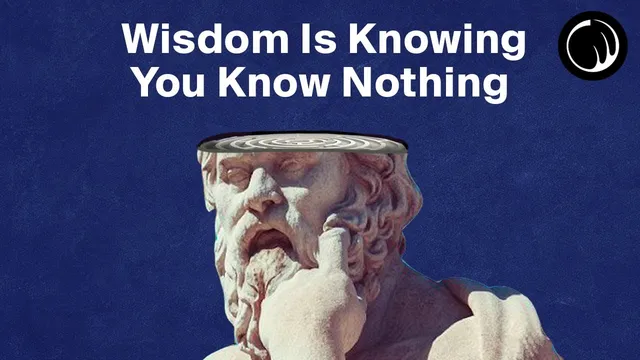
Socrates’ central claim of wisdom is tied to recognizing ignorance: real wisdom begins with admitting what one does not know.
Briefing
Socrates and Plato left behind a legacy less about settled answers than about disciplined doubt—and that uncertainty still shapes how people think about truth, ethics, and how to live. Socrates, born around 469 BC in Athens, is known mainly through others’ accounts, especially Plato’s writings. Accounts differ, but the core portrait is consistent: Socrates spent his later life questioning men considered “wise,” exposing how confidence often masked ignorance. In Plato’s “Apology,” Socrates describes a kind of humility that counts as wisdom—he believes he is “wiser” only because he knows he does not know, while others claim knowledge they do not possess. That stance becomes the defining “socratic paradox”: “I know that I know nothing.”
Socrates’ skepticism was not purely intellectual. He pushed practical moral priorities—virtue, self-knowledge, truth, and happiness over wealth, fame, and power—and developed an ethics built on the idea that evil comes from ignorance and harms the person who commits it more than the victim. He also criticized Athenian democracy, arguing that political life needed moral grounding rather than popular opinion. Yet his relentless questioning met resistance. After being accused of religious impiety and corrupting the youth, he was convicted and sentenced to death in 399 BC, forced to drink poison hemlock.
Plato took the “relay race” forward by writing down a more systematic philosophy. He produced roughly 36 books, many in dialogue form, and founded the Academy—often treated as the first true institution of philosophy in the Western tradition. Plato’s major shift was epistemological and metaphysical: he argued that knowledge is possible and that objective truths exist independent of human perception. He claimed that knowledge is innate and forgotten at birth, then recovered through reasoning. To explain how stable truth can exist, Plato separated the world of appearances from a higher realm of unchanging realities called the Forms. Material things are imperfect reflections—like trees as flawed shadows of a perfect “Tree” Form—so philosophy becomes a method for discerning justice, goodness, and other ideals.
Plato’s “Allegory of the Cave” dramatizes the stakes. Prisoners mistake shadows on a wall for reality until one escapes and sees the outside world; returning to tell others brings hostility and even violence. The allegory is often read as a warning about how difficult it is to communicate truth to people invested in their sensory “cave.”
Still, the framework raises a problem: how does the freed prisoner know the outside isn’t just another cave with a different source of shadows? The video treats this as a recurring weakness in Western philosophy—each new “truer” discovery could itself be another shadow. Even so, it argues that the enduring value of philosophy may lie in the process of questioning rather than in final certainty. Socrates’ prophecy that punishment would follow after his death is framed as a continuing cycle: each generation inherits the demand to doubt, to test beliefs, and to live with uncertainty. In that sense, philosophy’s futility becomes a kind of invitation—to keep playing with ideas, finding insight, love, and solace along the way, even without an ultimate instruction manual for reality.
Cornell Notes
Socrates is portrayed as the origin point of a lasting philosophical habit: treating ignorance as the starting line for real wisdom. Through Plato’s “Apology,” Socrates’ method is tied to a moral outlook—virtue and self-knowledge matter more than status—and to the claim that evil stems from ignorance. Plato then systematizes the project by arguing that objective knowledge exists in a higher realm of Forms, while the material world is only a flawed reflection. The “Allegory of the Cave” illustrates how people resist truth once it threatens their established beliefs. Yet the framework also invites a skeptical question: how can anyone be sure the “outside” isn’t just another cave?
Why does Socrates treat ignorance as a form of wisdom?
What practical moral commitments come with Socrates’ skepticism?
What led to Socrates’ death, and what does it symbolize in the legacy described?
How does Plato try to make knowledge possible after Socrates’ doubts?
What are the Forms, and how does the “tree” example clarify them?
What is the core challenge raised against Plato’s cave-like model?
Review Questions
- How does the “socratic paradox” function as both an epistemic claim (about knowledge) and a moral stance (about how to live)?
- What role do the Forms play in Plato’s account of why objective knowledge is possible?
- In the “Allegory of the Cave,” why might the freed prisoner’s return to the cave lead to resistance or violence?
Key Points
- 1
Socrates’ central claim of wisdom is tied to recognizing ignorance: real wisdom begins with admitting what one does not know.
- 2
Socrates links skepticism to ethics, emphasizing virtue, self-knowledge, truth, and happiness over status and power.
- 3
Plato preserves Socrates’ questioning but builds a more structured theory of knowledge and reality, arguing that objective truths exist.
- 4
Plato’s metaphysics separates the material world from the unchanging realm of Forms, which serve as the fundamental building blocks of what people experience.
- 5
The “Allegory of the Cave” illustrates how truth can be resisted when it threatens established beliefs and sensory habits.
- 6
A persistent challenge remains: even if someone escapes one “cave,” there’s no guarantee the new perspective isn’t another layer of shadow.
- 7
The enduring value of philosophy is framed as the ongoing practice of inquiry—finding meaning through questioning even without final certainty.