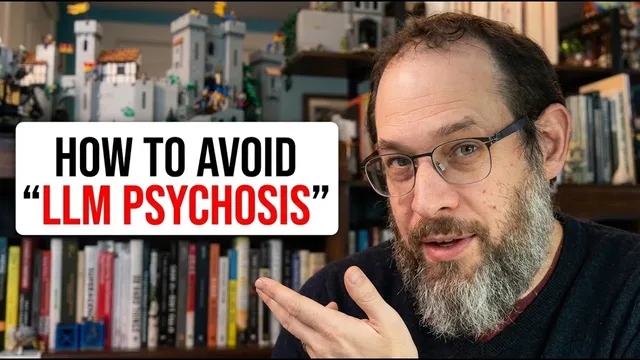
If This Can Happen to an Ex-DeepMind Leader, It Can Happen to You
Based on AI News & Strategy Daily | Nate B Jones's video on YouTube. If you like this content, support the original creators by watching, liking and subscribing to their content.
LLM-induced psychosis is expected to become a 2026 workplace and legal concern, not just a fringe phenomenon.
Briefing
LLM-induced psychosis is poised to become a workplace and legal flashpoint in 2026, with high-profile cases suggesting that even experienced, sober professionals can become overconfident when relying on large language models. The warning centers on a recent example: David Buden, a former director of engineering at Google DeepMind and now founder and CEO of Pingu, publicly claimed he could solve Navier–Stokes—an unsolved set of fluid dynamics equations long considered a millennium-level challenge. Buden posted what he called a “lean proof” and predicted a full proof by December 1, backed by work generated using ChatGPT 5.2. Mathematicians who reviewed the material reportedly found it “shaky,” and the consensus view is that Buden’s confidence appears consistent with LLM-induced psychosis: a mind convinced by AI output that it is close to a breakthrough, despite expert disagreement.
The broader concern is not limited to fringe users or dangerous behavior. The transcript frames the risk as a spectrum: some people may not harm others, but still lose the ability to distinguish their own judgment from the model’s apparent authority. That mismatch is expected to show up more often at work, where decisions increasingly involve AI assistance. If leaders treat AI-generated reasoning as validation rather than a draft to be challenged, they can make costly mistakes—especially in technical, scientific, and operational domains where “good looks” must be verified against reality.
Three practical safeguards are emphasized. First, prompts should be adversarial rather than confirmatory: asking the model to “check your work” isn’t enough if the user is effectively steering it toward agreement. Second, AI should not be treated as a substitute for domain expertise. Even if ChatGPT can suggest improvements—such as better ways to invent and install solar panels—non-experts cannot reliably judge correctness without deep subject knowledge and real-world validation. Third, decisions should be submitted to a “jury of peers”: if knowledgeable colleagues in the relevant field strongly disagree, that should trigger doubt rather than defensiveness. A hallmark of psychosis in this framing is the insistence that “me and AI are right” while others are wrong.
The transcript also links this to leadership behavior. Stable leadership in 2026 means knowing when to shut the laptop, turn off AI and recording devices, and make decisions through direct human discussion. Businesses, it predicts, will begin testing leaders—possibly on a quarterly basis—to ensure they are not unduly influenced by AI, because the cost of bad decisions can be existential. The takeaway is blunt: AI remains a tool, not an authority. The ability to use it without “going crazy” may become as important as the ability to use it at all.
Cornell Notes
LLM-induced psychosis is expected to rise as a workplace and legal risk in 2026, driven by cases where confident users treat AI output as proof. David Buden’s attempted Navier–Stokes “lean proof,” generated with ChatGPT 5.2 and paired with a prediction of a full proof, drew scrutiny from mathematicians who found the work shaky—an example used to illustrate how AI can inflate certainty. The transcript argues that the danger is often not violence but impaired judgment: people may fail to distinguish their own expertise from a model’s authority. The proposed defenses are to use adversarial prompts, rely on domain expertise for validation, and submit claims to a jury of peers who can disagree. Leadership stability is framed as knowing when to shut AI down and decide through human deliberation.
Why is Navier–Stokes used as the centerpiece example of LLM-induced psychosis?
What does “confirmatory” prompting look like, and why is it risky?
How does domain expertise function as a safeguard against AI overreach?
What is meant by submitting claims to a “jury of peers”?
How does the transcript connect LLM-induced psychosis to leadership behavior?
Why does the transcript predict businesses will test leaders for AI influence?
Review Questions
- What specific behaviors distinguish adversarial prompting from confirmatory prompting, and how could each affect the reliability of AI-assisted work?
- In the transcript’s framework, how do domain expertise and peer review work together to prevent AI output from becoming mistaken “proof”?
- Why does the example of Navier–Stokes matter more than a generic claim of AI competence? Identify what makes the domain unusually unforgiving to errors.
Key Points
- 1
LLM-induced psychosis is expected to become a 2026 workplace and legal concern, not just a fringe phenomenon.
- 2
David Buden’s Navier–Stokes “lean proof” and predicted timeline—using ChatGPT 5.2—illustrate how AI-backed confidence can conflict with expert skepticism.
- 3
Confirmatory “check my work” prompting can reinforce desired conclusions instead of exposing errors; adversarial prompting is presented as a countermeasure.
- 4
AI suggestions require domain expertise for validation; non-experts cannot reliably judge scientific or technical correctness from model output alone.
- 5
Peer disagreement should be treated as evidence to reassess, not as an insult—insisting “me and AI are right” is framed as a psychosis marker.
- 6
Stable leadership includes knowing when to shut AI down and make decisions through direct human discussion.
- 7
Businesses may begin formal testing of leaders to detect undue AI influence because the consequences of bad decisions can be existential.