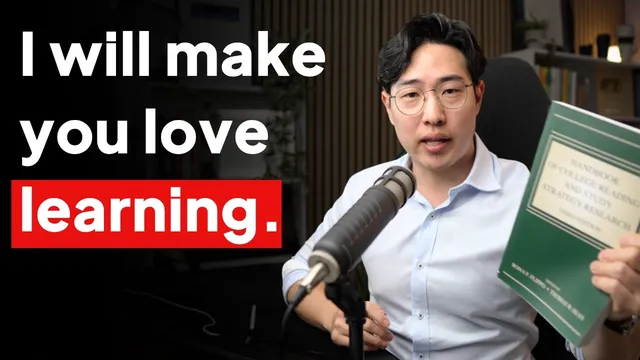
If You Don’t Enjoy Learning, You’re Doing It Wrong
Based on Justin Sung's video on YouTube. If you like this content, support the original creators by watching, liking and subscribing to their content.
Boredom during study is treated as a signal that the learning process isn’t engaging the brain in effective, connection-building work.
Briefing
Learning boredom is treated less like a personality trait and more like a diagnostic signal: when someone feels bored while studying, their brain is likely not engaging in effective learning. EEG research is used to contrast two brain states—passive, slow-wave patterns resembling drowsiness versus active, “chaotic” high-frequency activity seen during effective learning. The takeaway is blunt: effective learning and boredom don’t coexist. If boredom shows up, it usually means the learning process isn’t triggering the mental work needed to build understanding.
That mental work is framed as problem-solving. Effective learning is described as detective work: the brain collects clues (pieces of information), compares them, and tries to form patterns and networks that explain how concepts fit together. Techniques that succeed tend to force this kind of active comparison and restructuring, while common study habits often fail because they keep the brain passive. This leads to a key distinction—people may love learning experiences that feel meaningful (like following a TV series or reading a novel) but hate “studying” because traditional curricula lean heavily on memorization and repetition. The result is a mismatch between how the brain naturally enjoys learning and how studying is often practiced.
Several principles then explain how to fix that mismatch. First, relevance is presented as a skill rather than a fixed property of the material. The brain labels information “relevant” when it can connect new details to existing knowledge; when no connections appear, the material feels irrelevant. Learners can increase relevance by actively reframing how concepts might fit, connecting study to purpose or big-picture why, and using analogies to bridge unfamiliar topics to familiar domains.
Next comes the idea of flow: effective learning is linked to entering a peak cognitive state characterized by deep focus and rapid mental processing. Passive strategies—especially rereading—are criticized as cognitively circular: if the material doesn’t click, rereading repeats the same unproductive cycle, making the brain disengage, slow down, and drift into distraction. Engaging strategies that require constant “fit-checking” and comparison make it easier to sustain focus and reach flow.
Flow is also treated as something to manage, not chase endlessly. After high-quality, mentally taxing work, learners should rest and recover rather than forcing marathon sessions that eventually turn learning tedious and unproductive. The goal becomes maximizing quality time, not sheer hours.
The remaining principles focus on behavior change. The “best” learning strategy is the one a person can actually enjoy—because engagement supports consistency—and the optimal method evolves as preferences and challenges change. Learners are warned not to confuse enjoyment with ease: meaningful satisfaction often comes from overcoming difficulty, and “easier” methods may simply reflect outdated habits. Finally, self-testing is pitched as a way to trigger knowledge retrieval and force the brain into the same active, chaotic problem-solving mode as effective learning. With modern AI tools, generating practice questions can lower the barrier to testing, even when relevance feels hard to create. The overall message: boredom is a cue to redesign the learning process so the brain is actively building connections, not passively absorbing text.
Cornell Notes
Boredom during studying is treated as a symptom of ineffective learning: EEG patterns associated with passive learning resemble drowsiness, while effective learning shows high, fast neural activity. Effective learning is described as detective-style problem solving—comparing clues, finding patterns, and building networks of understanding. Relevance is framed as a controllable skill: learners can increase engagement by reframing how new information connects to prior knowledge, linking it to purpose, and using analogies. Flow is presented as the peak state that effective learning naturally supports, and passive habits like rereading block it. Self-testing is recommended to force knowledge retrieval, making learning more active even when material initially feels irrelevant.
Why does boredom signal a learning problem rather than just “low motivation”?
What does “effective learning” look like inside the mind?
How can someone make “irrelevant” material feel relevant?
Why is rereading criticized so strongly?
What’s the role of flow, and how should learners manage it?
How does self-testing create effective learning even when understanding is weak?
Review Questions
- What specific brain-state contrast (as described via EEG) is used to argue that boredom means learning isn’t happening?
- Describe how relevance is generated in the brain and list two concrete ways a learner can increase it.
- Why does self-testing work as an engagement strategy, and how does it differ from rereading?
Key Points
- 1
Boredom during study is treated as a signal that the learning process isn’t engaging the brain in effective, connection-building work.
- 2
Effective learning is framed as detective-style problem solving: comparing clues to form patterns and networks rather than memorizing isolated facts.
- 3
Traditional studying habits often rely on memorization and repetition, which can conflict with how the brain naturally enjoys learning.
- 4
Relevance is a skill: learners can actively reframe connections to prior knowledge, link material to purpose, and use analogies to make new information “fit.”
- 5
Flow supports deep learning, but passive strategies like rereading block flow by creating unproductive cycles of forgetting and re-encountering irrelevant material.
- 6
High-quality learning is mentally taxing; after strong focus, recovery breaks help maintain quality rather than forcing long, diminishing sessions.
- 7
The best strategy is the one a learner can enjoy and sustain; enjoyment should come from meaningful challenge, not just ease, and self-testing can trigger effective learning through knowledge retrieval.