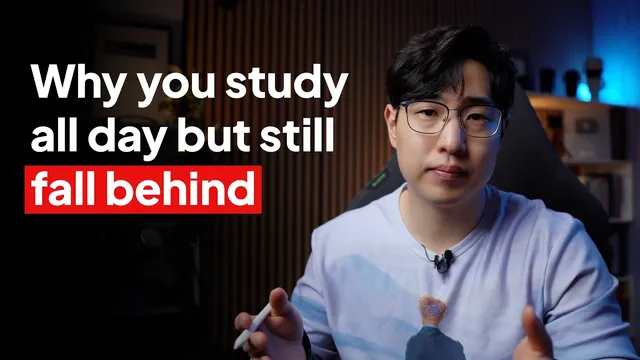
If you feel behind in life, please watch this video...
Based on Justin Sung's video on YouTube. If you like this content, support the original creators by watching, liking and subscribing to their content.
“Falling behind” is often a system problem, not a motivation problem: effort-first strategies ignore the processes that turn time into results.
Briefing
A burnout-prone feeling of “falling behind” often isn’t caused by a lack of effort—it’s caused by using the wrong upgrade path for recurring challenges. The core idea behind the “infinite staircase” is that life keeps presenting new, harder waves of difficulty, so catching up requires building a learning and performance system that’s ready not only for the current hurdle, but for the next several.
The transcript frames two common approaches to tackling a big task, like studying 200 pages for an exam in three weeks. The “effort-first” approach focuses on time and willpower: add more hours, push harder, and hope results follow. That strategy can work briefly, but it’s described as a near-guarantee of burnout because it ignores the processes and skills needed to turn effort into durable performance. It also leaves people dependent on motivation and natural ability—so even when they succeed, it’s unnecessarily exhausting and risky. The speaker ties this to personal experience and to a medical trainee, James, who was working 70 hours a week while studying 10–15 more, yet still felt overwhelmed and behind.
The alternative is the “effort-second” approach: first identify the learning processes, skills, and attributes required to succeed, then apply the time needed to build them. The metaphor is upgrading the boat rather than paddling harder into a wave. In practice, that means improving how someone reads, writes notes, encodes and re-encodes information, and retrieves knowledge—turning studying into a system rather than a pile of random techniques. But even this approach can fail over time, because it treats each challenge as if it resets the playing field.
That’s where the infinite staircase completes the model. Challenges are “infinite,” meaning new ones keep arriving—tests in school, higher-stakes responsibilities at work, and continuous learning in professional life. More importantly, each wave tends to be harder than the last, effectively raising the level of difficulty. Passing one challenge often grants access to a higher tier of expectations, where the same learning system becomes insufficient again. The result is a recurring cycle: people overcome a hurdle, celebrate briefly, then feel dread and anxiety as the next wave threatens to sink them.
To break that cycle, the transcript argues for a “future-proof” approach—upgrading the learning system beyond the minimum needed for the current task. Instead of moving from “level 1 to level 2,” the goal is to jump toward “level 6 or 7” by anticipating the next few waves of challenges. A key constraint is the “cost of change,” which isn’t linear: unlearning entrenched habits is expensive, and most of the time spent improving a learning system goes into removing subconscious mistakes before new techniques can stick. The speaker claims that paying this cost once—by upgrading far enough ahead—prevents repeatedly paying it again and again for each new challenge.
The practical prescription is to map the next few waves of difficulty by talking to people who have already faced them, then prioritize the skills and processes those people say they needed. The promised payoff is confidence and mental freedom: not just getting through the next exam or rotation, but building a system that keeps people ahead as difficulty escalates.
Cornell Notes
The “infinite staircase” model explains why effort alone often leads to burnout: life keeps delivering new, harder waves of challenges, and each win can raise the level of difficulty. An “effort-first” strategy—pushing more hours without upgrading the underlying learning processes—tends to exhaust people and makes progress fragile. An “effort-second” strategy improves the learning system first (how someone reads, encodes, and retrieves), but it can still fail if the system only fits the current hurdle. The solution is “future-proofing”: anticipate the next few challenges and upgrade the learning system far enough ahead, recognizing that the cost of change is largely about unlearning habits. This reduces the repeated cycle of falling behind after each wave.
Why does “effort-first” studying often end in burnout even when results seem possible at first?
What’s the practical difference between “effort-first” and “effort-second” using the transcript’s boat metaphor?
Why can an upgraded learning system still leave someone feeling like they’re falling behind?
What does “future-proof” mean in this framework, and how is it different from incremental improvement?
What is the “cost of change,” and why does the transcript say it’s not linear?
How should someone start applying the future-proof approach?
Review Questions
- How does the transcript define the difference between effort-first and effort-second approaches to challenges?
- In the infinite staircase model, why does passing one challenge often make the next one feel harder?
- What does “future-proof” upgrading aim to accomplish, and how does the “cost of change” concept support that strategy?
Key Points
- 1
“Falling behind” is often a system problem, not a motivation problem: effort-first strategies ignore the processes that turn time into results.
- 2
Effort-second works by upgrading learning habits and skills first—then applying the time needed to build them.
- 3
The infinite staircase explains why progress can still stall: challenges are continuous and each wave typically raises the level of difficulty.
- 4
Future-proofing means upgrading the learning system for the next several challenges, not just the current one.
- 5
The cost of change is largely driven by unlearning entrenched habits, so stopping early can force people to pay that cost repeatedly.
- 6
Anticipate upcoming waves by learning from people who have already faced them, then prioritize the skills and processes those experiences reveal.