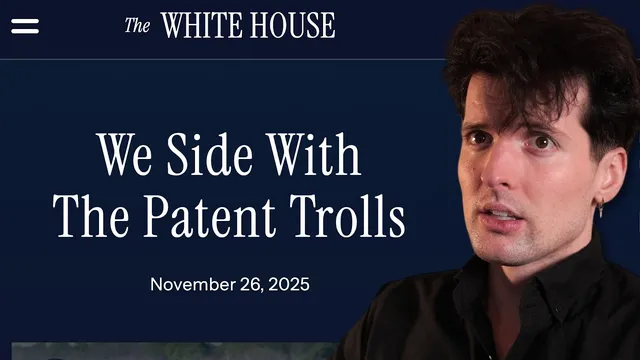
If you write code, please watch this.
Based on Theo - t3․gg's video on YouTube. If you like this content, support the original creators by watching, liking and subscribing to their content.
Software patents are portrayed as enabling “patent trolling,” where rights holders sue or demand licensing without using the patented technology.
Briefing
Software patents are framed as a major drag on everyday innovation, with “patent trolling” singled out as the most damaging pattern: entities acquire or hold patents they don’t use, then threaten developers and startups with licensing demands or lawsuits—often after a product becomes popular. The core warning is that a proposed change to the U.S. patent system could make it harder for developers to challenge low-quality or weaponized patents through inter partes review (IPR), increasing both cost and litigation risk for small teams and open-source projects.
The argument starts with the mismatch between patents’ original purpose—protecting truly novel inventions from immediate copying—and how the system functions in practice. Instead of deterring cloning, patents can become leverage for lawsuits over basic software concepts and features. The transcript describes a category of “patent trolling” where companies sue even when the target is building something ordinary (like an app on an app store or a live-video protocol), and where the accused party often has no realistic path to fight in court. In that environment, developers may be forced into settlements or licensing payments simply to avoid expensive legal battles.
A key policy focus arrives with a proposed rule from the U.S. Patent and Trademark Office that would reshape proceedings before the PTAB (Patent Trial and Appeal Board). The proposal would prioritize inter partes reviews for patent claims that have not previously been challenged in litigation or where prior litigation ended early. In practical terms, the transcript claims this would reduce the ability to attack “bad patents” via IPR—especially when other parties have already litigated the same claim or when parallel cases are likely to finish first.
The transcript also emphasizes why IPR matters to vulnerable innovators. Congress created IPRs to give startups, developers, and others without unlimited legal budgets a faster, less expensive route to challenge whether a patent should have been granted in the first place. The concern is that the new proposal would introduce “bright line” restrictions that block IPR petitions in common scenarios, and it would require petitioners to give up invalidity defenses in court if they pursue IPR. That combination, as described, could trap developers: if they try IPR and lose, they may lose key defenses later—making the process far less accessible.
Several examples illustrate how patents can distort software standards and product development. One anecdote involves a company (Lods) holding a patent tied to distributing software upgrades over the internet, later used to sue app developers; another describes Apple’s FaceTime being intended as an open standard but effectively locked down after patents related to connection methods (including peer-to-peer routing and DNS-based techniques) were asserted. The transcript also points to camera-industry disputes over compressed RAW concepts and codec-related licensing, and it highlights how enforcement can shift through settlements, acquisitions, or selective non-enforcement.
The closing push is action-oriented: developers, startups, open-source organizations, and even content creators are urged to submit public comments before the December 2 deadline. The stated goal is to stop the proposed rule from reducing IPR access, arguing that weakening challenges to bad patents would harm the broader ecosystem that enables innovation.
Cornell Notes
The transcript argues that software patents often function less as protection for genuine innovation and more as leverage for “patent trolling,” where entities hold patents they don’t use and sue or demand licensing from developers and startups. It warns that a proposed U.S. Patent and Trademark Office rule would make inter partes review (IPR) harder to use, especially when claims have already been litigated or when parallel cases are likely to finish first. The concern is that IPR was created to help vulnerable innovators challenge patents without the cost of full federal litigation, and the proposal could raise litigation risk and costs. A further worry is that pursuing IPR could require giving up invalidity defenses in later court fights. The transcript ends by urging public comments before December 2.
Why does the transcript claim software patents cause more harm than good?
What specific policy change is highlighted, and what does it do to IPR?
Why is IPR portrayed as crucial for startups and developers?
What is the transcript’s biggest fear about the “give up invalidity defenses” requirement?
How do the examples (FaceTime, software updates, codecs) support the broader claim?
What action does the transcript urge viewers to take, and by when?
Review Questions
- What mechanisms does the transcript describe that turn patents into tools for licensing pressure rather than innovation protection?
- How would the proposed PTAB/IPR rule change access to challenges, according to the transcript’s interpretation?
- Why does the transcript treat “giving up invalidity defenses” as a major risk for developers who pursue IPR?
Key Points
- 1
Software patents are portrayed as enabling “patent trolling,” where rights holders sue or demand licensing without using the patented technology.
- 2
A proposed U.S. Patent and Trademark Office rule would narrow when inter partes review (IPR) can proceed, reducing developers’ ability to challenge patents.
- 3
IPR is presented as a critical, lower-cost alternative to full federal litigation for startups, developers, and open-source projects.
- 4
The transcript highlights a requirement that petitioners give up invalidity defenses in court if they pursue IPR, increasing downside risk if the challenge fails.
- 5
Examples like FaceTime’s standardization path and software-update patent litigation are used to illustrate how patents can block or distort real product development.
- 6
The transcript urges public comments before December 2 to oppose the rule and preserve IPR access for vulnerable innovators.