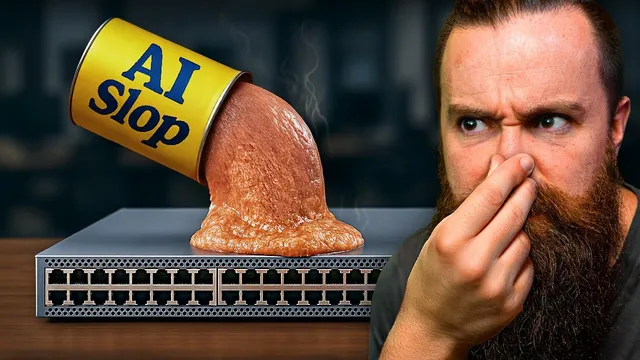
I'm done with the AI hype
Based on NetworkChuck's video on YouTube. If you like this content, support the original creators by watching, liking and subscribing to their content.
AI in networking should be judged by operational outcomes—fewer outages, faster root-cause analysis, and validated fixes—not by whether products carry an “AI” label.
Briefing
AI is being pasted onto networking products at a breakneck pace, but the real question for IT teams is whether it reduces outages and troubleshooting time—or just adds marketing gloss. A closer look at Juniper Mist frames the difference as less about “AI” in general and more about how network context and telemetry are gathered, structured, and used to drive decisions. The core claim: Juniper’s approach is “AI native,” built around a centralized, continuously updated model of the network, rather than bolting an LLM onto many disconnected data sources.
The transcript traces how this isn’t entirely new. Juniper’s AI networking roots connect back to Mist Systems, founded in 2014 by former Cisco employees, with a goal of a “self-driving network” that could detect and adapt to issues in real time. Mist’s early machine learning was tightly focused on wireless LAN data—trained on what “good” and “bad” Wi‑Fi looks like—rather than general-purpose language tasks. Mist was later acquired by Juniper in 2019 for $45 million, giving Juniper several years of accumulated product and data experience before the post-ChatGPT wave of generative AI hype.
That head start matters because AI performance depends heavily on data quality and context. The transcript argues that many vendors respond to the AI moment by feeding LLMs large volumes of telemetry—router and switch logs, packet captures, and monitoring outputs—then asking the model to “figure it out.” That strategy can work in demos, but it risks hallucinations and struggles with maintaining the right context across complex, multi-system environments.
Juniper’s counterpoint is architectural. Mist AI stores network context in the Mist AI cloud, including wireless access points, switches, routers, client behavior, configuration and state, and performance telemetry. A microservices design ingests and correlates this information, while an intent-based networking technology called Abstra builds a contextual graph database for data center relationships. The system then uses “Marvis minis,” which act like virtual clients created automatically to learn the network via unsupervised machine learning, authenticate, obtain IP addresses, query DNS and SaaS services, and map client journeys to detect anomalies—especially after configuration changes. On top sits Marvis AI, positioned as a question-and-troubleshooting layer that leverages the already-built network context.
A key practical example contrasts how troubleshooting might work. For a CEO reporting a bad Zoom call, a conventional approach would require pulling and correlating data across many sources after the fact. In the Juniper framing, Marvis AI can look up the relevant client journey and network state already captured in the cloud—identifying a likely root cause such as CRC errors on a specific switch port and recommending a patch cable replacement. After remediation, Marvis minis can re-simulate the client path to verify improvement via metrics like MOS.
The transcript also claims predictive maintenance: trend analysis using enriched graph data to forecast optic or cable failures before they impact applications, enabling earlier part ordering. While skepticism remains—this is still a market full of AI promises—the argument is that Juniper’s “single place” for context and its customer-deployed maturity make the use cases more credible than sticker-based integrations. The closing question is whether AI will genuinely deliver higher uptime and faster resolution, or whether it will remain mostly glitter—especially as automation encroaches on traditional network engineering work.
Cornell Notes
Networking vendors are rushing to add “AI” to products, but the transcript argues the deciding factor is not the label—it’s how network context is captured and used. Juniper Mist is presented as “AI native,” storing continuously updated network state in the Mist AI cloud and building a contextual graph (via Abstra) that links telemetry, topology, and client behavior. Marvis minis simulate clients using unsupervised learning to detect anomalies and validate changes, while Marvis AI answers troubleshooting questions using the already-built context. The practical payoff claimed is faster root-cause identification (e.g., pinpointing CRC-error ports affecting a Zoom call) and predictive maintenance (forecasting optic/cable failures).
Why does the transcript treat “data and context” as the bottleneck for AI in networking?
What is the difference between bolt-on LLM integration and Juniper’s “AI native” approach as described here?
What are Marvis minis, and how do they contribute to troubleshooting?
How does the CEO Zoom-call scenario illustrate the claimed advantage of having context already built?
What predictive maintenance capability is claimed, and what data does it rely on?
Why does the transcript bring up Mist Systems’ history before ChatGPT?
Review Questions
- What kinds of network context does Mist AI reportedly centralize, and why does that reduce the need for ad-hoc correlation across many telemetry sources?
- In the transcript’s framing, how do Marvis minis differ from a traditional monitoring alert, and how do they help validate fixes?
- What risks does the transcript associate with feeding an LLM large, unstructured telemetry datasets, and how does Juniper’s graph-based approach aim to address them?
Key Points
- 1
AI in networking should be judged by operational outcomes—fewer outages, faster root-cause analysis, and validated fixes—not by whether products carry an “AI” label.
- 2
AI performance depends on data quality and, especially, on having the right network context available at decision time.
- 3
Bolt-on approaches that dump many telemetry sources into an LLM can struggle with context maintenance and increase the chance of incorrect or confusing outputs.
- 4
Juniper Mist is presented as “AI native” by centralizing continuously updated network context in the Mist AI cloud and using structured modeling (including Abstra’s contextual graph database).
- 5
Marvis minis act like virtual clients that learn the network via unsupervised machine learning, detect anomalies, and re-simulate client journeys after changes.
- 6
Marvis AI is positioned as a troubleshooting and recommendation layer that leverages pre-built context to identify likely root causes and recommend targeted actions.
- 7
The transcript claims predictive maintenance is possible by forecasting optic/cable failures using trend analysis over enriched, relationship-aware data.