I'm leaving the cloud! (...and why you probably should too)
Based on Simon Høiberg's video on YouTube. If you like this content, support the original creators by watching, liking and subscribing to their content.
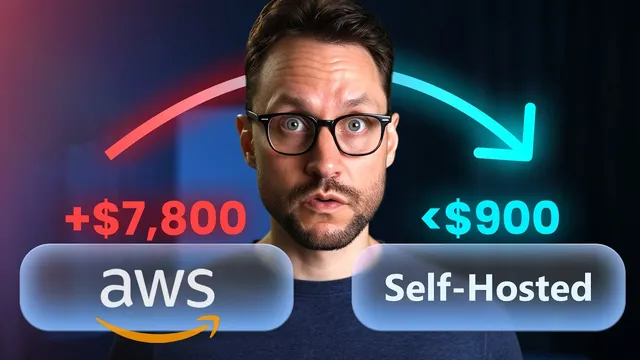
After moving more than 80% of workloads to dedicated Hzner servers, his AWS bill dropped from about $7,800/month to under $2,000/month, with further reductions expected as migrations finish.
Briefing
Moving most of his SaaS stack off AWS onto dedicated bare-metal servers cut monthly infrastructure costs by more than half and also sped up deployments—while reducing the risk of vendor lock-in that can force expensive, disruptive migrations. After shifting over 80% of his systems to Hzner, his average AWS bill fell from about $7,800 per month to under $2,000, with expectations that it could drop below $1,000 as the remaining migrations finish. The change matters because it directly affects both unit economics (costs that otherwise rise with usage) and operational resilience (the ability to keep running if a hyperscaler changes pricing or terms).
The new setup replaces AWS-managed serverless components with a more self-managed infrastructure layer. Code now runs in Docker containers orchestrated by Kubernetes on three dedicated Hzner servers. Data storage moved to PostgreSQL, caching to Redis, and background jobs/message queues to Bullmq. Monitoring and access logging are handled with Prometheus and Grafana. The cost model is also fundamentally different: Kubernetes, PostgreSQL, Redis, Bullmq, and Prometheus are open-source and free, with Grafana relying on its community edition. That leaves the dedicated servers as the primary recurring expense—around $200 per month for Hzner—plus whatever portion of infrastructure remains on AWS.
The trade-off is time and expertise. Migration required learning Kubernetes, Docker, and basic system administration, and infrastructure work spiked early in 2025. Over time, the workload returned to roughly prior levels, helped by better tooling and AI assistance. The financial logic hinges on that shift: the upfront migration effort is largely fixed, while the savings keep compounding month after month with no built-in usage ceiling like AWS’s per-request/per-resource pricing.
A second, arguably bigger reason centers on portability and continuity. AWS services such as DynamoDB, Lambda, and Fargate are robust, but they don’t run outside AWS. If AWS raises prices or stops serving a product configuration, the business can be “cooked,” because migration can’t be done quickly without careful planning. By moving to a stack that can run on any VPS or dedicated server, he aims to avoid being trapped by a single vendor’s infrastructure.
He still keeps some dependencies on AWS and other third parties. Stripe and OpenAI remain in the mix, and he’s experimenting with alternatives like Coinbase for payments and independent vendors for GPU-based AI inference. For the remaining AWS services, he’s tried to replace S3 with S3-compatible options such as Hzner storage buckets and Cloudflare R2, but vendor lock-in still persists. MinIO looked promising for self-hosted S3 compatibility, yet backup complexity and stability issues pushed him back to S3. Authentication also stayed on AWS for now: he tested Keycloak as an alternative to Cognito but returned to Cognito due to poor user/developer experience.
Finally, the move supports his business model. He sells both subscriptions and lifetime deals. Rising operational costs tied to user growth make lifetime pricing riskier; shifting to fixed-cost infrastructure makes financial planning easier and helps address customer questions about what happens if the company can’t host “lifetime” access. His goal is to make all products fully self-hostable so lifetime customers can run the software themselves if needed.
For deciding whether to do the same, he draws a line by stage: hobby projects should stay on cloud one-click platforms, mission-critical or highly scaling businesses may still benefit from managed hyperscalers, and the middle ground is where dedicated servers can be a practical, money-saving option—especially when teams want the freedom to use open-source tools internally.
Cornell Notes
The core shift is from AWS-managed, usage-priced infrastructure to dedicated servers that run a mostly open-source stack. After moving more than 80% of his SaaS systems to Hzner, monthly AWS costs dropped from about $7,800 to under $2,000, with potential to fall below $1,000 as migrations complete. The new architecture runs Docker containers on Kubernetes, stores data in PostgreSQL, uses Redis for caching, Bullmq for queues, and Prometheus/Grafana for monitoring. The biggest benefits are lower and more predictable costs plus reduced vendor lock-in risk, since the stack can run on other VPS/dedicated providers. The main downside is the upfront learning and migration effort, though he reports that ongoing infrastructure time returned to prior levels after an adjustment period.
What exact infrastructure stack replaced AWS for most of his SaaS workloads?
How did the cost picture change after leaving AWS for dedicated servers?
Why does vendor lock-in drive the decision beyond simple cost savings?
What were the biggest downsides during the transition, and how did they change over time?
Which AWS services remain, and what replacement attempts did he make?
How does leaving the cloud connect to his lifetime-deal business model?
Review Questions
- Which parts of his architecture are explicitly open-source/free, and how does that affect the cost model compared with AWS usage pricing?
- What specific failure mode does vendor lock-in create, and why is migration not something he treats as quick or low-risk?
- What remaining AWS dependencies are hardest to replace, and what trade-offs did his experiments (like MinIO and Keycloak) reveal?
Key Points
- 1
After moving more than 80% of workloads to dedicated Hzner servers, his AWS bill dropped from about $7,800/month to under $2,000/month, with further reductions expected as migrations finish.
- 2
The new core stack runs Docker containers on Kubernetes, with PostgreSQL for storage, Redis for caching, Bullmq for queues, and Prometheus/Grafana for monitoring.
- 3
The main financial advantage comes from shifting from usage-based cloud pricing to fixed server costs, making savings potentially unbounded as the business grows.
- 4
Vendor lock-in is treated as a continuity risk: AWS-only services can force slow, expensive migrations if pricing or availability changes.
- 5
Migration has an upfront learning curve (Kubernetes, Docker, system admin), but ongoing infrastructure time reportedly returned to prior levels after adjustment.
- 6
He still keeps some critical dependencies on AWS and third parties—especially for storage, authentication, and edge security—while actively searching for replacements.
- 7
Lifetime deals become easier to support when operational costs are more predictable and the software can be self-hosted by customers if needed.