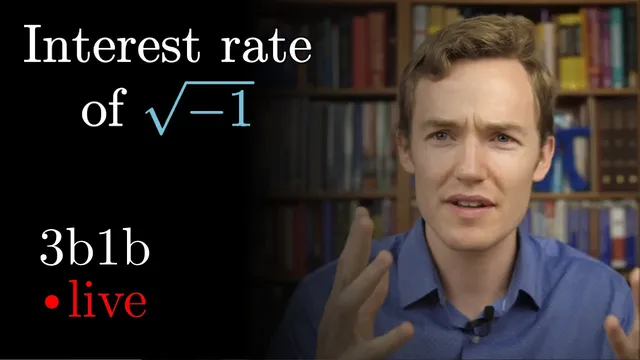
Imaginary interest rates | Ep. 5 Lockdown live math
Based on 3Blue1Brown's video on YouTube. If you like this content, support the original creators by watching, liking and subscribing to their content.
Ordinary compound interest is multiplicative: each interest payment is proportional to the current balance, so compounding frequency changes the final amount.
Briefing
An “imaginary interest rate” isn’t just a math prank: when interest compounds continuously, an interest rate of √−1 turns money growth into circular motion in the complex plane—so the real part oscillates between positive and negative values instead of steadily increasing. The punchline is practical: if a bank offered an annual rate of √−1 and compounded continuously, the account would repeatedly return to its starting value (after multiples of 2π years), but it would also swing negative in between, making it unusable for real life.
The lesson starts by building intuition for ordinary compound interest and why compounding frequency matters. A bank paying 12% per year makes a balance jump from $100 to $112 only at year’s end, but the key mechanism is multiplicative growth: each time interest is applied, the next interest payment is proportional to the new, larger balance. That’s why 12% for 10 years yields about $310, not $220. When compounding happens more frequently—like 6% every six months or 1% each month—the balance ends up higher, because the “rate of change is proportional to what you already have” keeps feeding back into itself. The Desmos walkthrough frames this with repeated multiplication by constants like 1.12 or 1.01, and then generalizes to a limit form where compounding becomes continuous.
That generalization leads to the constant e. By slicing time into n tiny intervals, the balance after time t becomes proportional to (1 + r·t/n)^n. As n grows, this expression approaches a constant: e ≈ 2.71828. In real-valued interest, this produces continuously compounded growth of the form e^(rt), tying the limit definition of e directly to the familiar exponential law.
The “imaginary rate” question then reuses the same limit machinery, but with r = √−1. Plugging √−1 into e^(rt) doesn’t make sense if interpreted as ordinary real exponentiation, yet the original limit definition still works because it only relies on algebraic operations that complex numbers support. Geometrically, multiplying by i rotates a vector by 90 degrees. So each tiny compounding step adds an increment perpendicular to the current “money vector,” meaning the balance doesn’t grow in magnitude the way real interest does—it moves around a circle.
To show how compounding frequency changes outcomes, the lesson contrasts annual compounding (big 90-degree jumps) with continuous compounding (infinitesimal steps). With annual steps, the real part becomes negative after enough years, and the account can owe money at certain times. Under continuous compounding, the motion becomes a smooth rotation: after π/2 years the balance is purely imaginary; after π years it’s purely negative real; after 2π years it returns to the starting value. The bank’s offer is therefore a “hold-and-wait” scenario only in the abstract sense—emotionally and financially it’s unstable.
Finally, the same mathematics becomes physics. By packaging spring displacement x and velocity v into a complex number, Hooke’s law (force = −kx) turns the dynamics into a 90-degree-rotation rule. The result is simple harmonic motion: displacement follows cosine behavior and velocity follows a phase-shifted sine behavior, all interpretable as shadows of circular motion. The imaginary-interest-rate thought experiment thus lands on a real-world endpoint: the exponential-of-imaginary form (via Euler’s formula) is exactly what describes oscillations without friction.
Cornell Notes
The core idea is that continuous compounding with an “imaginary” interest rate turns exponential growth into rotation. Ordinary compound interest leads to the limit (1 + r·t/n)^n, which approaches e^(rt) as n → ∞. Replacing r with i = √−1 changes the geometry: multiplying by i rotates by 90°, so each infinitesimal compounding step adds a perpendicular increment. With continuous compounding, the money state walks around a circle in the complex plane, returning to its starting value after 2π years while becoming purely imaginary at π/2 years and purely negative at π years. That same rotation picture reappears in physics: packaging spring displacement and velocity into a complex number makes Hooke’s law produce simple harmonic motion (sine/cosine) as circular motion shadows.
Why does compounding frequency change the final amount even when the annual rate is fixed?
How does the limit definition of e connect to continuously compounded interest?
What goes wrong with interpreting e^(i·t) using only real-number intuition?
Under continuous compounding with interest rate i, what happens at times π/2, π, and 2π?
How does the same math describe a frictionless spring?
Why does the lecture warn that e^(A+B) is not generally equal to e^A·e^B for matrices?
Review Questions
- If compounding happens n times per year with annual rate r, what expression gives the balance after one year, and what limit produces e?
- For an imaginary interest rate i under continuous compounding, why does multiplying by i correspond to circular motion rather than growth along the real axis?
- In the spring example, how does packaging displacement and velocity into a complex number turn Hooke’s law into a 90-degree-rotation rule?
Key Points
- 1
Ordinary compound interest is multiplicative: each interest payment is proportional to the current balance, so compounding frequency changes the final amount.
- 2
The continuously compounded growth law comes from the limit (1 + r·t/n)^n as n → ∞, yielding e^(rt) with e ≈ 2.71828.
- 3
An imaginary interest rate r = i = √−1 can be interpreted using the limit definition of e, not by forcing real-number exponent intuition.
- 4
Multiplying by i rotates vectors by 90°, so continuous compounding with rate i makes the money state move around a circle in the complex plane.
- 5
With continuous compounding at rate i, the real balance oscillates: it’s purely imaginary at π/2 years, purely negative at π years, and returns to the start at 2π years.
- 6
The same rotation mathematics describes frictionless simple harmonic motion: spring displacement and velocity correspond to the real and imaginary parts of a complex state rotating over time.
- 7
When extending exponential identities to matrices, non-commutativity (AB ≠ BA) breaks simplifications that rely on binomial expansion rules for commuting variables.