"Impossible" Device Creates Free Electricity from Earth's Magnetic Field
Based on Sabine Hossenfelder's video on YouTube. If you like this content, support the original creators by watching, liking and subscribing to their content.
Earth’s magnetic field can drive a measurable electrical signal only under specific conductor geometry, with a hollow cylinder reported to produce net current where a solid cylinder would not.
Briefing
Physicists have reported a small, steady electrical output that they attribute to Earth’s magnetic field—an effect long considered impossible under classic reasoning. The core result is a measured voltage of about 17 microvolts and a current near 25 nanoamperes from a carefully shielded hollow cylindrical conductor, yielding power on the order of 4×10^-3 watts. While that’s far too little to run devices, it functions as a proof of principle that Earth’s magnetic field can drive a measurable current under the right geometry.
The starting point is induction: moving a conductor through a magnetic field (or changing the magnetic field through a conductor) produces current. Since Earth rotates, one might expect relative motion between the planet and its magnetic field to induce electricity. But the usual “primary dipole” component of Earth’s field behaves differently than a rotating field would; it rearranges electrons slightly, building up an internal electric field that cancels the magnetic forcing. That cancellation prevents a usable circuit, which is why Faraday’s earlier analysis concluded there should be no net current.
The controversy began when researchers in 2016 argued that Faraday’s “no current” conclusion relied on assumptions that hold for a solid cylindrical conductor (essentially a wire), but not for a hollow cylinder. In that view, changing the conductor’s geometry breaks a key assumption in the mathematical treatment, creating a loophole where induction might not fully cancel. A follow-up effort in 2017 failed to observe the effect, but the original proponents criticized the test conditions—citing issues like cylinder length, orientation, and measurement care.
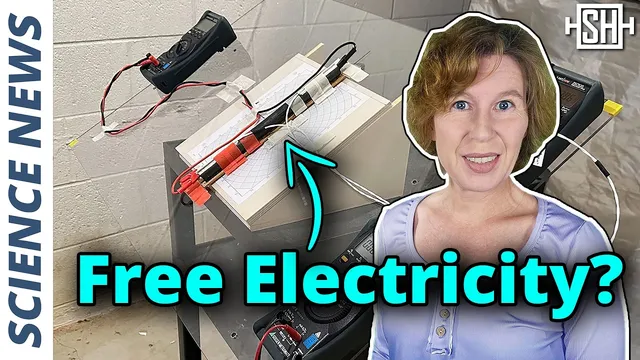
The new work aims to settle the dispute with a more controlled experiment. The setup uses a hollow cylinder—more like a pipe—about 30 cm long and roughly 1 cm in diameter. The apparatus is heavily shielded to suppress ambient noise and contamination from other magnetic fields, and the researchers explicitly rule out thermoelectric effects. They then report a steady voltage and current in the direction and magnitude predicted by their model.
To check that the signal isn’t a fluke, they perform “sanity checks”: repeating measurements in a different location and rotating the device to verify that the current direction flips as expected. The reported magnitude is tiny, but the directionality and reproducibility are presented as the key evidence.
Scaling is the next question. The authors suggest larger devices could increase power, but Earth’s magnetic field is weak, so there’s a practical ceiling; the effect likely won’t reach levels useful for mainstream power generation. Still, even nanowatt-scale power could matter for ultra-low-energy sensors or transmitters—devices that operate once per hour or day—especially if embedded in building materials. The broader significance is conceptual: a mechanism long dismissed by classical electromagnetic reasoning appears to work when geometry and experimental conditions align, reopening how researchers think about Earth-field electrodynamics.
The transcript also includes a separate promotional segment for UPDF, a PDF editor marketed as cheaper than Adobe and offering editing, conversion, and AI features, with a discount link and a pro-version offer.
Cornell Notes
Earth’s magnetic field has been shown—under specific geometry—to produce a measurable electrical signal, contradicting long-standing expectations from Faraday’s analysis. The reported experiment uses a hollow cylindrical conductor (a pipe-like geometry) rather than a solid cylinder, targeting a loophole claimed to exist in Faraday’s assumptions. Measurements report about 17 microvolts and 25 nanoamperes, corresponding to roughly 4×10^-3 W, with careful shielding and controls to eliminate thermoelectric and ambient magnetic noise. Directional behavior changes when the apparatus orientation is flipped, supporting the predicted mechanism. The power is far too small for general use, but it could be relevant for ultra-low-power sensors and transmitters if independently reproduced and potentially scaled.
Why does Earth’s rotation not automatically generate electricity from Earth’s magnetic field?
What was Faraday’s conclusion, and what loophole was proposed in 2016?
Why did later attempts produce conflicting results?
What experimental design details were used to make the new measurement credible?
How did the researchers test whether the signal behaves like the predicted mechanism?
What does the reported power imply for practical applications and scaling?
Review Questions
- What specific role does conductor geometry (solid vs hollow cylinder) play in the claimed loophole to Faraday’s no-current argument?
- How do shielding, thermoelectric controls, and orientation flips help distinguish a real Earth-field-driven effect from noise or artifacts?
- Given the reported voltage and current, what order of magnitude power output results, and why does that limit practical power generation?
Key Points
- 1
Earth’s magnetic field can drive a measurable electrical signal only under specific conductor geometry, with a hollow cylinder reported to produce net current where a solid cylinder would not.
- 2
Classic reasoning based on the primary dipole component predicts cancellation via an internal electric field, preventing a usable circuit in many configurations.
- 3
A 2016 proposal argued Faraday’s “no current” result depends on assumptions valid for solid cylinders but not for hollow cylinders, creating a geometry-based loophole.
- 4
Conflicting results in 2017 were met with critiques about cylinder length, orientation, and measurement rigor, motivating a more careful replication.
- 5
The reported experiment uses a ~30 cm long, ~1 cm diameter hollow cylinder with strong magnetic shielding and explicit checks against thermoelectric effects and ambient magnetic contamination.
- 6
The measured signal—about 17 microvolts and 25 nanoamperes—corresponds to power around 4×10^-3 W, suitable only for proof-of-principle and potential ultra-low-power sensing.
- 7
Independent reproduction is presented as the decisive next step before any realistic scaling toward useful power becomes plausible.