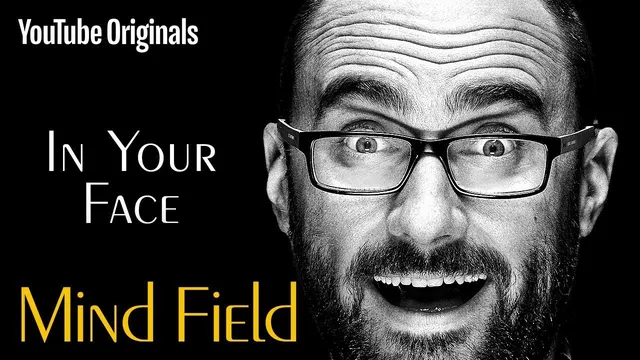
In Your Face - Mind Field (Ep 7)
Based on Vsauce's video on YouTube. If you like this content, support the original creators by watching, liking and subscribing to their content.
Forcing smile-like or frown-like facial muscle positions can change how pleasant or unpleasant people report emotionally loaded tasks to be.
Briefing
Faces matter because they act like a built-in feedback system for emotion—sometimes even when people try to suppress that feedback. The episode links three ideas: facial expressions are uniquely readable across humans, forcing certain expressions can shift how pleasant a task feels, and blocking facial movement can make it harder to recognize emotions in others.
The first half centers on a simple but telling mismatch: people can’t easily “feel” the same way when their face is held in a different configuration. After recruiting 20 volunteers under the cover of an allergy study, half are unknowingly forced into a smile and the other half into frown-like muscle positions. Both groups then complete the same two tasks designed to be emotionally loaded.
In the puppy herding task, the “smilers” treat the activity as fun—laughing, goofing around, and later rating the photo task highly (an average score of 8.5 out of 10 from the smiling group). The “frowners,” despite doing the same ordering-and-photographing activity, report more frustration and rate it much lower (average 7.4). The contrast becomes sharper in the disgust-heavy assignment: handling and inspecting dog feces. Smilers still rate the task as unpleasant (average 4.3), but frowners rate it far worse (average 1.9). In other words, facial muscle control appears to nudge subjective experience: smile-like muscle engagement makes tasks feel more tolerable, while frown-like engagement amplifies negative affect.
That theme shifts from self-feeling to social perception. The episode then argues that facial mirroring—subconsciously imitating others’ expressions—helps people understand what others feel. To test that, 12 volunteers take a facial-expression recognition quiz based on eye-region images showing positive or negative emotions. Before any intervention, participants identify positive emotions 77% of the time and negative emotions 78.8% of the time.
Next comes the key manipulation: participants receive Botox injections to reduce their ability to produce certain facial movements, especially frowning. After two weeks, their recognition performance drops. Positive-emotion accuracy falls to 73.8%, while negative-emotion accuracy drops more sharply to 68.8%. The episode frames this as evidence that losing the ability to mirror facial expressions—particularly those tied to negative emotions—can impair emotion reading.
The final segment widens the lens beyond visible facial geometry. Mark Changizi discusses how emotion correlates with subtle changes in blood flow under the skin, shifting perceived color (bluer/yellower with less oxygenation, redder/greener with more). He links this to technology: paramedic-style eyewear that enhances vein and oxygenation signals, potentially making emotion-related color modulations easier to detect. The takeaway is that faces remain central to communication, but emotion signals may live not only in shape and movement—also in physiology and even in what enhanced perception can reveal.
Cornell Notes
The episode argues that facial expressions do more than communicate—they feed back into emotion and shape how people read others. Forcing participants into smile or frown muscle positions changes how they rate emotionally charged tasks, including a puppy photo activity and a dog feces inspection. Separately, blocking facial movement with Botox reduces accuracy on a facial-expression recognition test, especially for negative emotions. The episode also points to a broader mechanism: emotions may correlate with physiological changes like blood oxygenation, which can be made more visible through specialized eyewear. Together, the results suggest facial feedback and mirroring are tightly linked to both feeling and understanding emotions.
Why does the episode emphasize that faces are uniquely important for emotion?
How did forcing smiles vs. frowns change participants’ experiences?
What is the “facial mirroring” idea, and how was it tested?
What did Botox change in emotion recognition accuracy?
How does Mark Changizi connect emotion to blood flow and color?
Review Questions
- If someone’s facial muscles are prevented from forming a frown, which part of emotion recognition accuracy is most likely to suffer according to the episode’s results, and why?
- What were the two main tasks used to compare smiling vs. frowning, and how did the average ratings differ between the groups?
- How does the episode’s blood-flow/color explanation broaden the idea of what counts as an emotion signal beyond facial shape and movement?
Key Points
- 1
Forcing smile-like or frown-like facial muscle positions can change how pleasant or unpleasant people report emotionally loaded tasks to be.
- 2
In the puppy photo task, participants held in a smile rated the experience much higher (average 8.5/10) than participants held in a frown (average 7.4).
- 3
In the dog feces inspection task, participants held in a smile rated it as less bad (average 4.3/10) than participants held in a frown (average 1.9).
- 4
Blocking facial movement with Botox reduced emotion recognition accuracy, with a bigger drop for negative emotions (from 78.8% to 68.8%).
- 5
Facial mirroring is presented as a mechanism linking self-expression to understanding others’ emotions.
- 6
Emotion cues may also be physiological—blood oxygenation and flow can shift visible skin color, potentially detectable with specialized eyewear.