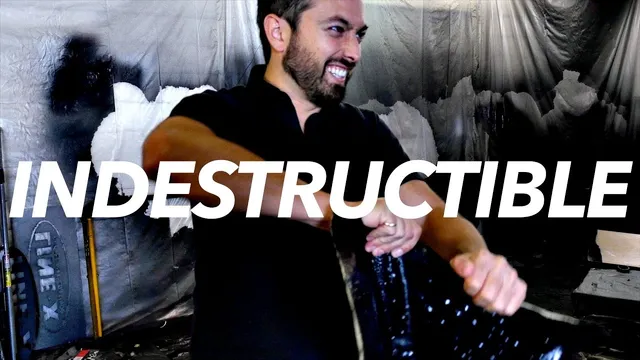
Indestructible Coating?!
Based on Veritasium's video on YouTube. If you like this content, support the original creators by watching, liking and subscribing to their content.
Line-X is a two-part polyurea coating made from reactive component A (dominated by Diphenylmethane-4,4'-diisocyanate, MDI) and component B (a long-chain polyether amine).
Briefing
A Line-X polyurea coating can keep a watermelon intact after a high-speed drop—bouncing instead of shattering at impact speeds above 100 km/h—because the material forms a tough, tangled molecular network that resists deformation. In a 45-meter drop tower test, a control watermelon predictably smashes after free fall for three seconds. The coated watermelon behaves very differently: it bounces, stays largely intact, and even resists cracking attempts with an axe, leaving behind a slushy interior rather than a fully destroyed rind.
The key to that “indestructible” behavior is how Line-X is made and how it cures. Line-X comes from two reactive components, commonly labeled A and B. Component A is dominated by Diphenylmethane-4,4'-diisocyanate (MDI), a highly reactive molecule with end groups that readily join with other species. Component B is a long-chain polyether amine (described in the transcript with a very long chemical name), which acts like a plasticizer and provides the backbone that will become part of the final polymer network.
When A and B are mixed in a simple stir-stick experiment, the reaction happens quickly—within seconds—and releases a lot of heat (it’s exothermic). The transcript describes the molecules seeking each other and linking into long chains, with urea groups forming at the junctions. The resulting polyurea structure is both hard and flexible: the “molecular threads” are tangled enough to resist tearing, yet they can stretch and then snap back when stressed.
That molecular behavior matters because effective coating production requires more than just mixing—it requires forcing the components together so they react fast and uniformly. Line-X is therefore applied using high pressure and high temperature, pushing A and B into a small mixing space so they combine almost immediately as they exit the spray gun. After application, curing and cross-linking continue as the heat dissipates and additional molecular connections form over time.
The transcript links the coating’s high tensile strength to the watermelon’s bounce. On impact, the watermelon’s contents are squeezed sideways, but the polyurea network pulls together under stress and limits how much the rind can deform and break apart. Instead of the rind failing catastrophically, the coated surface helps the fruit rebound.
Line-X’s performance isn’t just a stunt. The coating is used in high-stakes protection roles, including blast-mitigation applications in the Pentagon’s walls to reduce the chance that exterior explosions launch shrapnel inward. It’s also used in bullet-resistant vests to help contain fragments that could otherwise cause serious injury. The arc from truck bed liner to defense-grade material comes down to one practical chemistry lesson: rapid, exothermic formation of a cross-linked polyurea network under the right mixing conditions produces a tough, resilient shell that survives extreme impacts.
Cornell Notes
Line-X is a two-part polyurea coating made from reactive component A (dominated by Diphenylmethane-4,4'-diisocyanate, MDI) and component B (a long-chain polyether amine). When A and B react, they form polyurea chains with urea linkages, creating a tangled molecular network that is hard yet flexible. In a drop test, a Line-X–coated watermelon bounces and resists cracking even after free-fall impact speeds over 100 km/h, unlike an uncoated control that shatters. The coating’s high tensile strength helps limit rind deformation during impact, pulling the network together as the fruit is squeezed sideways. Line-X’s same properties underpin real-world uses such as blast protection and fragment containment in bullet-resistant vests.
Why does the coated watermelon bounce instead of shattering at over 100 km/h impact?
What are the two Line-X ingredients, and what roles do they play?
What happens at the molecular level when A and B are mixed?
Why does Line-X application rely on high pressure and high temperature rather than slow mixing?
How does the curing process relate to the heat observed during mixing?
Where else is Line-X used, and what problem does it address?
Review Questions
- How do the molecular structure and cross-linking of polyurea explain both hardness and flexibility in the Line-X coating?
- What differences between simple mixing and high-pressure spray mixing affect how quickly and uniformly A and B react?
- In the watermelon impact scenario, what mechanical effect during collision (deformation vs. tensile resistance) determines whether the rind fails?
Key Points
- 1
Line-X is a two-part polyurea coating made from reactive component A (dominated by Diphenylmethane-4,4'-diisocyanate, MDI) and component B (a long-chain polyether amine).
- 2
A and B react quickly and exothermically, forming polyurea chains with urea linkages that create a cross-linked molecular network.
- 3
High-pressure, high-temperature spray mixing forces A and B together in a small space so they react almost immediately as the material exits the gun.
- 4
The coating’s high tensile strength helps limit deformation during impact, allowing a coated watermelon to bounce instead of shattering.
- 5
During curing, heat release and ongoing cross-linking increase toughness over time, making the material harder to tear as it cools.
- 6
Line-X’s strength translates to real protection uses, including blast mitigation and fragment containment in bullet-resistant vests.