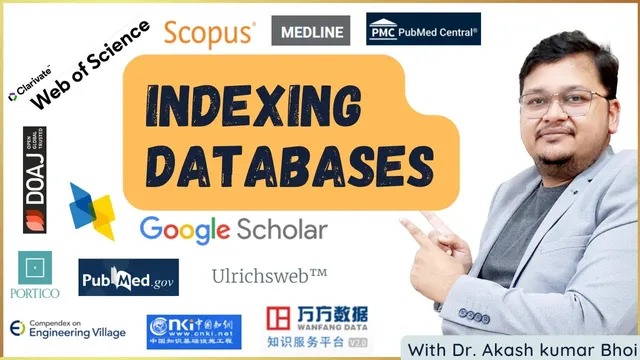
Indexing Databases | Research and Publication Ethics | eSupport for Research | 2022 | Dr. Akash Bhoi
Based on eSupport for Research's video on YouTube. If you like this content, support the original creators by watching, liking and subscribing to their content.
Indexing databases create searchable indices of scholarly records, including citations and metadata, which speeds up literature discovery and supports research planning.
Briefing
Indexing databases turn scattered research records—articles, references, metadata, and sometimes full text—into searchable systems that help researchers quickly locate relevant literature and identify gaps for new work. The core idea is straightforward: once records are indexed, finding documents in a specific field becomes faster and more reliable, whether the goal is building a literature review, checking citations, or selecting where to submit.
A major set of tools comes from citation-indexing platforms built around journal quality and disciplinary coverage. Web of Science, part of Clarivate Analytics, is an online subscription citation index service spanning cross-discipline research. It includes about 1.9 billion cited references across roughly 171 million records, organized through collections such as SCI (Science Citation Index Expanded), SSCI (Social Sciences Citation Index), and ASCI (Arts & Humanities Citation Index). It also extends beyond journals into Book Citation Index (BKCI) and Conference Proceedings Citation Index (CPCI). The platform’s journal inclusion is tied to a journal’s aim and scope and the quality standards it maintains, which is why many researchers use Web of Science-linked journals when planning publications.
Scopus is positioned as a broad abstract and citation database curated by independent subject-matter experts. It aggregates about 1.8+ billion cited references and includes around 84+ million records, plus large-scale author and affiliation coverage (17.6 million author profiles and 94.8k affiliated profiles). Scopus also lists thousands of publishers and provides subject-area breakdowns—social sciences, physical sciences (including computer science, engineering, environmental science, and material sciences), health sciences, life sciences, and agriculture/biological sciences—so researchers can narrow searches by domain and track scholarly impact through citations.
For biomedical research, Medline (hosted through the U.S. National Library of Medicine) is described as a premier bibliographic database with more than 29 million references focused on biomedicine and life sciences. PubMed Central (PMC) is highlighted as a full-text archive for biomedical and life sciences literature, with about 8.3 million articles stored for open access searching. PubMed.gov is also referenced as a way to search biomedical citations drawn from Medline and life sciences journals and online books, supporting early-stage literature review and gap identification.
Open-access discovery and engineering-focused indexing appear as additional pathways. The Directory of Open Access Journals (DOAJ) is presented as a directory of open-access journals covering 80 languages and 130 countries, listing 12,630 journals without APCs and enabling searches by journal or article. For engineering, Ei Compendex (Engineering Village) is described as a quality-selective database with about 20 million records from 77 countries across 190 engineering disciplines, typically requiring subscription access.
The transcript also lists region-specific and general scholarly search options. China’s CNKI (China National Knowledge Infrastructure) is described as a large integrated knowledge resource covering journal articles, theses, proceedings, monographs, and books, with extensive article and dissertation/conference coverage. A computer-science bibliographic database (DBLP) is mentioned as a specialized index for computer science journals and proceedings. For broader discovery, Google Scholar is framed as a free web search engine indexing scholarly literature across formats and disciplines, with an estimated 160 million documents, though full-text access may vary and sometimes requires subscriptions.
Overall, the message is that choosing the right indexing database—by discipline, access type, and search needs—determines how efficiently researchers can find credible sources, verify citations, and move from background reading to clearly defined research objectives.
Cornell Notes
Indexing databases organize scholarly records—citations, metadata, and sometimes full text—so researchers can quickly locate relevant literature and identify research gaps. Web of Science and Scopus provide large-scale citation and abstract coverage across disciplines, with journal inclusion tied to quality and scope. For biomedical work, Medline and PubMed Central (PMC) support bibliographic searching and full-text access, while PubMed.gov helps with citation discovery for early literature reviews. Open-access discovery tools like DOAJ help find free journals, and specialized indexes such as Ei Compendex target engineering literature. Broader search engines like Google Scholar aggregate scholarly materials but may offer partial access depending on the source.
Why does indexing matter for research and publication ethics?
How do Web of Science and Scopus differ in what they provide?
What tools are most relevant for biomedical literature searching?
How can researchers find open-access journals and articles more efficiently?
What role do specialized databases play outside general citation indexes?
What are the tradeoffs of using Google Scholar for discovery?
Review Questions
- Which indexing collections within Web of Science extend beyond journal articles, and what kinds of records do they include?
- Compare how Medline, PubMed Central (PMC), and PubMed.gov support different stages of biomedical literature searching.
- What kinds of search narrowing (discipline, subject area, or access type) are supported by Scopus, DOAJ, and Ei Compendex?
Key Points
- 1
Indexing databases create searchable indices of scholarly records, including citations and metadata, which speeds up literature discovery and supports research planning.
- 2
Web of Science (Clarivate Analytics) organizes coverage through collections like SCI, SSCI, ASCI, plus BKCI for books and CPCI for conference proceedings.
- 3
Scopus provides broad abstract and citation coverage with extensive author and affiliation data, and it supports subject-area filtering across multiple disciplines.
- 4
Medline and PubMed Central (PMC) are central for biomedical searching, with PMC offering full-text archives for life sciences literature.
- 5
DOAJ helps researchers locate open-access journals and articles, including journals without APCs, using searches by journal or article.
- 6
Ei Compendex (Engineering Village) targets engineering literature with quality-selective indexing across many engineering disciplines, usually requiring subscription access.
- 7
Google Scholar offers free discovery across disciplines, but full-text access may be partial and sometimes requires subscriptions.