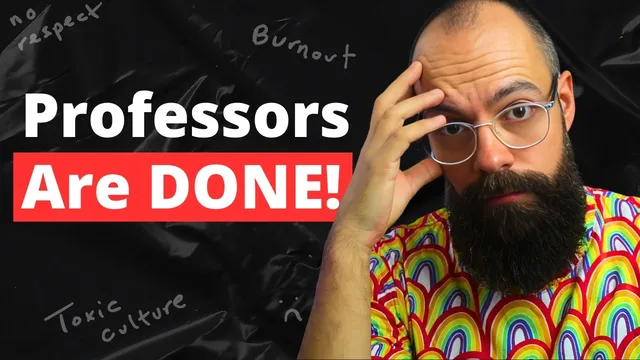
Inside Academia’s Collapse: What 4,000 Staff Just Admitted (It’s Worse Than You Think)
Based on Andy Stapleton's video on YouTube. If you like this content, support the original creators by watching, liking and subscribing to their content.
A survey of 4,000+ U.S. higher-education employees links academia’s crisis to toxic culture, rising workload, and weak recognition from leadership.
Briefing
A survey of more than 4,000 professors and higher-education staff in the United States paints a bleak picture: academic work has become increasingly toxic, heavier, and less supported—while recognition and leadership development lag far behind what employees say they need. The central finding is that many employees describe workplaces shaped by fear, mistrust, and burnout, not by the collaborative culture universities often claim to value. That matters because the same pressures that drive people to leave or burn out also erode the time and energy needed for teaching and research.
Respondents describe “toxic work environments” as a pattern of negative behaviors, weak leadership, and cultures that foster fear and exhaustion. The transcript links this toxicity to a structural feature of academia: funding and opportunities are treated like a zero-sum contest, so teams and departments compete for limited resources rather than cooperating. In that environment, employees report that research groups can become protective “castles,” prioritizing labs, money, students, and influence—sometimes at the expense of collegiality. A notable theme is that early-career researchers rarely speak up. The transcript attributes this silence to job insecurity: people on short-term contracts fear retaliation from those with tenure and power.
Workload and burnout show up as the second major pillar. Two-thirds of respondents say they work significantly or somewhat more than they did five years ago. Many describe exhaustion and a dim view of higher education’s future, with some willing to speak only anonymously. The transcript also points to a staffing and leadership problem: when colleagues retire, quit, or go on leave, departments often redistribute duties instead of hiring replacements. That approach increases the burden on remaining staff and stretches mental bandwidth. Leadership turnover compounds the strain, as new administrators and “high flyer” hires bring fresh initiatives—more meetings, more reporting, more forms—without reducing the underlying pressure.
Recognition and appreciation emerge as the third pressure point. Employees say token gestures—small celebrations, generic praise, or “well done” emails—don’t match what they want. A quarter of staff and 36% of faculty agree or strongly agree that their jobs are not respected by senior administrators. Many respondents frame money as the only meaningful form of appreciation, arguing that financial security enables intrinsic motivation and focus. Others cite practical supports such as professional development, free parking, and time and resources to pursue creative projects or develop new courses.
Underlying these complaints is a broader critique: the corporatization of higher education. As universities adopt business-style priorities—growth, key performance indicators, grant volume, and publication output—administrative demands expand and the academic mission gets crowded out. The transcript argues that administration has ballooned beyond its intended role, turning what should be a smaller slice of academic time into a full-time burden. The result is “paper cuts” of make-work that accumulate until teaching and research receive an ever smaller share of working hours. The transcript’s conclusion is blunt: academia is “beyond broken” because the system keeps adding tasks and incentives that protect administrative visibility while draining the time needed for the core work of universities.
Cornell Notes
A survey of 4,000+ U.S. higher-education employees links academia’s decline to three reinforcing problems: toxic workplace culture, rising workload and burnout, and inadequate recognition—especially from senior administrators. Many respondents describe fear-based environments with poor leadership, where speaking up is risky for early-career staff on short contracts. Work has increased sharply over the past five years, and vacancies are often covered by distributing duties rather than hiring replacements, while leadership turnover adds new reporting and initiatives. Employees say appreciation often amounts to performative gestures, and many view money and basic needs as the only reliable motivators. The transcript ties these issues to the corporatization of universities, where administrative growth and KPI-driven priorities crowd out teaching and research.
What does “toxic work environment” mean in the survey findings, and why does the transcript connect it to academia’s structure?
Why do early-career researchers appear less visible in the quotes about toxicity?
What workload trends and staffing practices drive burnout, according to the transcript?
How do employees say they want to be recognized, and what do they reject?
What does the transcript identify as the mechanism behind the administrative overload?
What is meant by “paper cuts” in the context of academic work?
Review Questions
- Which survey percentages are cited for increased workload and for perceptions of respect from senior administrators, and what do those numbers imply about morale?
- How does the transcript connect job insecurity for early-career staff to the pattern of who speaks up about toxicity?
- What specific administrative practices does the transcript describe as crowding out teaching and research, and how does it argue those practices spread?
Key Points
- 1
A survey of 4,000+ U.S. higher-education employees links academia’s crisis to toxic culture, rising workload, and weak recognition from leadership.
- 2
Many respondents describe toxicity as fear- and mistrust-driven behavior patterns tied to poor leadership and burnout, not just interpersonal conflict.
- 3
Work has increased sharply over the past five years, and burnout is intensified when departments redistribute duties instead of hiring replacements.
- 4
Leadership turnover can add new initiatives and reporting burdens, increasing workload without reducing underlying pressures.
- 5
Employees often view money as the most meaningful form of appreciation, while token gestures and generic praise fail to address core needs.
- 6
The transcript argues corporatization and KPI-driven priorities expand administration and crowd out teaching and research.
- 7
Accumulated administrative “paper cuts” can consume entire days, leaving less time for the core academic mission.