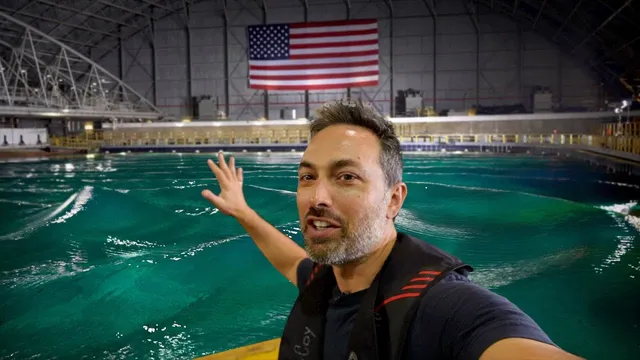
Inside The Navy's Indoor Ocean
Based on Veritasium's video on YouTube. If you like this content, support the original creators by watching, liking and subscribing to their content.
Carderock’s Indoor Ocean uses 216 programmable wave makers to generate repeatable waves with controlled amplitude, frequency, and direction.
Briefing
The U.S. Navy’s Carderock Indoor Ocean is built to reproduce ocean wave conditions with lab-grade precision—so ship designs can be tested and improved before ever meeting real seas. At 360 feet by 240 feet and 20 feet deep, the facility uses 216 computer-programmed wave paddles to generate repeatable waves with controlled amplitude, frequency, and direction, turning an environment that’s normally chaotic into one engineers can dial in and measure.
What makes the basin stand out isn’t just scale; it’s controllability. The wave makers can produce waves across a wide angular range (from -45 degrees to 135 degrees) and generate specific wave characteristics repeatedly, down to settings like a one-hertz test. Sensors then verify what’s actually happening in the water—ultrasonic arrays measure wave height, period, and direction to ensure the experiment matches the intended conditions. That repeatability matters because ship performance depends on wave dynamics, not just “roughness” in a general sense.
The facility also serves as a physics laboratory for wave behavior. Regular waves with the same amplitude but different frequencies look different because higher-frequency waves have steeper slopes, and frequency changes wave speed: when water is deeper than the wave base, wave speed varies inversely with frequency. A striking demonstration sends high-frequency waves first, then progressively lower-frequency waves; because the faster low-frequency components catch up, the engineers time the meeting point so the combined crest breaks at the same place and moment—an engineered example of superposition, where wave heights add when waves overlap.
Engineers go further by creating standing-wave patterns using waves traveling toward each other. In some locations the waves cancel to near zero amplitude, while other points amplify into maximum amplitude nodes and antinodes. The basin can also focus energy into a single “bullseye” point by sending waves from multiple directions so circular wave fronts coalesce. Even with minimal net water movement, floating objects can be funneled into the breaking region, illustrating how localized wave energy can become hazardous.
Beyond demonstrations, the Indoor Ocean’s mission is to replicate the wave environments Navy ships will face. Researchers test scaled ship models—often billion-dollar vessels in miniature—while matching key fluid-dynamics scaling rules. Instead of keeping Reynolds number identical, the facility uses Froude number scaling, based on the ratio of inertial to gravitational forces. With a hull 46 times smaller, the model must travel about 1/√46 of the real-world speed (roughly 6.8 times slower) to preserve the wave-related physics. The basin also uses fresh water and adjusts buoyancy so the model behaves like it would in salty ocean conditions.
Wave conditions themselves vary by geography and storm history, producing different spectra—mixtures of frequencies—across regions like the North Sea, mid-Atlantic, and North Atlantic. Engineers therefore select spectra that match where a ship will operate, then run tests that measure deck wetness and other performance risks, including scenarios involving helicopter landing pads. The result is a controlled, measurable bridge between theory and real-world sea keeping—one that supports every Navy ship and submarine in the fleet.
Cornell Notes
Carderock’s Indoor Ocean is a 360-by-240-foot, 20-foot-deep wave basin designed to generate repeatable ocean-like conditions for ship testing. It uses 216 programmable wave makers to control wave amplitude, frequency, and direction, while ultrasonic sensor arrays verify wave height, period, and direction. The facility also demonstrates core wave physics—superposition, standing waves, and energy focusing into a “bullseye”—showing how overlapping waves can create much larger breaking events than any single component. For engineering accuracy, experiments use Froude number scaling rather than Reynolds number, and model buoyancy is adjusted for fresh-versus-salt water differences. The payoff is realistic, repeatable sea-keeping data before ships ever face open ocean conditions.
What feature makes the Indoor Ocean more useful than a typical wave pool?
How do frequency and amplitude interact in the basin’s “regular wave” demonstrations?
Why does the basin’s timed “catch-up” demo produce a breaking wave at a specific location?
What’s the difference between traveling waves and standing waves in this facility?
Why does ship testing use Froude number scaling instead of Reynolds number scaling?
How do engineers account for different ocean conditions around the world?
Review Questions
- How does wave speed change with frequency when the water depth is greater than the wave base, and how does that affect engineered wave timing?
- Explain how superposition leads to larger breaking waves in the basin’s catch-up demonstration.
- Why does Froude number scaling require the model ship to move about 6.8 times slower when the hull is 46 times smaller?
Key Points
- 1
Carderock’s Indoor Ocean uses 216 programmable wave makers to generate repeatable waves with controlled amplitude, frequency, and direction.
- 2
Ultrasonic sensor arrays measure wave height, period, and direction to verify that the basin matches the intended wave conditions.
- 3
Wave speed depends on frequency when depth exceeds the wave base, enabling timed “catch-up” experiments that force breaking at a chosen location.
- 4
Superposition is central: overlapping waves add their heights, allowing engineered combinations to produce much larger breaking events than individual components.
- 5
Standing waves emerge when two regular waves travel toward each other, creating cancellation nodes and maximum-amplitude antinodes.
- 6
Ship model testing relies on Froude number scaling (not Reynolds number similarity) to preserve wave-related physics, including speed adjustments based on model size.
- 7
Wave spectra vary by geography and storm history, so engineers select spectra that match expected operating regions before running sea-keeping tests.