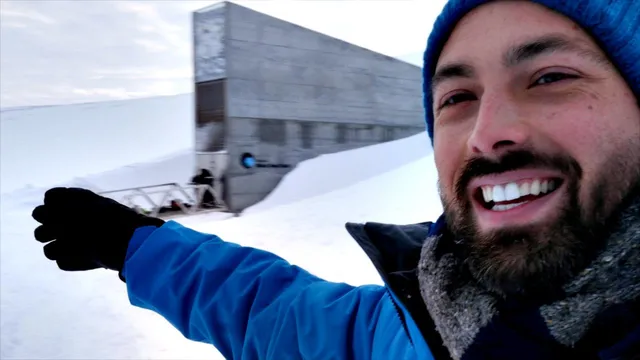
Inside the Svalbard Seed Vault
Based on Veritasium's video on YouTube. If you like this content, support the original creators by watching, liking and subscribing to their content.
The Svalbard Global Seed Vault is designed as a centuries-long backup for crop genetic diversity, not as a short-term storage facility.
Briefing
The Svalbard Global Seed Vault is built to preserve the world’s crop diversity as a last-resort backup—designed to keep seeds viable for centuries even if power systems fail. Buried more than 120 meters into a mountain on Norway’s Arctic island of Svalbard, the vault relies on surrounding permafrost that stays around -4 to -5°C year-round. If cooling stops, the facility is still expected to hold roughly the same temperatures indefinitely, assuming global warming doesn’t overwhelm the permafrost.
Inside, the layout resembles a bank vault system: seeds arrive in sealed boxes, and no one at the facility can open them. Depositors can retrieve their own samples, while vault staff cannot access individual contents. The boxes also pass security screening similar to airport checks to ensure they don’t contain explosives or other prohibited materials. Norway has set additional restrictions, including a ban on genetically modified material and drugs; the vault is intended to safeguard conventional crop genetic diversity rather than introduce new or controversial genetic lines.
The vault’s cold storage is maintained at about -18°C for the active storage room, where nearly a million seed varieties are already stored. The temperature is so low that visitors can physically sense the cold moisture in the air, and the boxes are labeled with numbers tied to an online database. That database allows the public to look up what specific countries have deposited, turning the vault into something like a “publicly available” bank ledger—while the physical boxes remain inaccessible to anyone except the depositor.
Vault 2 holds the currently used collection, with two other vault rooms built for future capacity. The facility is engineered to withstand extreme events: it was designed to last around 200 years and to endure earthquakes and explosions. It is also positioned above sea level even in a worst-case scenario where all ice melts, because it sits on the side of a mountain rather than at sea level.
The vault is sometimes called the “Doomsday Vault” because it aims to protect food security under catastrophic disruption. The logic is straightforward: climate change and other shocks can make today’s crops less viable decades from now, so future farmers may need seeds adapted to warmer, drier, or wetter conditions. The vault’s long-term value depends on having genetic options ready when conventional seed supplies fail.
That redundancy has already been tested by real-world conflict. After the gene bank in Aleppo, Syria, was bombed, a portion of its stored material was moved to other locations, including Morocco and Lebanon, and some returned material was used to restart operations. The transcript frames this as evidence that the vault can function as insurance when local storage systems are destroyed.
While the risk of a full “doomsday” scenario is described as remote, the vault’s purpose is to keep options open. With thousands of other gene banks worldwide, Svalbard is presented as a high-stakes backstop—an Arctic archive meant to preserve agricultural diversity for the next generations, whatever disruptions come first.
Cornell Notes
The Svalbard Global Seed Vault is a long-term backup for the world’s crop genetic diversity, designed to keep seeds viable for centuries. Seeds are sealed in tamper-proof boxes and can’t be opened by vault staff; only the depositor can retrieve their own samples. The active storage room is kept at about -18°C, while the vault’s deeper placement in permafrost provides a fail-safe: even if cooling stops, temperatures are expected to remain around -4 to -5°C. Nearly a million seed varieties are already stored, with capacity planned to reach millions more. The vault’s relevance has been demonstrated by withdrawals and transfers after the Aleppo gene bank was damaged in Syria’s conflict.
How does the vault keep seeds cold even during power failures?
What makes the vault’s “bank vault” model different from a typical seed bank?
What rules govern what can be deposited?
How can outsiders learn what’s stored without opening boxes?
Why is the vault considered important in the context of climate change?
What real event shows the vault’s value beyond theory?
Review Questions
- What temperature regimes does the vault rely on, and how do permafrost and active cooling work together?
- Why does the vault restrict access to sealed seed boxes, and how does the online database still provide public information?
- How do conflict-driven withdrawals (like Aleppo) illustrate the vault’s role in global food security planning?
Key Points
- 1
The Svalbard Global Seed Vault is designed as a centuries-long backup for crop genetic diversity, not as a short-term storage facility.
- 2
Permafrost around the deeply buried vault is expected to maintain about -4 to -5°C even if active cooling fails.
- 3
The active storage room is kept around -18°C, where nearly a million seed varieties are already stored.
- 4
Seed boxes are sealed and cannot be opened by vault staff; only the depositor can retrieve their own samples.
- 5
Deposits face screening, and Norway’s rules exclude drugs and genetically modified material.
- 6
The vault’s capacity is planned to expand across multiple vault rooms, with millions of plant varieties envisioned over time.
- 7
Real-world withdrawals after the Aleppo gene bank was bombed show the vault’s “insurance” value during emergencies.