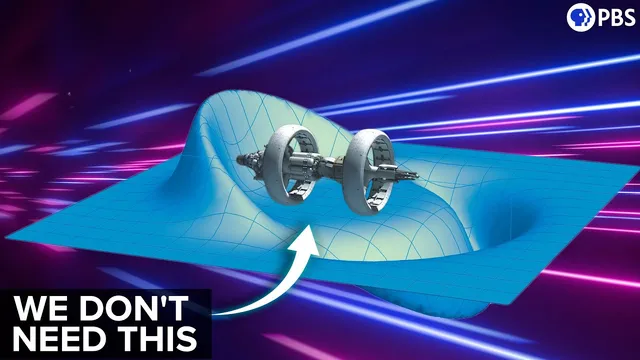
Interstellar Expansion WITHOUT Faster Than Light Travel
Based on PBS Space Time's video on YouTube. If you like this content, support the original creators by watching, liking and subscribing to their content.
Faster-than-light travel is treated as essentially impossible under special relativity, so Proxima Centauri B requires either relativistic near-light speeds or multi-generation planning.
Briefing
Interstellar travel without faster-than-light propulsion may still be possible—if humanity is willing to bet on generation ships, extreme life-support recycling, and carefully engineered social systems. The core constraint is speed: Einstein’s special relativity makes faster-than-light travel essentially off the table, so reaching Proxima Centauri B (4.2 light-years away) likely requires either relativistic near-light travel or multi-century, multi-generation voyages.
One path assumes fusion-based propulsion can be scaled into a spacecraft that reaches about 3% of light speed. At that pace, a crew could reach Proxima-B in roughly 140 years—about four or five generations. Another, slower boundary case assumes propulsion resembles scaled-up chemical or electric assist concepts, yielding travel times on the order of 6,300 years (around 200 generations). With cryogenics and other “single-generation” survival strategies unlikely to be perfectly reliable on such timelines, the mission design shifts from “send a crew” to “build a self-sustaining society that can last.”
That design starts with propulsion because speed dictates ship size, generation count, and risk. The transcript contrasts the fastest human spacecraft conceptually—highlighting the Parker Solar Probe’s hydrazine-based acceleration and gravitational assists—with fusion pulse concepts that use thermonuclear explosions rather than steady reactors. Even optimistic estimates for fusion-driven designs land far below light speed, so the planning focuses on two travel-time extremes: 140 years if fusion works, or 6,300 years if it doesn’t.
Population genetics then becomes a make-or-break requirement. Using Monte Carlo simulations from French researchers Frédéric Marin and Camille Beluffi, the minimum viable starting population for a 6,300-year journey is estimated at about 100 people, growing to roughly 500 during most of the voyage. The point isn’t just survival—it’s maintaining genetic diversity while accounting for disasters (like losing a third of the population), infertility rates, and intrinsic “chaotic” factors.
Life support drives the engineering math. Artificial gravity is treated as essential to prevent long-term health damage from microgravity; the simplest approach is a rotating habitat ring with a radius around 100 meters spinning fast enough to approximate 1-g. Food production is another bottleneck: a balanced omnivorous diet is estimated to require about 0.45 km² of growing area, far beyond what a small ship could spare, pushing the plan toward nutrition-dense hydroponic or aeroponic crops (e.g., sweet potatoes) and protein sources like mealworms. Water is even more unforgiving. An adult needs roughly 2 liters per day, so 500 people consume about a cubic meter daily; for a 6,300-year mission, the ship would need massive storage unless recycling efficiency climbs to around 99.5%. Water also doubles as radiation shielding—about a meter of depth can block most dangerous space radiation.
Keeping people alive is only half the problem. The transcript emphasizes mental health under isolation and the growing communication delay, which can approach nearly 8.5 years near the end of the journey. Proposed mitigations include VR-based “Earth immersion,” recorded messages played back in virtual environments, and even an AI therapist—referencing NASA’s Cimon 2.0—to help manage conflict and emotional strain.
Finally, the mission must outlive its founders. Passing down skills, preserving culture, and maintaining a stable social structure that supports both operational efficiency and individual freedoms are framed as the hardest, most speculative challenges. The overall takeaway is pragmatic: a generation ship to Proxima-B is not guaranteed, but it is presented as within reach if fusion progress, recycling breakthroughs, and human factors planning all move forward together.
Cornell Notes
The transcript argues that reaching Proxima Centauri B without faster-than-light travel likely requires generation ships because realistic propulsion speeds imply multi-generation voyages. Two planning extremes are used: ~140 years at ~3% of light speed with fusion-pulse concepts, or ~6,300 years if propulsion stays far slower, implying ~200 generations. Genetic diversity sets a minimum starting population—Monte Carlo work by Frédéric Marin and Camille Beluffi suggests at least ~100 people, growing to ~500 for much of the journey. Engineering constraints then cascade: rotating habitats for artificial gravity, tightly managed food and water production with very high recycling efficiency, and breathable-air systems relying heavily on plant-based CO2 recycling. Long-duration mental health support is treated as essential, with VR “Earth” immersion and an AI therapist (Cimon 2.0) proposed to reduce isolation-driven stress.
Why does the plan shift from “fast interstellar travel” to “generation ships” even if humans can build advanced propulsion?
What propulsion scenarios set the two extreme mission timelines?
How do genetics and population size determine whether a long voyage is viable?
Why is artificial gravity treated as non-negotiable, and what design is proposed?
What makes food and water the biggest engineering bottlenecks, and how are they mitigated?
How does the transcript address mental health and social stability over centuries?
Review Questions
- If faster-than-light travel is ruled out, what two speed assumptions produce the transcript’s two mission-length extremes to Proxima-B?
- How do the Marin and Beluffi simulations translate genetic diversity concerns into a minimum starting crew size?
- Which life-support systems are most sensitive to recycling efficiency, and why does water recycling also matter for radiation protection?
Key Points
- 1
Faster-than-light travel is treated as essentially impossible under special relativity, so Proxima Centauri B requires either relativistic near-light speeds or multi-generation planning.
- 2
Two mission extremes anchor the design: ~140 years at ~3% of light speed (fusion-pulse scenario) versus ~6,300 years if propulsion remains much slower.
- 3
Genetic diversity sets a minimum starting population: Monte Carlo work by Frédéric Marin and Camille Beluffi suggests at least ~100 people, growing to about ~500 for most of a 6,300-year voyage.
- 4
Long-duration health depends on artificial gravity; a rotating ring habitat with ~1-g centrifugal acceleration is proposed to prevent bone-density loss.
- 5
Food production must shift toward high-yield hydroponic/aeroponic crops and dense protein sources (like mealworms) to fit within realistic ship area.
- 6
Water recycling is the critical life-support lever; raising recycling toward ~99.5% can reduce storage needs enough to make multi-millennia travel plausible, and water also provides radiation shielding.
- 7
Mental health and continuity require more than survival systems: VR-based Earth connection, AI support (Cimon 2.0), and stable cultural/social structures are framed as essential for keeping later generations aligned with the mission.