Introducing Llama 3.1: Meta's most capable models to date
Based on Krish Naik's video on YouTube. If you like this content, support the original creators by watching, liking and subscribing to their content.
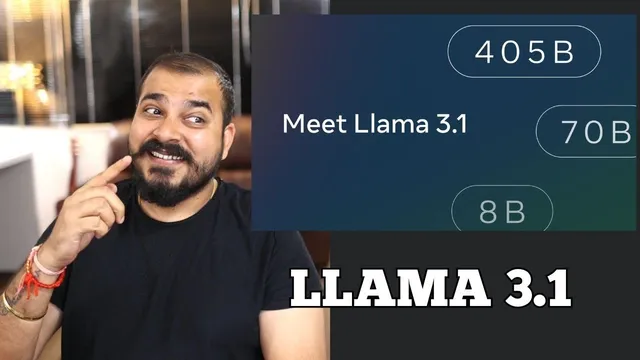
Llama 3.1 is released in three open-source parameter sizes: 405B, 70B, and 8B.
Briefing
Meta’s newly released Llama 3.1 positions open-source AI as a serious contender to top paid models, with the biggest draw being multimodal capability plus strong benchmark results across major hosted platforms. The release arrives with three parameter sizes—405B, 70B, and 8B—making it easier for developers to match model strength to cost and latency. Meta also expands the usable context window to 128K tokens, supports eight languages, and emphasizes instruction-following quality while maintaining safety.
A key practical element is that Llama 3.1 is fully open source, including model weights available for download, so teams can fine-tune, distill, and deploy it outside any single vendor ecosystem. At the same time, the transcript highlights that many users will interact with it through managed inference services. Access is described as being available through a broad set of cloud and platform partners “from day one,” including NVIDIA NIM, AWS, Google Cloud, Azure, Snowflake, and Groq. The pricing model mentioned is inference-only charges, which matters because the cost center for large language models is typically runtime rather than training.
The model’s multimodal behavior is demonstrated through Meta AI: prompts that request image generation and animation (for example, creating an animated dog image or an animated robot interacting with humans) produce outputs directly in the interface. That multimodal framing is reinforced by the claim that Llama 3.1 can work with both text and images—an increasingly important capability as applications move beyond chatbots into richer content generation.
On evaluation, Llama 3.1 is presented as outperforming or matching leading paid systems on multiple metrics, including comparisons against GPT-4, GPT-4o, Claude 3.5 Sonnet, and others. The transcript cites MMLU-style results (and additional accuracy figures) where Llama 3.1’s scores are described as higher than comparable models, including paid offerings, while also showing strong performance relative to other open-source baselines such as Google’s Gemini 2. Human evaluation is also referenced, with win/tie/loss outcomes used to gauge preference.
Under the hood, the transcript describes the architecture as transformer-based with an encoder stack (text token embeddings, self-attention, feed-forward layers) and auto-regressive decoding to generate output tokens. For tuning, it points to supervised fine-tuning and techniques including rejection sampling and Direct Preference Optimization (DPO), aimed at improving helpfulness, instruction following, and response detail while handling the expanded 128K context and larger model sizes.
Overall, Llama 3.1’s significance in the transcript is less about a single benchmark number and more about the combination: open weights, long context, multilingual support, multimodal generation, and immediate availability across major inference platforms—making it easier for developers to test, deploy, and iterate without waiting for closed-model access or custom infrastructure.
Cornell Notes
Llama 3.1 from Meta is presented as a major open-source step up in capability, offered in three sizes (405B, 70B, and 8B). It supports an expanded 128K context window, works across eight languages, and is positioned as both instruction-following and multimodal (text plus image generation/animation). The transcript emphasizes that it is fully open source with downloadable weights, enabling fine-tuning, distillation, and deployment anywhere. It also highlights broad availability through inference platforms and cloud partners (including NVIDIA NIM, AWS, Groq, Azure, Google Cloud, and Snowflake), with charges framed as inference-only. Benchmark comparisons are described as strong against both paid models (e.g., GPT-4 variants and Claude 3.5 Sonnet) and other open-source systems such as Gemini 2.
What makes Llama 3.1 stand out for developers beyond just “bigger model sizes”?
How does the transcript describe access and cost for using Llama 3.1 in production?
What tuning and alignment methods are mentioned for improving instruction following and safety?
What evaluation comparisons are cited to support Llama 3.1’s performance claims?
How is the model architecture described in the transcript?
Why does the transcript emphasize integration with cloud services like AWS and synthetic data generation?
Review Questions
- Which specific capabilities in the transcript are linked to Llama 3.1’s improved usefulness (context length, languages, multimodal behavior, instruction following)?
- How do supervised fine-tuning, rejection sampling, and Direct Preference Optimization (DPO) relate to the stated goals of helpfulness and safety?
- What differences in deployment approach does the transcript imply between downloading open weights versus using hosted inference platforms?
Key Points
- 1
Llama 3.1 is released in three open-source parameter sizes: 405B, 70B, and 8B.
- 2
The model supports a 128K token context window and eight languages, aiming to improve long-context instruction performance.
- 3
Multimodal capability is highlighted, with Meta AI demonstrations for image generation and animation from prompts.
- 4
Meta emphasizes open weights for fine-tuning, distillation, and deployment anywhere, while hosted inference options provide inference-only billing.
- 5
Major inference and cloud partners are listed as offering Llama 3.1 from day one, including NVIDIA NIM, AWS, Groq, Azure, Google Cloud, and Snowflake.
- 6
Benchmark results are presented as strong versus both paid models (GPT-4 variants, Claude 3.5 Sonnet) and open-source baselines like Gemini 2.
- 7
Alignment and instruction-following improvements are attributed to supervised fine-tuning plus rejection sampling and Direct Preference Optimization (DPO).