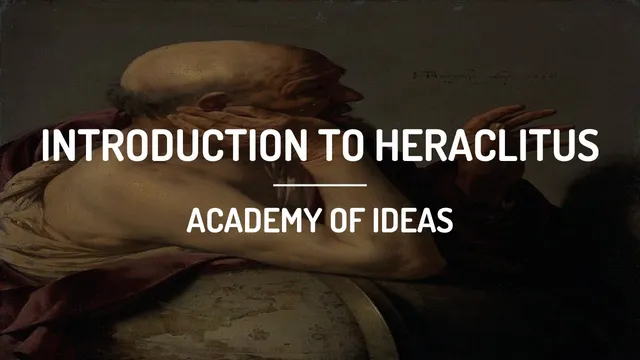
Introduction to Heraclitus
Based on Academy of Ideas's video on YouTube. If you like this content, support the original creators by watching, liking and subscribing to their content.
Heraclitus’ Logos is a universal, objective principle that permeates reality, but most people miss it because they rely on narrow personal perceptions.
Briefing
Heraclitus is remembered less for a tidy philosophy than for a set of ideas that make reality feel unstable, even unsettling: everything is in flux, order arises from conflict, and most people remain unable to see the underlying truth. Born around 540 BC in Ephesus, he reportedly declined a path to kingship and instead pursued a solitary search for wisdom. Ancient accounts portray him as an aristocratic misanthrope who distrusted “the masses,” treating their political chatter and everyday perceptions as noise rather than insight. That temperament connects directly to his central claim: reality is structured by a single, ever-present principle called the Logos—an objective truth that permeates all things.
The Logos is not hidden in some distant theory; it is everywhere, but comprehension requires personal effort. Heraclitus’ “truth” cannot be obtained through academic study or by merely listening to other philosophers. The best a knowledgeable person can do is point toward it, while the individual must “perform on one’s own” and see it directly. This emphasis on inner contemplation helps explain why his sayings were later described as paradoxical and obscure—ancient readers struggled to decode aphorisms that seemed deliberately resistant to easy interpretation.
Heraclitus’ most famous image, the river, functions as more than a description of flowing water. It symbolizes the nature of reality itself: the universe is constantly changing, so nothing remains the same from one moment to the next. Ancient commentators, including Plutarch, report the consequence in stark terms—if everything shifts instantly, knowledge of the sensible world becomes impossible. Even if someone could know something at one instant, it would already have transformed by the next, making the previous knowledge obsolete. This “flux-doctrine” can also slide toward despair: if all values and achievements decay with time, meaning seems doomed to dissolve.
To capture the world’s ceaseless transformation, Heraclitus described it as “an ever living fire.” Conservative readings treat fire as a symbol for ongoing change, but Stoics later linked fire to the Logos itself, claiming it was rational and responsible for governing the cosmos. Heraclitus also connected the human soul to fire—“a man’s soul is fire”—and contrasted the best condition (dry, hot) with the worst (wet). When death comes, the soul turns to water, reinforcing the idea that even inner life is part of the same transforming material order.
Finally, Heraclitus framed change through conflict. “War is the father of all” and “strife is justice” suggest that existence arises only through the destruction of something else. Rather than treating opposition as a defect that must be eliminated, he treated it as constitutive: each living thing and object is made from opposing forces, so harmony is always shadowed by tension. Scholars often illustrate this with examples like the bow, where internal strain enables function. This vision of reality—built from flux and driven by conflict—left a durable mark, influencing later thinkers such as Nietzsche, who applied Heraclitus’ idea of warring inner forces to human development, arguing that strength, insight, and wisdom emerge through internal battle.
Cornell Notes
Heraclitus presents reality as governed by a universal principle, the Logos, which permeates everything and provides an objective truth. Most people fail to grasp it because they live inside narrow personal perceptions; understanding requires personal effort and inner vision rather than formal study or secondhand teaching. His “flux-doctrine” claims that everything is constantly changing, so stable knowledge of the sensible world is deeply threatened. He also describes the world as “ever living fire” and links the soul to fire, with death transforming it into water. Finally, Heraclitus treats conflict as foundational—“war is the father of all” and “strife is justice”—so opposition is not an accident but the engine of existence and apparent harmony.
What is the Logos in Heraclitus’ thought, and why does it matter for how people know anything?
Why does the river image lead to a problem for knowledge?
How does “ever living fire” connect to the Logos and to the soul?
What does Heraclitus mean by “war is the father of all” and “strife is justice”?
How does the lecture connect Heraclitus to Nietzsche?
Review Questions
- How does Heraclitus’ Logos differ from a conventional “theory” that can be learned from others?
- What specific challenge to knowledge arises from the claim that everything changes from moment to moment?
- Why does Heraclitus treat conflict as productive rather than as a problem to eliminate?
Key Points
- 1
Heraclitus’ Logos is a universal, objective principle that permeates reality, but most people miss it because they rely on narrow personal perceptions.
- 2
Understanding the Logos requires personal effort and inner vision; it cannot be secured through academic study or by simply listening to others.
- 3
The river image supports a flux-doctrine: everything changes instantly, making stable knowledge of the sensible world difficult or impossible.
- 4
Heraclitus’ “ever living fire” can be read as a symbol for ceaseless change, and Stoics later linked fire directly to the Logos as the rational governing force.
- 5
Heraclitus connects the soul to fire and describes death as a transformation into water, reinforcing that inner life is part of the same changing order.
- 6
Conflict is foundational in his worldview: “war is the father of all” and “strife is justice” mean opposition generates existence and underlies apparent harmony.
- 7
Nietzsche’s psychology of self-development is presented as influenced by Heraclitus’ idea that opposing forces within a person can produce strength, insight, and wisdom.