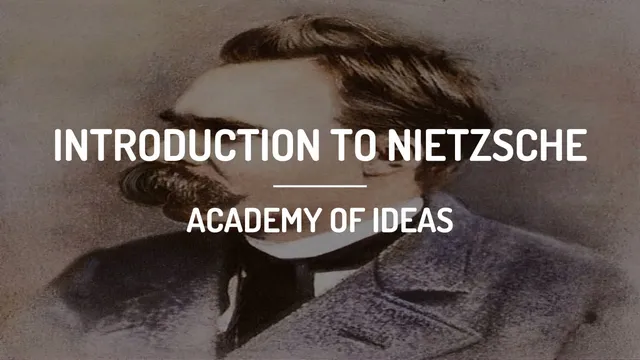
Introduction to Nietzsche
Based on Academy of Ideas's video on YouTube. If you like this content, support the original creators by watching, liking and subscribing to their content.
Nietzsche’s philosophy is framed as a practical program for producing a higher individual capable of life-affirmation under tragedy.
Briefing
Frederick Nietzsche’s philosophy, as presented here, is less a search for abstract truth than a practical project aimed at producing a “great individual” capable of fully affirming life—even when it includes suffering, pain, and tragedy. The central claim is that greatness requires self-overcoming: a person must learn to master the inner chaos of competing drives, resist the social pressures that flatten ambition into conformity, and transform despair into a kind of life-affirming power.
That inner struggle begins with Nietzsche’s picture of the higher man as a turbulent, self-conflicted being. Within such a person, powerful drives clash continuously, creating deep suffering and a constant risk of self-destruction. Greatness depends on imposing order on this chaos rather than escaping it. Yet Nietzsche also insists that most people are pulled in the opposite direction by what he calls the herd instinct—an innate desire to obey and conform to the masses. Herd morality, tied to cultural definitions of “good” and “evil,” becomes a tool for steering people “by the nose.” It rewards weakness by redefining it as virtue and treats the qualities the herd lacks as evil. The result is a moral system that pressures individuals to become obedient and mediocre, which the higher man must reject in favor of a self-created, life-affirming morality.
Escaping the herd is not only a matter of belief but of life-pattern. Nietzsche argues that solitude is essential: the masses, driven by fear and laziness, avoid the deepest questions of existence. For the higher man, the key questions are why one lives and why one suffers—and Nietzsche links them tightly, treating the need for meaning as inseparable from the experience of suffering. This connection becomes sharper with Nietzsche’s diagnosis of nihilism, the despairing sense that life lacks meaning or purpose. The lecture attributes nihilism to a misguided pursuit of objective knowledge: if there is no discoverable object of meaning and truth itself is impossible as an external, knowable fact, then people are left with the bleak suspicion that they are “nothing” in a meaningless universe.
Nietzsche’s response is not to chase truth but to interpret. Since people cannot escape their own perspective, the task becomes creating life-promoting interpretations rather than waiting for a final, objective answer. Pain, in this framework, is not an objection to life but a precondition of greatness: a life without suffering would be miserable, and great suffering can become great advancement. That is why Nietzsche invents the overman as an ideal—an unreachable perfection that nonetheless provides motivation. The higher man’s shame at being far from that ideal can turn into self-love, because the deficiencies that provoke self-hatred also generate the drive to grow.
The lecture then ties these themes together through Zarathustra’s parable of the shepherd and the black snake: overcoming despair by biting off the snake’s head leads to a rapturous, overman-like laughter that signals complete life affirmation. Two concepts formalize that affirmation: amor fati (love of fate) and the eternal recurrence. Amor fati demands affirming a world filled with evil and tragedy by recognizing their “inherent beauty” as sources of growth. The eternal recurrence functions as a psychological test: the higher man, even near death, would not want non-existence but would wish to relive life endlessly—because the struggle itself becomes something to say “yes” to, again and again.
Cornell Notes
Nietzsche’s project is portrayed as a practical way to cultivate a “higher man” who can affirm life fully despite suffering. Herd morality and the herd instinct push people toward conformity by redefining weakness as goodness, so greatness requires solitude and a self-created morality. Nihilism arises when people expect objective truth about life’s meaning, but Nietzsche rejects objective knowledge and treats meaning as something created through interpretation. Pain is reframed as a precondition for greatness, feeding the drive toward self-overcoming and the ideal of the overman. Amor fati and the eternal recurrence then serve as tests of whether one can truly say “yes” to life, including tragedy, without wishing for an escape from existence.
Why does Nietzsche connect the question “why do I live?” with “why do I suffer?”
What role does herd morality play in keeping most people from becoming “higher”
How does Nietzsche’s view of truth lead to nihilism, and what replaces it
Why is suffering treated as necessary rather than merely harmful
What does the parable of the shepherd and the black snake symbolize
How do amor fati and eternal recurrence function as tests of life affirmation
Review Questions
- How does herd morality reshape “good” and “evil,” and why does that matter for the higher man’s development?
- What does Nietzsche reject about objective truth, and how does that change the way meaning is produced?
- In what way do amor fati and eternal recurrence each operationalize “yes-saying” to suffering?
Key Points
- 1
Nietzsche’s philosophy is framed as a practical program for producing a higher individual capable of life-affirmation under tragedy.
- 2
The higher man must impose order on inner chaos created by competing drives, rather than seeking comfort through conformity.
- 3
Herd morality functions as a social technology: it rewards weakness as virtue and labels the herd’s missing traits as evil.
- 4
Solitude is treated as necessary because the herd avoids deep questions like why one lives and why one suffers.
- 5
Nihilism is linked to the demand for objective knowledge about life’s meaning; Nietzsche replaces that demand with interpretive creation.
- 6
Suffering is reinterpreted as a precondition for greatness, fueling self-overcoming and the drive toward the overman.
- 7
Amor fati and the eternal recurrence act as tests for whether someone can affirm life—including pain—without wishing for escape.