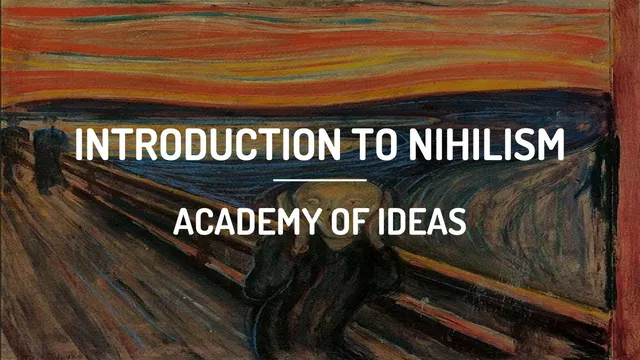
Introduction to Nihilism
Based on Academy of Ideas's video on YouTube. If you like this content, support the original creators by watching, liking and subscribing to their content.
Nietzsche’s nihilism is presented as the devaluation of the highest values, producing a loss of aim and answers.
Briefing
Nihilism, in Friedrich Nietzsche’s framing, is the collapse of value: “the highest values devaluate themselves,” leaving life without an aim and without answers. The lecture treats nihilism not as a single doctrine but as a family of denials that share one core feature—an attitude of negation toward meaning—culminating in existential nihilism, the form Nietzsche most cared about and the one most often meant when people use “nihilism” alone.
The term gained traction in the West in the mid-19th century, with Ivan Turgenev’s 1862 novel *Fathers and Sons*. In it, a character defines a nihilist as someone who “does not bow down before any Authority” and does not accept principles on faith. That literary usage points to a broader cultural shift: once people stop treating moral, epistemic, or cosmic claims as authoritative, meaning becomes harder to sustain. To clarify what “meaning” loss can involve, the lecture distinguishes four types of nihilism, drawing on Donald Crosby’s taxonomy. Moral nihilism denies the sense of moral obligation and the objectivity of moral principles. Epistemological nihilism denies that anything like truth or meaning exists beyond what is confined to an individual or a conceptual scheme. Cosmic nihilism rejects intelligibility or value in nature, portraying the world as indifferent or hostile to human concerns. Each of these attacks a traditional source of meaning—moral order, truth, or a meaningful cosmos—making existential nihilism more likely.
Existential nihilism negates the meaning of life itself. The lecture links this to the chain reaction produced when people deny objective bases for value, truth, and meaning: if moral principles aren’t true or false but merely subjective, if truths aren’t real beyond schemes, and if nature contains no value or intelligibility, then the universe offers no grounding for purpose. Existential nihilism then becomes the general outcome—life appears “depressingly meaning and absurd,” especially when the world is taken to be indifferent or even hostile to human hopes.
To explain what is being denied, the lecture turns to how “meaning” works. David Rutnik’s discussion of Greek usage distinguishes meaning as “having a purpose” (life is meaningful if it has an identifiable aim) from meaning as mere content. A purpose must be something people can signify or recognize; otherwise it doesn’t count as meaning. Why humans seek meaning is debated, but Arthur Schopenhauer is cited for tying the desire to meaning to suffering and the inescapability of death.
Historically, the lecture argues, Western meaning was often supplied by “two-world” theories—especially Christianity’s heaven. Christian teaching offered a purpose for earthly suffering: live according to God’s will to gain entry to a blissful reality after death. That promise functioned as an antidote to nihilism by guaranteeing that pain would not be pointless.
But the lecture traces nihilism’s rise to Christianity’s decline, accelerated by the scientific revolution. As faith in the two-world framework weakened—captured by Nietzsche’s “God is dead”—a crisis of meaning followed. Science, it claims, can make the universe more comprehensible while also making it seem pointless, echoing Steven Weinberg’s remark that the more the universe seems comprehensible, the more it seems pointless. The lecture also points to early scientific “seeds” that degraded humanity’s special place in the cosmos, including Giordano Bruno’s infinite universe and the possibility of other worlds. Nietzsche is presented as anticipating that, with the death of God, the feeling that life is meaningless would spread—defining modern civilization by how it responds to and eventually overcomes that crisis.
Cornell Notes
Nietzsche’s nihilism is framed as the devaluation of the highest values, leaving life without an aim. The lecture breaks nihilism into four related forms: moral nihilism (no objective moral obligation), epistemological nihilism (no truth or meaning beyond schemes), cosmic nihilism (nature lacks intelligibility or value), and existential nihilism (life itself lacks meaning). Denying objective bases for value, truth, and meaning makes existential nihilism the most general outcome, since it removes the grounds for purpose across the moral, cognitive, and cosmic domains. Historically, Western culture often resisted nihilism through “two-world” theories—especially Christianity’s promise of heaven—where suffering gained purpose. As faith in that framework weakened (notably through the rise of science and the “death of God”), the lecture argues that meaning crises became more widespread.
How does the lecture connect Nietzsche’s “devaluation of values” to the different types of nihilism?
Why does the lecture say existential nihilism is the “most general” form?
What does “meaning” mean in this discussion, and why does that definition matter?
What role do “two-world” theories—especially Christianity—play in resisting nihilism?
How does the lecture link the decline of Christianity to the rise of nihilism?
Which scientific ideas are presented as “seeds” of nihilism, and what do they change?
Review Questions
- Which of the four nihilism types denies moral obligation, and which denies truth or meaning beyond schemes?
- According to the lecture’s definition of meaning, what makes a life’s purpose count as “meaningful”?
- How does the lecture argue that the decline of Christianity leads to a wider feeling that life is meaningless?
Key Points
- 1
Nietzsche’s nihilism is presented as the devaluation of the highest values, producing a loss of aim and answers.
- 2
Four related forms of nihilism—moral, epistemological, cosmic, and existential—share a common negation of meaning.
- 3
Denying objective moral principles, objective truth, and value in nature makes existential nihilism more likely because it removes grounding for purpose.
- 4
Meaning is defined as an identifiable purpose; a purpose that no one can recognize does not generate meaning.
- 5
“Two-world” theories, especially Christianity’s promise of heaven, historically supplied purpose by turning suffering into a path toward a blissful afterlife.
- 6
The lecture links nihilism’s spread to the weakening of Christian faith, symbolized by Nietzsche’s “God is dead,” and accelerated by the rise of science.
- 7
Scientific cosmology and mechanistic worldviews are portrayed as increasing comprehension while often failing to provide purpose, encouraging skepticism about religious meaning-sources.