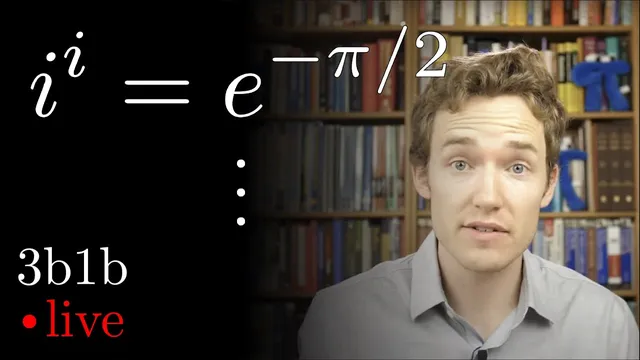
Intuition for i to the power i | Ep. 9 Lockdown live math
Based on 3Blue1Brown's video on YouTube. If you like this content, support the original creators by watching, liking and subscribing to their content.
Rewrite i as e^x using Euler’s formula so i^i becomes e^{x·i}, yielding e^{-π/2}≈0.2079 when x=(π/2)i.
Briefing
Raising the imaginary unit to an imaginary power—specifically i^i—collapses to a real number because complex exponentials can be reinterpreted as motion with changing dynamics. The key move is rewriting i as e^{x} for a complex x, then using Euler’s formula to translate exponentials into rotations on the complex plane. Solving e^{x}=i leads to x= (π/2)i (up to adding multiples of 2πi), so i^i becomes e^{(π/2)i·i}=e^{-π/2}≈0.2079. That “imaginary-in, real-out” outcome stops looking like a trick once exponentials are treated as a system whose derivative is proportional to its current state.
The episode builds intuition in two stages. First, Euler’s formula is given a computational meaning via the power-series definition of exp(x)=1+x+x^2/2!+…, which works cleanly for complex inputs. Then the geometric meaning is reinforced: e^{iθ} corresponds to walking an angle θ around the unit circle. Under that lens, multiplying by i is a 90° rotation, so e^{(π/2)i} is exactly the rotation that lands on i.
The deeper “why” comes from dynamics. Consider e^{it} as a time-evolving position in the complex plane. Because e^{x} differentiates to itself, differentiating e^{it} introduces a factor of i; that factor rotates the position vector by 90° to produce the velocity vector. This rule—velocity equals a quarter-turn rotation of position—forces circular motion. The time needed to reach i is therefore π/2, matching the angle interpretation.
But the expression i^i introduces a second layer: raising e^{it} to the power i changes the dynamics from circular motion to exponential decay. After the transformation, the derivative becomes negative times the current value, so the motion heads toward the origin with a shrinking step size—an exponential approach to zero. After waiting π/2 units of time under this decay rule, the position lands at e^{-π/2}. In this sense, “two 90° rotations” don’t literally add angles; one rotation sets the circular dynamics, while the other rotation (through the exponent i) flips the system into decay.
A major complication then appears: e^{x}=i has infinitely many solutions because the complex logarithm is multivalued. Adding 2πi to x doesn’t change e^{x}, but it changes the resulting exponential function. That’s why values like x= (π/2)i, (5π/2)i, or -(3π/2)i all satisfy e^{x}=i yet produce wildly different outputs for e^{x·i}. The episode connects this to the general ambiguity of roots in complex numbers and to the idea of choosing a “branch” of a multivalued function.
To unify everything, the episode argues that exponentials are best expressed as exp(r x) rather than b^x when complex numbers enter. Different choices of r correspond to different branches, and varying r changes the function even if exp(r)=b stays the same. The lecture ends by extending the theme to power towers (iterating exponentiation) where ambiguity and numerical iteration can lead to cycles and even chaotic behavior, depending on the chosen branch. The central takeaway is that complex exponentiation is not just “more complicated arithmetic”—it is a family of functions whose behavior depends on how the logarithm is chosen.
Cornell Notes
The episode shows that i^i is real because complex exponentials can be interpreted through Euler’s formula and through differential-equation dynamics. Solving e^x=i gives x=(π/2)i (plus 2πi·k), so i^i = e^{(π/2)i·i}=e^{-π/2}≈0.2079. The “real number” result becomes intuitive when e^{it} is treated as circular motion (velocity is a 90° rotation of position), while exponentiating by i changes the dynamics into exponential decay. A crucial lesson is that e^x=i has infinitely many logarithm values in the complex plane, so i^i is inherently multivalued unless a branch is fixed. That multivaluedness mirrors how complex roots and functions like logarithms require branch choices.
Why does solving e^x=i lead to x=(π/2)i, and what does that imply for i^i?
How does the “dynamics” viewpoint explain Euler’s formula and the appearance of rotations?
What changes when exponentiating by i, and why does that produce decay instead of circular motion?
Why are there infinitely many possible values for x satisfying e^x=i, and why does that make i^i multivalued?
How does the episode connect this to complex roots and “branch” choices?
Why does the lecture prefer writing exponentials as exp(r x) instead of b^x in complex settings?
Review Questions
- What differential-equation/dynamics rule corresponds to e^{it}, and how does that rule imply circular motion?
- Explain how adding 2πi·k to a complex logarithm value preserves e^x but changes the value of e^{x·i}.
- Why does choosing a branch of the complex logarithm (or root) matter for turning a multivalued expression into a single-valued function?
Key Points
- 1
Rewrite i as e^x using Euler’s formula so i^i becomes e^{x·i}, yielding e^{-π/2}≈0.2079 when x=(π/2)i.
- 2
Treat e^{it} as a complex-valued position whose derivative rotates the position vector by 90°, producing circular motion and matching the π/2 time-to-reach-i intuition.
- 3
Exponentiating by i changes the governing dynamics from rotation to exponential decay, explaining why the final result is real.
- 4
Complex logarithms are multivalued: if e^x=i then x can be shifted by 2πi·k without changing e^x, producing infinitely many possible values for i^i unless a branch is fixed.
- 5
The multivaluedness of i^i parallels multivalued complex roots (e.g., multiple fourth roots of 16) and is resolved by choosing a branch convention.
- 6
In complex contexts, expressing exponentials as exp(r x) makes branch dependence explicit and avoids the ambiguity of b^x notation.
- 7
Iterating exponentiation in power towers inherits these branch ambiguities and can lead to cycles or chaotic behavior under numerical iteration.