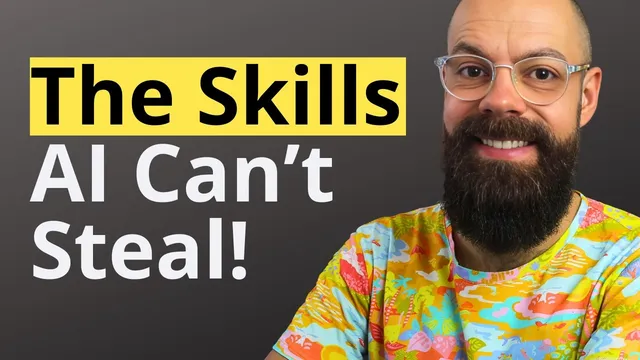
Irreplaceable Research Skills in an AI Era
Based on Andy Stapleton's video on YouTube. If you like this content, support the original creators by watching, liking and subscribing to their content.
AI’s strengths in retrieving and drafting can reduce time spent on routine academic tasks, but that doesn’t eliminate the human functions that drive academic progress.
Briefing
AI tools are increasingly taking over the “good enough” parts of academic work—especially manual literature review and other time-consuming tasks—yet that shift doesn’t eliminate the core human functions that make academic careers and research progress possible. The central claim is that academia will become more human-centric as more routine tasks get outsourced to software, because several high-stakes skills depend on relationships, lived experience, and human judgment that algorithms cannot replicate.
First, human connection-building is framed as irreplaceable. Academic success isn’t just about what someone knows; it’s also about who we know—trust built through repeated interactions, collaboration, and even informal moments like conference networking and conversations with editors. The transcript cites a personal example: a paper rejection that later succeeded after invoking a prior relationship, suggesting that professional rapport can materially affect outcomes such as journal acceptance.
Second, the transcript argues that deep research intuition—described as a “sixth sense”—emerges from long immersion in a niche field. AI can retrieve facts and figures, but it lacks the subconscious, experience-driven sense of what to try next, what gap is opening, and when a direction “feels” right. That intuition is portrayed as the product of constant rumination and lived daily engagement with the research problem, including ideas that surface outside formal analysis (for instance, during a shower or at night).
Third, the emotional and motivational impact of human criticism is presented as uniquely powerful. Feedback from a respected supervisor or principal investigator “cuts deeper” than criticism from a large language model, because it carries personal stakes, authority, and a desire to meet someone’s expectations. The transcript suggests that this sting can be a useful motivator for pushing through hurdles.
Fourth, presenting research—whether at poster sessions or oral talks—is treated as a distinctly human performance. AI may summarize results, but it struggles with the interactive, audience-specific defense of work: answering questions in a way that satisfies academic standards, explaining the “why” behind the choices, and conveying the research personality that makes findings land. The transcript compares an AI presentation to reading slides—technically possible, but ineffective and dull.
Fifth, leadership and inspiration are described as essential across every research role, from PhD students to professors. Research is portrayed as an unknown territory filled with setbacks; teams need someone who can guide others through uncertainty and sustain momentum after failure. AI is said to be unable to grasp the human toll of research, and therefore cannot provide the same kind of encouragement that keeps people going.
Finally, the transcript argues that AI cannot fully understand the human impact of research. Funding decisions and public interest often hinge on lived, human-centered reasons—how a problem affects real lives and why it matters beyond data. The transcript concludes that the “lived human experience” behind what attracts researchers to a topic, and what makes results meaningful, remains difficult for algorithms to replicate. The takeaway is not that AI is useless in academia, but that the most consequential research skills—relationship-building, intuition, emotional resilience, communication, leadership, and human-centered purpose—remain fundamentally human.
Cornell Notes
As AI takes over routine academic tasks like literature review, the most valuable remaining skills are those rooted in human relationships and lived experience. The transcript highlights six areas AI cannot replace: building trust and networks, developing intuition about what to try next, absorbing deep feedback from respected mentors, presenting and defending work in interactive academic settings, leading and inspiring teams through uncertainty, and explaining research impact in human terms. These capabilities depend on emotion, credibility, and context—factors that don’t reduce cleanly to data retrieval or text generation. The practical implication is that academia will likely become more human-centric, with researchers leaning harder on interpersonal and experiential strengths.
Why does relationship-building matter so much in academia, and how is it portrayed as measurable?
What is meant by “sixth sense” or intuition in research, and why can’t AI replicate it?
How does the transcript distinguish human criticism from AI-generated feedback?
Why is research presentation treated as something AI struggles to do well?
What does the transcript claim about leadership and inspiration in research teams?
How does the transcript connect research importance to human impact rather than data alone?
Review Questions
- Which of the transcript’s “non-replaceable” skills do you think is most vulnerable to automation, and why?
- How does the described “sixth sense” differ from pattern recognition in data analysis?
- What would a “human-centered” research presentation include that an AI summary might miss?
Key Points
- 1
AI’s strengths in retrieving and drafting can reduce time spent on routine academic tasks, but that doesn’t eliminate the human functions that drive academic progress.
- 2
Academic success depends heavily on relationship-building—trust, networking, and informal professional interactions can influence collaboration and publication outcomes.
- 3
Long-term immersion in a research niche can produce intuition about what to try next; that experience-driven “sixth sense” is portrayed as hard to translate into machine logic.
- 4
Feedback from respected mentors carries emotional weight that can motivate researchers to revise and push through obstacles more effectively than generic AI criticism.
- 5
Presenting and defending research requires interactive, audience-aware communication and a human research personality, not just correct results.
- 6
Research leadership is framed as the ability to inspire persistence through uncertainty and failure—something the transcript says AI cannot truly replicate.
- 7
The importance of research is often tied to human impact and lived experience, which AI struggles to express in a way that resonates with funders and communities.