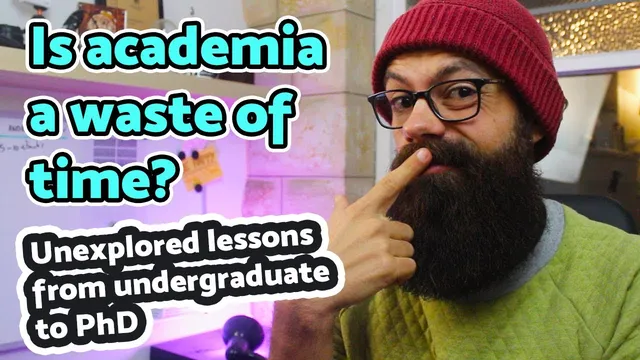
Is academia a waste of time? Make sure it isn't with this...
Based on Andy Stapleton's video on YouTube. If you like this content, support the original creators by watching, liking and subscribing to their content.
Academia is most likely worth it when the target profession legally or practically requires a specific degree or certification.
Briefing
Academia isn’t automatically a waste of time—but it becomes one when students chase degrees for the wrong reasons and ignore the job market waiting on the other side. The core test is practical: if the profession requires a specific qualification (like a law degree, medical training, or a PhD for university teaching), then the credential can be a legitimate investment. The bigger problem comes when people assume that earning the highest grades and stacking qualifications will automatically translate into a fulfilling, high-paying career.
That mismatch often starts with how students choose. A chemistry student’s path illustrates the trap: choosing an undergraduate degree based on what felt rewarding in the moment—praise from teachers and an ego-driven sense of being “clever”—didn’t match the reality of available jobs after graduation. The result was a pattern of “doubling down” through postgraduate study, hoping more education would fix the mismatch. The same dynamic can hit other fields: someone aiming for marketing may find too few roles, or a law track may reveal years of grinding hours before reaching partnership—then the sunk-cost feeling makes it hard to exit.
Universities, meanwhile, are described as operating like businesses that profit when students enroll, especially international students who often pay more. Marketing leans on rankings and slogans (“top” universities, unstoppable careers, study with the best), but those messages rarely center the hard outcomes: projected job growth, hiring competition, success rates, and how networking and timing shape employment. In that environment, career advice from universities can mislead—particularly when students treat a degree as a guaranteed gateway rather than one input in a competitive labor market.
To avoid wasting time, the guidance is to “start with the end in mind.” That means looking at facts and figures early: expected pay, job availability, success rates, and who needs to be networked with to land roles. It also means leaving romantic ideas behind—like the belief that passion and purpose alone will produce a stable career. Even when passion is real and energizing, the skills gained in academia can often be built elsewhere, sometimes more cheaply and directly.
The transcript argues that the most durable advantage isn’t the degree by itself; it’s the combination of skills around it. A PhD in chemistry can still pay off if it’s paired with additional capabilities—writing, internships, communication, and industry-relevant experience—creating a “unique Venn diagram” that makes someone valuable. Coding, video production, sales, and technical writing can be learned through online courses, self-directed projects, and real-world practice rather than requiring another credential.
Ultimately, whether academia is worth it is personal and risk-based. Students should weigh debt, time costs, and their own risk tolerance, then decide whether the qualification is truly required for the job they want. If it is required, academia can open doors. If it isn’t, alternative routes—self-learning, vocational training, and building experience—may deliver the same competencies with less cost and faster entry into the work itself.
Cornell Notes
Academia is worth it when a target profession genuinely requires a specific credential, but it can waste years when students chase degrees based on praise, marketing, or romantic career fantasies. The key decision framework is “start with the end in mind”: check pay, job availability, growth projections, hiring competition, and networking realities before committing time and money. Universities are portrayed as marketing-driven institutions that may emphasize rankings and slogans more than labor-market outcomes, especially when international enrollment is lucrative. The transcript also stresses that degrees don’t automatically create employability—skill combinations and real experience do. If the job doesn’t require a degree, similar skills can often be built through online learning, internships, and self-directed projects.
When does academia become a good investment rather than a time sink?
Why do high grades and extra credentials sometimes fail to produce a satisfying career?
How do university marketing incentives distort career decision-making?
What does “start with the end in mind” mean in practice?
If degrees aren’t the only path, what makes someone employable?
How should students weigh risk and reward when choosing academia?
Review Questions
- What specific labor-market data should a student check before committing to an undergraduate or postgraduate degree?
- Describe the “doubling down” trap mentioned in the transcript and how sunk-cost pressure can keep someone in an unwanted career path.
- Give two examples of skills that can be built outside a degree and explain how they might combine with a credential to improve employability.
Key Points
- 1
Academia is most likely worth it when the target profession legally or practically requires a specific degree or certification.
- 2
Choosing based on praise or “being good at something” can lead to a mismatch between study and the real job market after graduation.
- 3
University marketing often emphasizes rankings and career slogans while downplaying labor-market realities like competition, networking, and projected growth.
- 4
Before enrolling, students should research pay, job availability, success rates, and how people actually find roles in that field.
- 5
Degrees don’t guarantee employability; skill combinations and hands-on experience often determine outcomes.
- 6
If a degree isn’t required for the job, students can often build equivalent skills through online learning, internships, and self-directed projects.
- 7
The decision should be treated as a personal risk-reward calculation, factoring in debt, time costs, and individual risk tolerance.