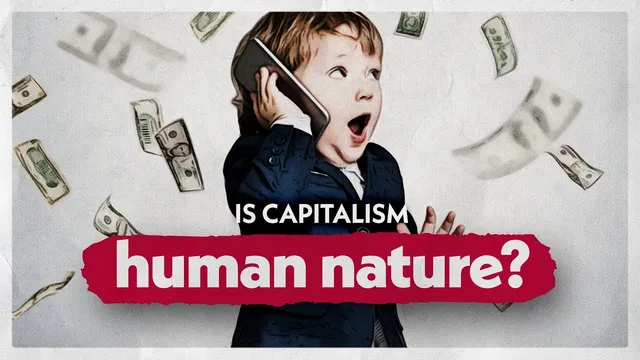
Is Capitalism Really Human Nature?
Based on Second Thought's video on YouTube. If you like this content, support the original creators by watching, liking and subscribing to their content.
The presence of selfishness does not logically justify building an economy that rewards greed and exploitation as the route to power.
Briefing
Capitalism’s defenders often lean on “human nature” to argue socialism can’t work—because people are too selfish, greedy, or cruel. The core pushback here is that this line of reasoning doesn’t actually justify capitalism’s institutions, and it also misreads what socialism requires. Even if humans sometimes act selfishly, that fact doesn’t logically mean an economy should be designed to reward the most exploitative behavior; it only shows that selfishness exists. Socialism, as framed in the argument, is not an honor system where everyone must be nice. It’s an economic arrangement where the means of production are collectively owned and democratically controlled, so decisions that affect everyone are made through collective governance rather than by private owners pursuing profit.
The transcript then attacks the “human nature” claim on two fronts. First, it argues that essentializing human nature into its worst traits ignores abundant evidence of everyday selflessness—people making sacrifices without immediate payoff, mutual aid networks, and countless small acts of help that are so common they barely register. More importantly, the argument says socialism doesn’t depend on eliminating selfishness; it depends on changing incentives and power. Under capitalism, the winning strategy is often to outmaneuver others because ownership lets a few people withhold opportunities and extract value. Under socialism, the claim is that the “winning strategy” shifts toward collaboration because no one can unilaterally control access to the tools and resources others need.
Second, the transcript challenges the historical story used to naturalize capitalism. A common justification traces capitalism to a supposedly universal human propensity to “truck, barter, and exchange,” often associated with Adam Smith’s account in The Wealth of Nations. The transcript counters that this story is speculative and not supported by historical evidence: ethnographic research and historical scholarship suggest that pure barter economies are not found in the way the theory implies, and that for most of human history people relied more on gifts, redistribution, and common ownership of resources. It also argues that capitalism itself is historically recent—on the order of a few hundred years—rather than an inevitable expression of timeless human behavior.
From there, the argument reframes capitalism as a product of specific political and economic conditions: the rise of a merchant class, the weakening of feudal structures, legal changes around private property, and technologies that enabled large-scale trade and production. The “human nature” narrative arrives later as a convenient myth to legitimize the new order—portraying people as rational in markets while supposedly irrational or violent outside them. That contradiction, the transcript suggests, functions like a safety valve for economic theory: when reality doesn’t match the model, it can blame “irrational” behavior without changing the underlying assumptions.
Finally, the transcript returns to socialism’s definition to clear up a common misconception. Socialism isn’t about everyone sharing everything equally; it’s about collective ownership and democratic control over what matters most—production and distribution decisions. Trade can remain, but profit and ownership power are constrained so that wealth accumulation can’t be driven primarily by exploiting others’ dependence. The closing segment shifts to climate policy, arguing that systemic problems like fossil-fuel lock-in require more than individual action, and promoting Ren as a way to fund carbon-reduction projects with transparent updates.
Cornell Notes
The transcript argues that “human nature” is a weak justification for capitalism and a misunderstanding of what socialism requires. Even if selfishness exists, that alone doesn’t mean society should reward greed; socialism can function by changing ownership and decision-making power rather than demanding saint-like behavior. It also challenges the historical claim that humans naturally evolved toward barter and capitalism, citing ethnographic work suggesting barter economies are rare and that much of human history relied more on gifts, redistribution, and common resource access. Capitalism is presented as a historically contingent system shaped by political upheavals, property laws, and enabling technologies—not an inevitable outcome of timeless human traits. The result: socialism’s feasibility doesn’t hinge on eliminating human flaws, but on redesigning institutions that currently let exploitation pay.
Why doesn’t the existence of selfishness automatically justify capitalism’s institutions?
What evidence is used to argue that humans aren’t only selfish?
How does the transcript challenge the Adam Smith “propensity to barter” justification for capitalism?
What does the transcript claim about capitalism’s historical origins?
How is socialism defined in a way that avoids the “people must be nice” critique?
What incentive shift does the transcript claim socialism would create?
Review Questions
- What logical gap does the transcript highlight between “humans are selfish sometimes” and “capitalism should be the system that rewards selfishness”?
- How does the transcript use historical/ethnographic claims to dispute the idea that barter naturally evolved into capitalism?
- In the transcript’s definition, what exactly changes under socialism—sharing norms, or ownership and democratic control over production and distribution?
Key Points
- 1
The presence of selfishness does not logically justify building an economy that rewards greed and exploitation as the route to power.
- 2
Socialism is framed as institutional design—collective ownership and democratic control—rather than a requirement for universal selflessness.
- 3
Everyday selfless behavior and mutual aid networks are used to argue that “human nature” claims overemphasize the worst traits.
- 4
The transcript disputes the barter-to-capitalism origin story by arguing that pure barter economies and their supposed evolution into money and capitalism are not supported by historical evidence.
- 5
Capitalism is presented as historically contingent, shaped by political upheavals, private property laws, and enabling technologies—not an inevitable expression of timeless human traits.
- 6
“Human nature” narratives are described as legitimizing myths that can protect economic theory when reality doesn’t match predictions.
- 7
Climate action is treated as systemic as well as personal, with carbon offsets offered as a concrete individual contribution alongside broader structural change.