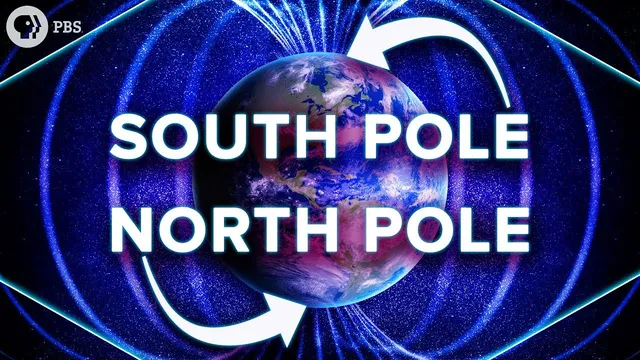
Is Earth's Magnetic Field Reversing?
Based on PBS Space Time's video on YouTube. If you like this content, support the original creators by watching, liking and subscribing to their content.
Earth’s magnetic field is generated by a dynamo in the molten outer core, where convection and rotation amplify and organize a weak magnetic seed rather than creating magnetism from scratch.
Briefing
Earth’s magnetic field does not appear to be “about to flip” in any certain, imminent way—but the field is known to weaken and scramble during geomagnetic reversals, leaving reduced protection for thousands of years. That matters because the magnetosphere normally deflects fast charged particles from the Sun; if protection drops substantially, more high-energy radiation can reach the atmosphere and surface, raising risks for technology and biology even if past reversals have not been linked to mass extinction.
The field is generated by a dynamo effect in the molten outer core. Earth’s core consists of a ~2400 km-thick outer layer of liquid iron and nickel (with other materials) and a ~1200 km-radius solid inner core. Cooling slowly causes the inner core to grow, releasing impurities that feed convection. Those moving conducting fluids get twisted into helical flows by the Coriolis force, while differential rotation winds any existing magnetic field into toroidal rings. The helical convection then breaks that toroidal field into many small loops, creating organized electrical currents—effectively an electromagnet—that sustain a large-scale dipole field.
Reversals happen because the dynamo does not build a field from zero; it amplifies and reorganizes whatever weak magnetic seed exists. Even tiny random magnetic fluctuations—such as thermal variations—can trigger a runaway amplification. Once the system becomes sufficiently scrambled, the magnetic configuration can rebuild with north and south swapped. Geological evidence supports this: Earth’s field has fully flipped about 183 times over the past 84 million years, roughly once per half-million years on average, with the last full reversal occurring more than 700,000 years ago. Despite that “past due” headline, the timing looks largely random, so being late does not automatically mean a flip is imminent.
What’s changed recently is not proof of a reversal, but signs of unusual behavior. The magnetic north pole has been drifting rapidly—around 60 km per year—about 5 degrees south of the geographic pole, moving from Canada toward Siberia. The field’s strength and the positions of magnetic poles also shift as outer-core flows change. During a reversal, the field likely does not shut off completely; instead, it weakens and becomes messy, with temporary “mini” north and south poles appearing across the surface.
Scientists distinguish full geomagnetic reversals (a complete polarity flip) from geomagnetic excursions (a major disturbance that ends with the same polarity). Potential triggers—like asteroid or comet impacts, core–mantle interactions, or large plume formation—have been proposed, but there’s no clear evidence tying specific events to reversals. Most researchers treat reversals as a natural outcome of chaotic outer-core fluid motion tangling magnetic field lines and reducing field strength.
Current monitoring relies on the World Magnetic Model, updated every five years but adjusted when the north pole’s motion accelerates. Even so, the rapid drift alone does not justify alarm: the field fluctuates significantly even without a reversal. Past reversals also haven’t shown increased extinction rates. The main concerns are higher radiation exposure during weaker-field periods, greater satellite vulnerability to solar wind, and short-term confusion for migrating birds and navigation systems that depend on stable magnetic cues.
Cornell Notes
Earth’s magnetic field is produced by a dynamo in the molten outer core, where convection and rotation wind and twist magnetic field lines into a sustained dipole. Full geomagnetic reversals—north and south swapping—have happened about 183 times in the past 84 million years, but the timing appears largely random. During reversals or excursions, the field likely weakens and becomes scrambled rather than fully switching off, leaving reduced protection for thousands of years. Recent pole drift and field changes signal active outer-core dynamics, yet they do not, by themselves, prove an imminent flip. Past reversals show no clear extinction spike, though radiation exposure and technology risks likely increase when the field weakens.
How does Earth generate a strong, organized magnetic dipole if the core isn’t intrinsically magnetic?
Why can the magnetic field flip polarity even though Earth’s rotation direction stays the same?
What does the geological record say about how often reversals occur?
What’s the difference between a geomagnetic reversal and a geomagnetic excursion?
Does recent pole movement mean a reversal is imminent?
What are the real-world consequences if the field weakens during a reversal?
Review Questions
- What physical motions in Earth’s outer core lead to the dynamo effect, and how do they transform a weak seed field into a sustained dipole?
- Why does the timing of geomagnetic reversals not follow a simple schedule, even though the last full reversal was over 700,000 years ago?
- During a reversal, what changes in the magnetic field configuration are expected, and how do those changes translate into risks for life and technology?
Key Points
- 1
Earth’s magnetic field is generated by a dynamo in the molten outer core, where convection and rotation amplify and organize a weak magnetic seed rather than creating magnetism from scratch.
- 2
Differential rotation winds magnetic fields into toroidal rings, while helical convection flows twist those structures into loops that drive organized electrical currents.
- 3
Geomagnetic reversals have occurred many times—about 183 times in 84 million years—but their timing appears largely random, so “past due” does not guarantee an imminent flip.
- 4
Recent rapid drift of the magnetic north pole and changing field strength reflect active outer-core dynamics, but they are not sufficient evidence on their own for an approaching reversal.
- 5
Reversals and excursions likely involve field weakening and scrambling rather than a complete shutdown, producing temporary mini poles across Earth’s surface.
- 6
Past reversals have not been linked to increased extinction rates, but weaker protection would likely raise radiation exposure and increase stress on satellites and navigation systems.