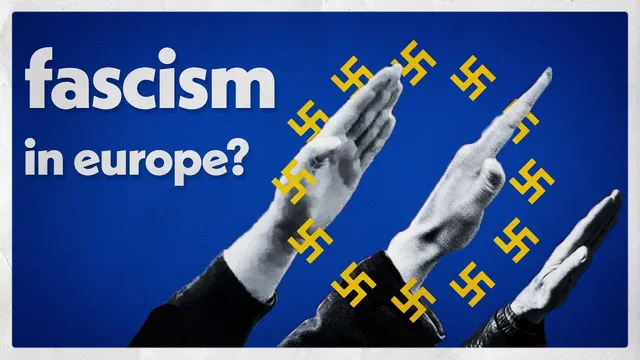
Is Europe Turning Fascist?
Based on Second Thought's video on YouTube. If you like this content, support the original creators by watching, liking and subscribing to their content.
France’s far-right gains are portrayed as driven by seat wins plus coalition instability on the left, with internal fragmentation reducing unified resistance.
Briefing
Far-right parties in Europe have gained enough seats and institutional leverage to move from protest politics into a more threatening phase—especially in France—while centrist leaders have increasingly normalized immigration and “national decline” rhetoric that fuels fascist-style politics.
In France, the far right’s National Rally (NFP in the transcript) won the most seats through coalition-building, and the presidential coalition is described as fragmented and loosely aligned, with internal threats of parties breaking away. That instability matters because it reduces the odds of a unified governing bloc. At the same time, the far right’s vote share is portrayed as meaningfully larger than in earlier cycles: Le Pen’s bloc is said to have reached about 10 million votes, compared with roughly 7 million each for the left and center-right. The transcript adds another practical factor—hundreds of candidates reportedly withdrew so left and center-right voters would not split—helping prevent the far right’s plurality from turning into a total sweep.
The same pattern is framed as spreading across Europe. In EU Parliament elections held that summer, the far right reportedly led in France as well (around 31%), and made major gains in Italy, Germany, Austria, the Czech Republic, and the Netherlands. The consequence is not just electoral change but policy drift: with more far-right influence, the EU is described as likely to become worse on immigration enforcement, climate policy, defense spending, and health care. A specific example is the EU “migration pact,” described as mirroring harsh border practices—detention of immigrant adults and children (up to six months), worse conditions for asylum seekers, and limited support for those crossing the Mediterranean.
The transcript then pivots to a broader claim: anti-immigration narratives and policies are not grounded in evidence and are instead tied to real-world violence. It cites UK incidents where far-right mobs attacked mosques and hotels housing asylum seekers, including reports of assaults and intimidation. It also argues immigration is beneficial, pointing to a paper from the NBR claiming immigration raises wages and employment for native workers across education levels, increases contributions to social programs like Social Security, and is associated with lower per-capita crime than among native-born residents—while emphasizing immigrants’ precarious living conditions.
To explain why electoral gains can translate into fascism, the transcript uses Robert Paxton’s definition: fascism is driven by national decline, a belief that an in-group is superior and threatened by outsiders, a desire to restore hierarchical status, and readiness to use indiscriminate violence through legal or extra-legal means—often with or without help from traditional elites. It argues fascist movements are flexible on policy details but consistent in scapegoating outsiders and exploiting economic anxiety.
Finally, the transcript traces the political conditions that make this possible: neoliberal reforms since the 1980s and 1990s are described as weakening unions and the welfare state, increasing insecurity, and selling austerity as “freedom.” It claims centrist and center-right leaders—citing Emmanuel Macron—have adopted far-right talking points and normalized harsher immigration policies, helping make fascist logic seem legitimate. The proposed counterweight is solidarity: a left coalition in France is described as unexpectedly becoming the largest party in parliament with an anti-austerity platform, offering a path to break the cycle—though the outcome is portrayed as uncertain and dependent on whether radical solidarity can out-organize fascist momentum.
Cornell Notes
Far-right parties in Europe—especially in France—have gained enough electoral and institutional power to shift from fringe influence toward a more dangerous stage of politics. The transcript links these gains to vote totals, coalition instability, and coordinated candidate withdrawals that prevent a far-right sweep. It argues that fascism is identifiable less by specific policies than by a core pattern: national decline narratives, an in-group/out-group hierarchy, and willingness to use indiscriminate violence. It also claims that neoliberal austerity and weakened solidarity create the economic insecurity that fascist movements exploit, while centrist leaders have normalized parts of the far-right agenda. The proposed antidote is organized left solidarity that challenges corporate power and austerity rather than competing on the same economic ground.
What specific French election dynamics are described as enabling far-right momentum?
How does the transcript connect EU-wide far-right gains to policy outcomes?
Why does the transcript say immigration rhetoric matters beyond elections?
What definition of fascism is used, and what are its core components?
How does the transcript explain why fascist movements often fail to deliver “anti-capitalist” promises once in power?
What conditions does the transcript identify as making fascism more likely, and what counter-strategy is proposed?
Review Questions
- Which election mechanics described in France are most likely to prevent a far-right plurality from becoming a governing majority?
- According to the transcript’s Paxton-based definition, what combination of beliefs and actions distinguishes fascism from other authoritarian politics?
- How does the transcript connect neoliberal austerity, weakened unions, and insecurity to the appeal of ultranationalist “order” narratives?
Key Points
- 1
France’s far-right gains are portrayed as driven by seat wins plus coalition instability on the left, with internal fragmentation reducing unified resistance.
- 2
Vote totals and tactical candidate withdrawals are described as key variables affecting whether far-right plurality becomes a full sweep.
- 3
EU-wide far-right advances are linked to expected policy shifts on immigration enforcement, climate action, defense spending, and health care.
- 4
The transcript argues immigration fear narratives are not evidence-based and are associated with real-world intimidation and violence.
- 5
Fascism is framed as a pattern—national decline, in-group/out-group hierarchy, and readiness for indiscriminate violence—rather than a fixed set of policies.
- 6
Neoliberal austerity and weakened solidarity are presented as creating the insecurity that ultranationalism exploits.
- 7
The proposed remedy is radical left solidarity that challenges austerity and corporate power, not just electoral competition.