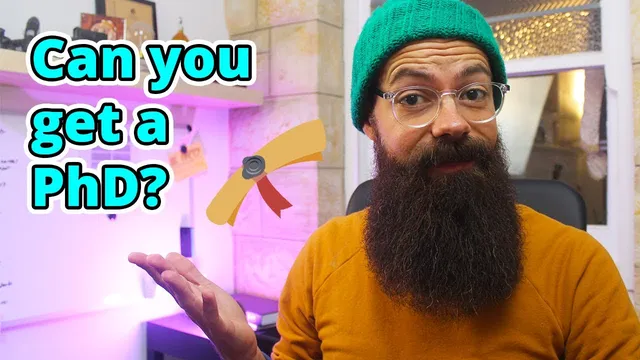
Is everyone capable of doing a PhD?
Based on Andy Stapleton's video on YouTube. If you like this content, support the original creators by watching, liking and subscribing to their content.
Financial stability is portrayed as a decisive constraint because PhDs often require five-plus years of support without crippling debt.
Briefing
Doing a PhD isn’t just a matter of intelligence. It requires a stack of resources, personal traits, and “fit” with the work—plus a system that doesn’t treat applicants equally—so many people who are capable in an intellectual sense still can’t realistically sustain the demands of a multi-year research degree.
A major gatekeeper is financial capacity. A PhD typically lasts five-plus years, and the ability to pay tuition and live without crippling debt can determine whether someone can focus on research rather than survival. The transcript frames this as privilege and luck: some students enter with family support, manageable loans, grants, or independent wealth, while others must work during undergraduate and graduate study, creating stress and time constraints. Even when funding exists, the lifestyle trade-offs can be a dealbreaker, and the decision to “go deep” on a subject for years depends partly on whether someone can afford to take that risk.
Beyond money, success depends on personal traits that aren’t taught in school. Perseverance, self-motivation, staying focused after setbacks, and the ability to learn what works for oneself all matter. The transcript uses an analogy of an ambiguous, open-ended exam with no guidance—research as a process of figuring things out without a clear roadmap. Many people may not have the motivation, access to resources, or tolerance for long stretches of uncertainty that a PhD demands.
Interest and exposure also shape who can make it through. Undergraduate study can provide a surface-level understanding, but PhD work is hands-on and reveals whether earlier interests match the reality of sustained research. The transcript suggests that some people never get the chance to explore enough topics to discover what genuinely pulls them forward; others are content with top-level knowledge and don’t want the depth required for a five-year project. For those who do pursue depth, the drive often comes from genuine curiosity—researching something one doesn’t care about is portrayed as nearly impossible to sustain.
Finally, academic bias and luck influence access to opportunities. The transcript points to structural advantages for white, straight, English-speaking men, including confidence in interviews and easier access to universities and supervisors. It also claims that women and people of color face harsher barriers, requiring them to be “the best” to stand out and secure scholarships. On top of that, career paths are shaped by chance: “sliding doors” moments like choosing a university with a year abroad can determine where someone ends up, who they meet, and which supervisors later sponsor a PhD.
The bottom line: not everyone is capable of doing a PhD in practice—not because they lack intelligence, but because the combination of financial support, personal readiness, sustained interest, systemic access, and luck is uneven. Dropping out can be a rational choice rather than a failure, and the transcript emphasizes moving forward without shame.
Cornell Notes
The transcript argues that PhD completion depends on more than intellectual ability. Financial stability, personal traits like perseverance and self-motivation, and genuine interest in going deep all strongly affect whether someone can sustain multi-year research. It also highlights structural barriers in academia—biases that can favor certain demographics and confidence signals—along with luck-driven “sliding doors” events that shape opportunities. The message is that many people are capable in principle but still face constraints that make a PhD unrealistic or undesirable, and leaving a PhD can be a legitimate outcome.
Why does financial ability play such a central role in whether someone can do a PhD?
What personal traits are described as necessary for PhD success beyond what school teaches?
How does exposure to different subjects affect who can commit to a PhD?
What role do academic biases and luck play in access to PhD opportunities?
What does the transcript say about intelligence and dropping out?
Review Questions
- Which factors in the transcript are described as controllable by individuals, and which are framed as structural or luck-based?
- How does the transcript distinguish between being “capable” intellectually and being “capable” in practice for a PhD?
- What kinds of experiences outside academia are suggested as building blocks for PhD readiness?
Key Points
- 1
Financial stability is portrayed as a decisive constraint because PhDs often require five-plus years of support without crippling debt.
- 2
PhD success depends on personal traits like perseverance, self-motivation, and the ability to keep working through failure and ambiguity.
- 3
Genuine interest in going deep matters; sustained research is difficult when motivation is absent.
- 4
Undergraduate exposure can determine whether students discover a subject they truly want to pursue at research depth.
- 5
Academic bias can affect who gets access to supervisors, scholarships, and opportunities, independent of raw ability.
- 6
Luck and “sliding doors” decisions can redirect educational and career trajectories in ways individuals can’t fully control.
- 7
Dropping out is framed as a legitimate choice when the PhD isn’t the right fit, not as a mark of lack of intelligence.