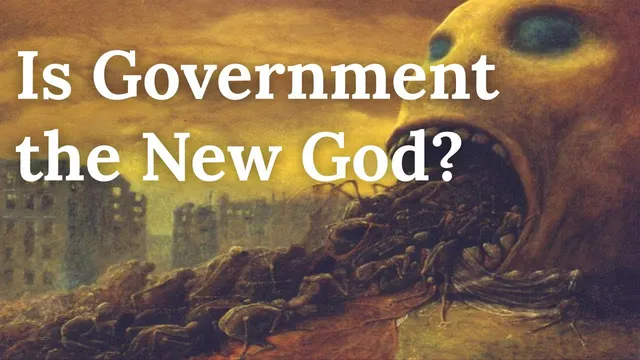
Is Government the New God? - The Religion of Totalitarianism
Based on Academy of Ideas's video on YouTube. If you like this content, support the original creators by watching, liking and subscribing to their content.
Totalitarianism is framed as a conversionist religion that aims to reshape inner conscience, not just political behavior.
Briefing
Totalitarianism functions like a religion: it promises a man-made “golden age,” demands total loyalty, and uses fear, propaganda, and coercive indoctrination to reshape not just laws but inner belief. That framing matters because it explains why totalitarian rule doesn’t stop at governing—its goal is conversion, producing citizens who will obey even when the regime turns on them.
The argument traces a through-line from 20th-century totalitarian movements to older religious structures. Like Christianity and Islam, totalitarian ideologies project a future paradise—except the transformation is assigned to an all-powerful State rather than a divine figure. Early versions imagined racial purity or a Communist utopia of equality and prosperity. Modern variants shift the “heaven” into ecological harmony with “mother earth,” and in harsher forms into fantasies of transcending disease and death, even merging humans with machines.
Those utopian visions, the account says, are effective not because they deliver, but because they mobilize mass enthusiasm and justify unlimited means. The promised end—salvation through the State—becomes a license for mass surveillance, censorship, oppression, imprisonment, and extermination. The moral logic is organized around a religious-style division of people into “chosen” believers and “sinners” or heretics who block history. Zygmunt Bauman’s “society-as-garden” analogy captures the dehumanizing mechanism: unwanted groups are treated like weeds to be segregated, contained, removed, and, if necessary, killed.
Yet the core target is psychological and spiritual rather than merely political. Outward compliance is portrayed as insufficient; totalitarianism seeks control of conscience and even private thought. Giovanni Amendola’s description of fascism as a project to monopolize citizens’ consciences is used to illustrate the conversion requirement: power must penetrate belief, not just behavior. That conversion is pursued through proselytizing methods—state propaganda through culture and public rituals, compulsory schooling that indoctrinates youth, and a “terror and love” strategy that alternates intimidation with displays of care. Ongoing wars, fear campaigns, and threats of loss create a trauma bond, while ceremonial praise and assurances of protection make the regime feel like a safe haven.
The result is a “true believer” who can remain loyal even as the regime persecutes and purges its own followers. Hannah Arendt’s account of believers who may help prosecute their own deaths is presented as evidence that the movement’s hold is deeper than self-interest. Historical examples from the Soviet system—such as Nikolai Vilenchik’s willingness to affirm belief after years in Stalinist gulags—reinforce the claim that totalitarianism manufactures devotion rather than merely extracting obedience.
The closing sections argue that totalitarianism never fulfills its promises: it produces hell on earth, corrupts those who run the machinery of power, and drives society toward chaos. With a modern revival feared, the prescription is resistance through counter-influence—refusing indoctrination of children, socially ostracizing blind obedience, exposing hypocrisy, supporting independent culture and information, and building voluntary “counter economy” networks outside state control. The central takeaway is that the choice is not between comfort and hardship; compliance is framed as the riskiest path because it rests on the false belief that this time the monster won’t devour its own children.
Cornell Notes
Totalitarianism is portrayed as a religion with a political program: it sells a future “golden age” and treats the State as the vehicle for salvation. Believers are divided into “chosen” followers and “sinners” who obstruct history, and the regime justifies extreme violence as necessary for the promised end. Conversion is the goal, not just compliance—citizens are pressured to control their inner thoughts through propaganda, compulsory education, and a “terror and love” pattern that builds trauma bonds. The movement’s hold can persist even when it persecutes its own members, making it uniquely dangerous. Because it never delivers paradise, resistance and independent social influence are presented as practical defenses.
How does the “religion” framing change what totalitarianism is understood to be?
What makes totalitarian utopias persuasive even though they fail?
How are enemies identified and targeted within this religious structure?
Why does “terror and love” matter for creating loyal followers?
What evidence is used to show loyalty can survive persecution?
What countermeasures are recommended to resist a modern revival?
Review Questions
- What features of totalitarianism are described as religious—belief, community structure, or methods of conversion—and how do they work together?
- How does the “chosen vs. sinners” division enable both propaganda and violence?
- Why does the alternation of terror and love create a different kind of loyalty than ordinary fear or coercion?
Key Points
- 1
Totalitarianism is framed as a conversionist religion that aims to reshape inner conscience, not just political behavior.
- 2
Utopian promises—whether racial, communist, ecological, or technological—function as salvation narratives that justify extreme coercion.
- 3
The regime’s moral map divides society into chosen believers and sinners/heretics, enabling dehumanization and elimination of “obstacles.”
- 4
Control is pursued through propaganda, compulsory schooling, and a “terror and love” cycle that builds trauma bonds between citizens and the State.
- 5
Loyalty is portrayed as able to persist even during purges and persecution, because movement status and belief override self-preservation.
- 6
The recommended resistance strategy emphasizes independent information and culture, social pressure against blind obedience, and voluntary economic life outside state control.