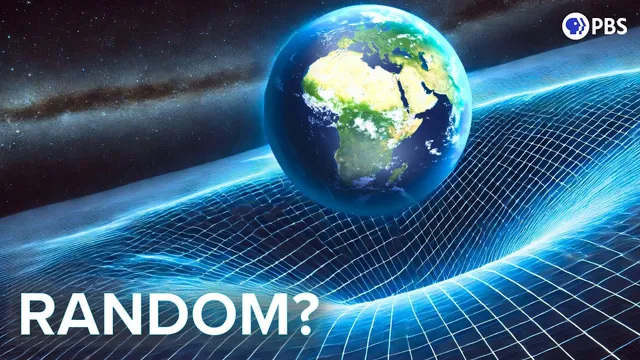
Is Gravity RANDOM Not Quantum?
Based on PBS Space Time's video on YouTube. If you like this content, support the original creators by watching, liking and subscribing to their content.
Post-quantum gravity keeps spacetime classical but makes the gravitational field fluctuate randomly, with statistics tied to the quantum state of the matter that sources it.
Briefing
A new “post-quantum gravity” proposal argues that gravity may not need to be quantized at all. Instead, gravity could remain classical while its gravitational field fluctuates randomly in space and time—fluctuations whose statistical pattern mirrors the quantum superpositions of the matter that sources the field. If that works, it would let classical spacetime coexist consistently with the probabilistic behavior of quantum mechanics, without forcing a full “quantum Einstein tensor” that has resisted decades of attempts.
The starting point is the Einstein field equations, which relate spacetime geometry (the Einstein tensor) to the matter content (the stress-energy tensor). In standard semiclassical gravity, the geometry is set by the expectation value of the quantum stress-energy tensor. That approach works well when quantum effects average out—like for macroscopic objects such as Earth, where the random quantum uncertainty of countless atoms largely cancels when measuring the center of mass. But the proposal highlights a failure mode using a genuinely quantum Earth in a superposition of two center-of-mass locations. Semiclassical gravity would place the Earth at the “in-between” expectation value, so an apple would fall toward the midpoint rather than toward either actual location. For observers who only see one branch of the superposition, that would look as if the Earth attracts nothing—an outcome that undermines the consistency of treating spacetime as a single smooth classical geometry tied to quantum averages.
A second option keeps spacetime classical but assigns a different classical geometry to each possible quantum stress-energy configuration—so an apple would fall left or right randomly, matching the quantum uncertainty. Yet this runs into a deeper quantum constraint: Heisenberg’s uncertainty principle. A classic argument (attributed in the transcript to Feynman, Aharonov, and Rohrlich) uses a double-slit setup. If gravity from a passing particle were classical and localized—effectively “going through one slit or the other”—then a nearby test mass could respond to the gravitational pull and reveal which path the particle took without destroying the interference pattern. That would amount to measuring both position and momentum too precisely, violating the uncertainty principle.
Post-quantum gravity tries to thread the needle by adding noise to gravity itself. The gravitational field is still classical and single-valued, but it fluctuates randomly at every point. Those fluctuations are not arbitrary: their probability distribution is shaped by the quantum superposition of the matter generating the field. In the quantum-Earth example, the apple’s fall becomes a random walk—sometimes biased left, sometimes right—because the noisy gravitational field does not “perfectly learn” the Earth’s exact position. Meanwhile, feedback between the noise in the gravitational field and the quantum matter gradually drives decoherence, effectively collapsing the Earth’s superposition into one definite location. The same mechanism blocks the double-slit “Heisenberg cheat”: noisy gravity prevents the gravitational interaction from encoding path information with the precision needed to identify which slit was taken.
The most radical consequence in the proposal is the abandonment of strict determinism: the gravitational noise must be truly random. That randomness also opens the door to destroying quantum information, which would remove the need for certain paradoxes that rely on information conservation, such as the black hole information paradox. Even if post-quantum gravity is not the final answer, it reframes the search for quantum gravity by suggesting that the key missing ingredient might be not quantization of spacetime, but a controlled, quantum-shaped randomness in gravity’s classical field.
Cornell Notes
Post-quantum gravity keeps spacetime classical but makes the gravitational field intrinsically noisy. The noise fluctuates randomly at every point, and its statistical distribution is determined by the quantum superpositions of the matter that sources gravity. This avoids the problems of semiclassical gravity, where using expectation values would make a quantum superposition behave like a single “in-between” classical geometry. It also avoids the Heisenberg-violating “double-slit” scenario by ensuring gravity cannot localize path information with perfect precision. In the proposal, the same noisy gravitational interactions gradually decohere and collapse quantum superpositions, and the randomness can even allow quantum information to be destroyed.
Why does semiclassical gravity fail for a “quantum Earth” in superposition?
What is the uncertainty-principle problem with making spacetime classical but branching by quantum configuration?
How does post-quantum gravity use noise to preserve quantum behavior while keeping spacetime classical?
What happens in the apple-and-quantum-Earth example under post-quantum gravity?
Why does the proposal claim the double-slit “gravity cheat” no longer works?
What does the proposal mean by “throwing away determinism,” and what consequence does it highlight?
Review Questions
- In semiclassical gravity, what physical quantity sets the spacetime geometry, and why does that choice create trouble for a superposed macroscopic object?
- How does noisy gravity prevent a test mass in a double-slit setup from revealing which path a particle took?
- What role does decoherence play in the post-quantum gravity picture of how a superposition ends up as a single outcome?
Key Points
- 1
Post-quantum gravity keeps spacetime classical but makes the gravitational field fluctuate randomly, with statistics tied to the quantum state of the matter that sources it.
- 2
Semiclassical gravity uses the expectation value of the quantum stress-energy tensor to set curvature, which can mispredict motion for genuinely quantum macroscopic superpositions.
- 3
Branching spacetime by quantum configuration runs into a Heisenberg uncertainty problem because classical localized gravity could reveal which-path information in a double-slit experiment.
- 4
Noisy gravity blocks the double-slit “Heisenberg cheat” by preventing gravity from encoding path information with perfect precision.
- 5
In the apple-and-quantum-Earth scenario, gravitational noise drives a random-walk trajectory and correlates the apple’s outcome with the Earth’s eventual collapsed position.
- 6
The proposal requires truly random gravitational fluctuations, which implies loss of determinism and can permit quantum information destruction.
- 7
Even if not the final theory, post-quantum gravity offers a new route to reconciling quantum mechanics with classical spacetime without fully quantizing gravity.