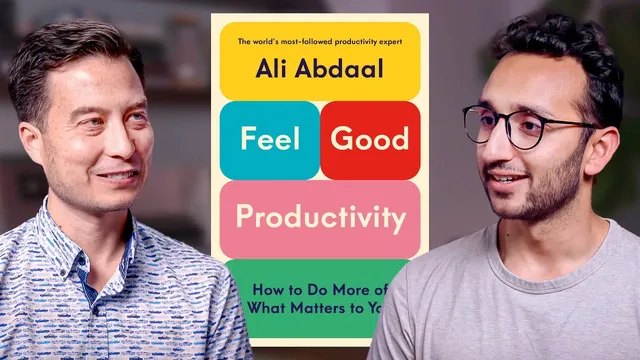
Is Hard Work Overrated? Ali Abdaal on Feelgood Productivity
Based on Tiago Forte's video on YouTube. If you like this content, support the original creators by watching, liking and subscribing to their content.
“Feelgood productivity” treats enjoyment as an input to performance, not a reward after success—because positive emotion broadens attention and reduces stress.
Briefing
“Feelgood productivity” reframes work as something that can be both effective and emotionally sustainable. Instead of treating productivity as a grind powered by discipline, the core claim is that people perform better when their work feels energizing—because positive emotion broadens attention and action, reduces stress, and makes effort more sustainable over time.
Ali Abdaal’s argument starts with a familiar cultural script: work should hurt, and struggling is treated as proof of seriousness. That mindset shows up in everything from the Protestant work ethic (“hard work” as moral worth) to modern workplace signals like staying late, plus motivational mythology that lionizes suffering. Abdaal contrasts that with research on flow states—where high performance comes with a sense of enjoyment and time passing quickly—and with the practical observation that the best work often happens when people feel good, not when they’re enduring pain.
The “feelgood” part isn’t presented as soft or purely emotional. Abdaal ties it to positive psychology, especially Barbara Fredrickson’s broaden-and-build theory: when people experience positive emotions, they relax out of survival mode, explore more, and build resources like creativity and social connection. He also points to evidence that positive affect at work predicts success more than success predicts positive affect. In that framing, “feel good” becomes instrumental—useful for performance, creativity, and resilience.
Abdaal then lays out a structured approach meant to be tested like experiments rather than accepted like commandments. The book is organized into nine principles, each with multiple strategies and experiments, totaling 27 strategies and 54 experiments. The guiding method is to treat each tactic as something to try, measure subjectively (“does it feel good?”), and iterate—an approach he likens to Richard Feynman’s curiosity-driven problem solving.
Several strategies illustrate the theme. “Shin” (beginner’s mind) aims to restore learning mode and reduce performance anxiety by approaching tasks as if they’re new—turning boring admin into curiosity games (he describes doing this with medical notes by looking up mechanisms of action). “Own the process” focuses on agency: even when outcomes are fixed, people can take ownership of how they do the work—through efficiency, empathy, or small workflow redesigns—so disengagement doesn’t drain energy. “Choose your character” draws on play research (Stuart Brown and the National Institute of Play) and suggests adopting a playful archetype—like Storyteller or Explorer—so routine tasks feel like role-based challenges rather than obligations.
Other tactics reinforce the same engine: “The Magic Post-It note” uses a simple prompt—“what would this look like if it were fun?”—to trigger small environmental and behavioral changes that add pleasure and energy. “Overcommunicate the good” argues that people often under-communicate appreciation; explicit validation creates a positive feedback loop. Finally, “align” addresses the longer-term question of whether to stay in a job: after trying enough “feelgood” experiments, persistent misalignment with personal values becomes a signal to reconsider.
Across the conversation, productivity is treated less like a moral test and more like a personal system: find what makes effort feel energizing, then use that as the foundation for sustained output—whether the work is a job, a business, or life’s daily responsibilities.
Cornell Notes
Ali Abdaal’s “Feelgood productivity” argues that high performance doesn’t require suffering. Positive emotions—grounded in positive psychology’s broaden-and-build theory—reduce stress, widen attention, and help people build resources like creativity and social connection, which in turn improves productivity and makes it more sustainable. The approach is practical and testable: the book organizes nine principles into 27 strategies and 54 experiments, encouraging readers to run small trials and keep what works for them. Key tactics include adopting a beginner’s mind (“Shin”), owning the process (agency over how work gets done), choosing a playful character, and using prompts like “what would this look like if it were fun?” to redesign daily effort. The payoff is energy, reduced burnout, and more time for life outside work.
Why does “feel good” lead to better productivity, according to the framework here?
What does “Shin” (beginner’s mind) change about how work feels?
How can someone “own the process” when outcomes are fixed (like a job or exam)?
What does “choose your character” mean, and how is it supposed to work?
Why is the prompt “what would this look like if it were fun?” treated as powerful?
When should someone consider quitting a job rather than trying more “feelgood” experiments?
Review Questions
- Which part of positive psychology (broaden-and-build) is used to explain why positive emotions improve performance, and what changes in attention or behavior does it predict?
- Pick one strategy (Shin, own the process, choose your character, or the “fun” Post-It). What would a concrete experiment look like for your next workday?
- How does the framework distinguish between “seriousness” and “sincerity,” and why does that distinction matter for play at work?
Key Points
- 1
“Feelgood productivity” treats enjoyment as an input to performance, not a reward after success—because positive emotion broadens attention and reduces stress.
- 2
The approach is evidence-based through positive psychology (broaden-and-build) and flow-state research, with the practical claim that feeling good makes work more sustainable.
- 3
Productivity myths that equate effectiveness with pain are traced to cultural narratives like the Protestant work ethic and visible workplace signals (e.g., staying late).
- 4
The book’s method is experimental: nine principles, 27 strategies, and 54 experiments, encouraging readers to test what improves both energy and output for them.
- 5
“Shin” (beginner’s mind) reduces performance anxiety by shifting tasks into learning mode, turning routine work into curiosity and discovery.
- 6
“Own the process” builds intrinsic motivation by focusing on agency over method—efficiency, empathy, and workflow design—when outcomes are fixed.
- 7
“Align” reframes quitting as a values question: after trying enough experiments, persistent misalignment becomes a signal to reconsider the job or direction.