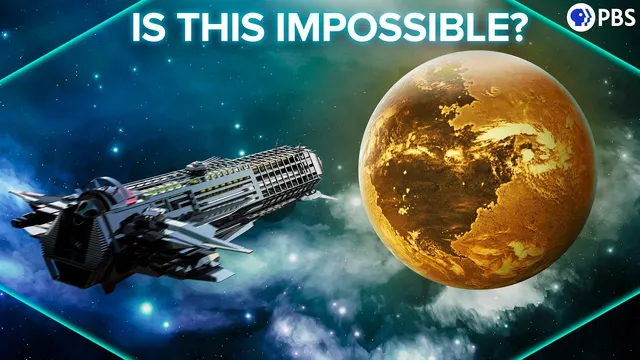
Is Interstellar Travel Impossible?
Based on PBS Space Time's video on YouTube. If you like this content, support the original creators by watching, liking and subscribing to their content.
Interstellar travel’s distance problem is difficult but potentially solvable; reaching nearby stars within a human lifetime likely requires speeds around 0.2c or higher.
Briefing
Interstellar travel may be less “impossible” than many fear—not because space is empty, but because the interstellar medium (ISM) is survivable with the right kind of shielding. The biggest practical obstacle isn’t the distance to nearby stars; it’s the damage inflicted by fast-moving gas and dust grains, plus the radiation that seeps through even a thin hull. At 20% the speed of light, a human-carrying starship aimed at Proxima Centauri could, in principle, make the trip in about a generation, but only if its front end is protected against micrometeoroids and its crew is protected against radiation.
The case starts with the “solvable” problem: travel time. Proxima Centauri sits 4.2 light-years away, and reaching it within a human lifetime requires relativistic speeds—fractions of light speed. Current spacecraft are far too slow, but concepts such as Breakthrough Starshot propose laser-accelerated, solar-sail craft that could reach roughly 20% of light speed. Scaling that idea up to a crewed ship changes the mass and shielding requirements dramatically, yet the distance itself doesn’t appear to be a hard limit.
What threatens the mission is the ISM. Space between stars contains diffuse gas and dust grains. Even at low densities, relativistic travel turns each atom or grain into a high-energy projectile. A millimeter-scale dust grain would deliver enough kinetic energy at 0.2c to vaporize a ship instantly, but such large grains are extremely rare outside planetary systems. The more common threat comes from smaller grains and heavier elements in the gas: impacts can vaporize and erode the forward hull down to roughly a millimeter over multi-light-year distances. That points to a “windshield” style solution—shielding concentrated on the front of a long, narrow ship—rather than a massive cocoon.
Radiation adds a second, more lethal constraint. While heavier elements in the ISM can be stopped within about a millimeter, hydrogen can penetrate much deeper. Those hydrogen atoms can lose electrons and become high-energy protons, creating radiation levels comparable to the core of a nuclear reactor if shielding is inadequate. Calculations suggest a titanium windshield on the order of centimeters to a couple of centimeters thick at 20% light speed, or about a meter of water, could reduce exposure to survivable levels. Lead or similar inner shielding would also be needed to block secondary radiation. Cosmic rays complicate matters further because they arrive from all directions; at more modest relativistic speeds, shielding likely must cover the whole ship. A meter-thick water shell would work but may be too heavy for early propulsion systems, implying that early interstellar travelers might accept elevated cancer risk.
Taken together, the hazards don’t force a “galactic prison” conclusion. Interstellar travel is difficult, but the physics of ISM impacts and radiation suggests it’s not ruled out in principle—meaning the Fermi Paradox likely isn’t solved by “everyone stayed home” because travel is categorically impossible. The episode closes by shifting to a separate thread: a physicists’ Q&A on informational quantum mechanics, black hole information ideas, and wormholes, including discussion of model-dependent realism and how Hawking radiation entanglement could, in principle, reveal interior information.
Cornell Notes
Interstellar travel isn’t automatically impossible; the limiting factor is whether a crewed ship can survive relativistic impacts and radiation from the interstellar medium (ISM). At 0.2c, dust and gas grains can erode the forward hull to about a millimeter depth over multi-light-year distances, suggesting a front “windshield” shield rather than a fully armored shell. Hydrogen in the ISM penetrates more deeply and can generate lethal radiation unless shielding is thick enough—roughly centimeters of titanium or about a meter of water at 20% light speed, with additional inner shielding to stop secondary radiation. Cosmic rays are harder to block because they hit from all directions, potentially requiring whole-ship shielding that may be too massive for early propulsion. The upshot: the Fermi Paradox isn’t explained by travel being categorically unworkable; it’s explained only if these engineering and health constraints become prohibitive at scale.
Why does the ISM become deadly at relativistic speeds even though it’s diffuse?
What does the micrometeoroid/dust impact analysis imply for shielding thickness and placement?
How can hydrogen in the ISM create a radiation hazard even if heavier elements are blocked quickly?
Why are cosmic rays a different kind of problem than ISM gas and dust?
How does this connect to the Fermi Paradox’s “boring” explanation?
Review Questions
- At 0.2c, what depth of forward-hull damage is expected from dust/gas impacts, and why does that suggest front-loaded shielding?
- What shielding materials and thicknesses are suggested to protect against radiation created by penetrating hydrogen, and what role does inner lead-like shielding play?
- Why does cosmic-ray protection scale differently with speed than ISM shielding, and what mass tradeoff does that create?
Key Points
- 1
Interstellar travel’s distance problem is difficult but potentially solvable; reaching nearby stars within a human lifetime likely requires speeds around 0.2c or higher.
- 2
The interstellar medium is not empty: fast impacts from gas and dust grains can erode or vaporize the forward hull to roughly millimeter scales over multi-light-year distances.
- 3
Large (millimeter-scale) dust grains are rare outside planetary systems, making the most practical threat smaller grains and heavier elements rather than instant catastrophic impacts.
- 4
Radiation is a separate dealbreaker: hydrogen can penetrate deeper than heavier elements and generate lethal proton radiation unless shielding is thick enough.
- 5
At 20% light speed, suggested shielding for radiation includes centimeters of titanium or about a meter of water, plus an inner layer to block secondary radiation.
- 6
Cosmic rays arrive from all directions, so protecting the whole ship may be necessary at plausible speeds, potentially forcing health-risk tradeoffs for early missions.
- 7
Because shielding and radiation mitigation appear feasible in principle, interstellar travel being categorically impossible is not a strong standalone solution to the Fermi Paradox.