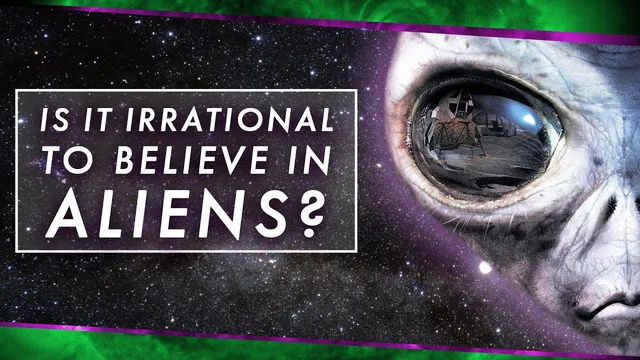
Is It Irrational to Believe in Aliens?
Based on PBS Space Time's video on YouTube. If you like this content, support the original creators by watching, liking and subscribing to their content.
Alien intelligence estimates require modeling probabilities for habitable planets, life emergence, and intelligence evolution, not relying on direct sightings.
Briefing
The central challenge in deciding whether intelligent aliens exist isn’t a lack of imagination—it’s a lack of data. With no confirmed sightings or verifiable evidence, the only rational way to estimate how many alien civilizations might exist is to model the chain of probabilities behind life: how many planets could support life, how often life actually starts, and how often it evolves into intelligence. This logic mirrors the Drake equation in spirit, but it runs into a hard limitation: Earth is the only known example of life, so the key probabilities for life’s emergence—and especially for intelligence—are essentially educated guesses.
Even so, the transcript lays out why scientists still treat the question as statistically discussable rather than hopeless. The “pro aliens” case leans on sheer numbers. The Milky Way contains roughly 200 billion stars, and recent exoplanet analyses suggest about one potentially habitable planet per star on average—around 200 billion habitable worlds. If the odds of intelligence are low but not unimaginably tiny, the vast number of opportunities could still yield many civilizations. Carl Sagan is cited as a major advocate of this view, using an analogy: even if the probability of producing intelligent life were as small as winning Powerball with a single ticket (about 1 in 175 million), the galaxy could still host over 1,000 civilizations. The underlying intuition is that a universe where intelligent life is effectively impossible would make Earth and humanity look “absurdly special,” a scenario many scientists find uncomfortable because it conflicts with the Copernican principle that we’re not privileged in the cosmic sense.
The counterweight is the Fermi paradox, associated with Enrico Fermi. The argument starts by accepting the pro-alien logic: the galaxy is about 10 billion years old, and if intelligence is common enough, there should have been both time and opportunity for civilizations to spread. Human technology is used as a benchmark—Pioneer and Voyager probes have already left the solar system, and with plausible future capabilities, probes or robots could cross the galaxy in tens of millions of years. Since that timescale is short compared with the galaxy’s age, the absence of any detectable traces—no alien signals, no artifacts, no lingering evidence of extinct civilizations—becomes the key fact. If intelligence were inevitable across billions of worlds, why is the sky so quiet? The paradox pushes toward astronomically low probabilities for intelligence and/or for civilizations to leave observable marks.
Between these camps sits a third option that tries to reconcile both sides without requiring extreme coincidences: a “great filter.” Oxford philosopher Nick Bostrom is credited with articulating the idea that intelligent life might arise fairly often, but it may frequently fail to survive long enough to expand—because of extinction events, natural catastrophes, or self-inflicted disasters such as nuclear war or uncontrolled nanotechnology. In that framing, the silence isn’t proof that intelligence never appears; it’s proof that it often doesn’t last.
Ultimately, the transcript frames the decision as weighing which improbability feels less unlikely: intelligence never evolving, or intelligence evolving but never spreading in a detectable way over cosmic timescales. The question remains open, but the reasoning is treated as a legitimate statistical problem rather than a matter of belief.
Cornell Notes
Intelligent aliens are hard to evaluate because the key probabilities—how often life starts and how often it becomes intelligent—are based on a sample size of one: Earth. A “pro aliens” case uses numbers: the Milky Way’s ~200 billion stars and roughly one habitable planet per star could produce many civilizations even if intelligence is rare. The “Fermi paradox” flips the logic by pointing to time and expansion: the galaxy is ~10 billion years old, and human probes show spreading is feasible on ~20 million-year timescales, yet there’s no evidence of alien signals or artifacts. A third reconciliation, the “great filter” (Nick Bostrom), suggests intelligence may arise but often goes extinct before it can spread. The debate becomes a choice among which low-probability step is most responsible for the silence.
Why does estimating alien intelligence rely on probability chains rather than direct observation?
What is the core logic of the “pro aliens” argument associated with Carl Sagan?
How does the Fermi paradox use time and expansion to challenge the “numbers” view?
What does the “great filter” hypothesis (Nick Bostrom) add to the debate?
If both Sagan-style and Fermi-style arguments are uncertain, what decision does the transcript say remains?
Review Questions
- What specific probabilities must be multiplied to estimate the number of intelligent civilizations, and which one is most uncertain given current evidence?
- How does the Fermi paradox translate the galaxy’s age into an expectation of detectable traces?
- How does the great filter hypothesis change what “silence” in the sky would mean?
Key Points
- 1
Alien intelligence estimates require modeling probabilities for habitable planets, life emergence, and intelligence evolution, not relying on direct sightings.
- 2
Earth-only evidence makes the probability of life—and especially intelligence—highly uncertain, so any numeric estimate is largely a guess.
- 3
The pro-alien case argues that enormous numbers of habitable worlds could produce many civilizations even if intelligence is rare.
- 4
The Fermi paradox argues that the galaxy’s ~10-billion-year age should allow spreading, yet the absence of any traces suggests intelligence or expansion is extremely unlikely.
- 5
The great filter hypothesis reconciles the two by suggesting intelligent species often go extinct before they can spread across the galaxy.
- 6
The debate ultimately turns on which improbability—no intelligence or no detectable spread—is less unlikely.