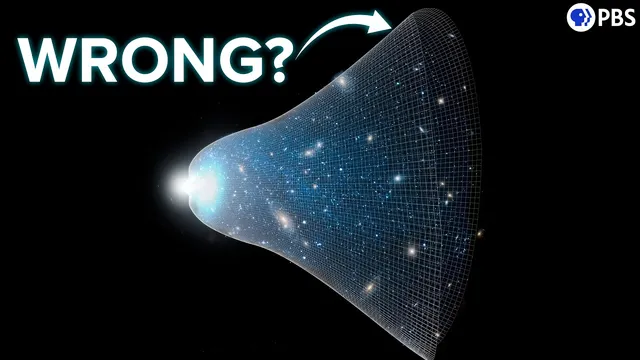
Is Our Model of Dark Energy WRONG? | New 4.2σ Results
Based on PBS Space Time's video on YouTube. If you like this content, support the original creators by watching, liking and subscribing to their content.
DESI’s second data release, combined with CMB initial conditions and Type 1A supernova distances, yields evidence for weakening dark energy at roughly the 4.2σ level—close to but below the 5σ discovery threshold.
Briefing
Cosmology is circling a major possibility: dark energy may not be constant. Results from the Dark Energy Spectroscopic Instrument (DESI) have pushed evidence that the strength of dark energy could be fading with time to about 4.2σ when combined with Type 1A supernova data—close to the 5σ threshold usually required to claim a discovery. The closeness is what matters: it’s strong enough to trigger a wave of follow-up work, but not strong enough to settle the question.
The standard baseline is the cosmological constant, Λ, in the ΛCDM model, where dark energy behaves like a constant energy density and drives exponential expansion. DESI’s earlier hints suggested a changing dark energy component, but the second data release elevated that hint to near-detection. In the specific varying-dark-energy framework tested, DESI finds only a marginal improvement over ΛCDM on its own; the signal becomes more compelling when DESI is combined with other probes. Those include the cosmic microwave background (CMB), which fixes the universe’s initial conditions, and an independent distance ladder from Type 1A supernovae, which helps pin down the absolute distance scale that DESI’s baryon acoustic oscillation (BAO) measurements alone struggle to determine.
BAO are central to DESI’s method. The early universe’s sound waves left a characteristic “standard ruler” imprint—gigantic, roughly circular patterns in galaxy distributions—that expands with the cosmos. DESI measures galaxy redshifts using spectra from thousands of optical fibers, translating the redshift into both distance and the expansion history along the light’s journey. But turning those measurements into a clean expansion curve requires combining “size of the universe at different times” (from BAO) with “distances to those times” (from supernovae and other anchors), all while controlling model assumptions.
Even so, the evidence is not yet definitive. The analysis tests a particular parameterization of changing dark energy, and adding extra freedom in model fitting can make an apparent improvement look stronger than it truly is. The next step is therefore not just more data, but better constraints on the full set of cosmological parameters.
The path forward is framed as a three-part upgrade: measure the universe’s starting state, measure the universe’s size across cosmic time, and measure distances to those epochs. CMB constraints are already extremely precise, so the limiting factors are expected to be BAO statistics and supernova calibration. DESI can improve BAO by expanding galaxy redshift surveys—more galaxies, deeper observations, and reduced uncertainties. Supernova work will focus on both collecting more Type 1A events and tightening calibration, a contentious area because supernova distances depend on a chain of earlier measurements.
To reduce reliance on supernovaes, independent distance methods are gaining momentum. Gravitational lensing time delays—where multiple images of a variable quasar arrive at different times due to different path lengths—offer an expansion-history probe independent of the supernova ladder. Meanwhile, galaxy clustering and weak lensing add another layer by constraining dark matter content and the growth of structure.
DESI is only one piece of a broader precision-cosmology push. The Dark Energy Survey (DES) complements it with imaging and photometric redshifts, while the Euclid satellite aims to map over a billion galaxies to constrain clustering and weak lensing to the ~1% level on key dark-energy parameters. The Legacy Survey of Space and Time (LSST) at the Vera C. Rubin Observatory will repeatedly image much of the southern sky for a decade, adding hundreds of thousands of Type 1A supernovae and enabling far larger samples of lensed quasars—making lensing time delays practical at scale. Together, these efforts are meant to turn a tantalizing 4.2σ hint into a precision test of whether dark energy truly evolves, and what physics could produce the universe we observe.
Cornell Notes
DESI’s second data release, when combined with CMB constraints and Type 1A supernova distances, yields evidence that dark energy may weaken over time at roughly the 4.2σ level—close to the 5σ bar for discovery. The result challenges the simplest ΛCDM picture where dark energy is a constant cosmological constant (Λ) driving exponential expansion. DESI’s core measurements rely on baryon acoustic oscillations (BAO) as a standard ruler and galaxy redshifts to trace the expansion history, but DESI alone can’t fully fix the absolute distance scale. The next decade’s strategy is to improve BAO statistics, tighten supernova calibration, and add independent distance and growth-of-structure probes such as gravitational lensing time delays, galaxy clustering, and weak lensing. Euclid and LSST are expected to sharpen constraints further by mapping vastly larger samples and enabling precision measurements of the dark-energy equation-of-state behavior.
Why does DESI’s BAO measurement need help from supernovae (and the CMB) to test dark energy?
What does “4.2σ” mean here, and why isn’t it enough to declare a discovery?
How do gravitational lensing time delays provide an expansion-history measurement independent of supernova distances?
What additional cosmological information comes from galaxy clustering and weak lensing beyond BAO and redshifts?
How are Euclid and LSST expected to change the dark-energy test compared with DESI alone?
Review Questions
- What roles do BAO, Type 1A supernovae, and the CMB each play in constraining dark energy, and what degeneracy does each help break?
- Why might a varying-dark-energy model show a better fit without necessarily representing a real physical change in dark energy?
- Which future survey capabilities (statistics, calibration, or independent distance probes) are most likely to push the field from ~4σ hints to precision tests?
Key Points
- 1
DESI’s second data release, combined with CMB initial conditions and Type 1A supernova distances, yields evidence for weakening dark energy at roughly the 4.2σ level—close to but below the 5σ discovery threshold.
- 2
BAO provide a standard ruler for tracking how the universe’s size evolves, but DESI’s redshift-based distances need an absolute distance anchor like supernovae to tighten dark-energy constraints.
- 3
The result is not yet definitive because it relies on a specific varying-dark-energy parameterization and because extra model freedom can mimic improved fits.
- 4
Improving the measurement hinges on doing everything better: larger/deeper galaxy redshift surveys for BAO, more Type 1A supernovae, and tighter supernova calibration across the full distance ladder.
- 5
Independent distance and geometry probes—especially gravitational lensing time delays—can validate or challenge supernova-based inferences.
- 6
Galaxy clustering and weak lensing help constrain dark matter and the growth of structure, reducing parameter degeneracies in cosmological model fits.
- 7
Euclid and LSST are expected to deliver the scale and multi-probe coverage needed for ~1% level constraints on dark-energy behavior and a decisive test of whether dark energy truly evolves.