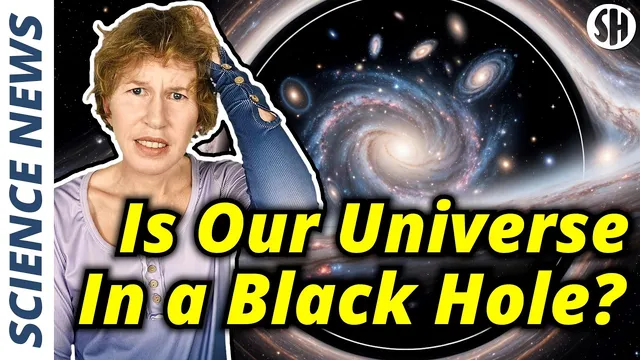
Is Our Universe Inside a Black Hole? This Makes it Plausible
Based on Sabine Hossenfelder's video on YouTube. If you like this content, support the original creators by watching, liking and subscribing to their content.
The proposal treats the Big Bang-like expansion as a bounce inside a black hole rather than an absolute beginning.
Briefing
A new line of cosmology suggests the Big Bang may not have been the start of everything at all: instead, our expanding universe could be the aftermath of a previous universe collapsing into a black hole—meaning “the universe” might literally live inside a black hole. The core appeal is that the interior of a black hole can mimic the large-scale behavior of standard cosmology closely enough that the difference would be hard to detect, while still leaving a measurable signature.
The argument starts with Einstein’s general relativity, where the distribution of energy and mass shapes the dynamical behavior of spacetime. In the simplest, highly symmetric models, the universe’s energy density is treated as uniform on average. The same kind of approximation can describe a collapsing star, except that the energy distribution is “cut off” at some radius and replaced by vacuum outside—like using a cookie cutter. In that setup, collapse typically drives matter toward a singularity: an endpoint where energy density becomes infinite and time effectively breaks down. Most physicists consider that outcome unphysical, expecting quantum gravity to intervene before infinities form.
The proposed fix is that quantum effects prevent energy density from diverging. Instead of continuing to collapse, the contraction stalls at a maximum density and then turns into expansion. Mathematically, that expansion can resemble the standard picture of an expanding universe, but with three crucial differences: (1) the entire cosmological region sits inside a black hole, (2) the interior is not infinitely large because the “cookie cutter” implies a boundary, and (3) the interior spacetime is not perfectly flat—cutting out a region from a larger geometry leaves residual curvature.
What’s new in the recent paper is a specific mechanism for why the collapse bounces. The authors focus on fermions—particles such as electrons and quarks—that obey the Pauli exclusion principle, which prevents identical fermions from occupying the same quantum state. The paper postulates that an exclusion principle of this kind persists at super-high densities, blocking the formation of a true singularity. That same constraint is claimed to generate negative pressure, and negative pressure is what drives a rapid expansion.
The most testable part comes from identifying that negative pressure with the cosmological constant. If the “bounce” is powered by a persistent cosmological-constant-like effect, then the size of the black hole interior—and the curvature of spacetime inside it—becomes linked to the same parameter. The prediction: our universe should not be perfectly flat, and the curvature should be large enough to become measurable soon.
Still, the idea faces a credibility hurdle. The Pauli exclusion principle works well for known matter in settings like white dwarfs and neutron stars, where it can halt collapse. But it cannot be assumed to hold indefinitely under arbitrarily extreme conditions without additional physics. The paper therefore relies on an additional, effectively ad-hoc “ultimate” exclusion principle at densities beyond current regimes. Even so, the proposal is presented as mathematically lean and close to standard cosmology—making it plausible as a quantum-gravity-motivated way to avoid singularities, while offering a concrete observational target: nonzero curvature.
Cornell Notes
The proposal reframes the Big Bang as a bounce inside a black hole: a previous universe collapses, reaches a maximum density where singularities are avoided by quantum-gravity effects, and then transitions into an expanding interior that resembles standard cosmology. The mechanism hinges on fermions and a Pauli-exclusion-like constraint at extreme densities, which both prevents infinite energy density and produces negative pressure. That negative pressure is treated as equivalent to a cosmological constant, linking the interior’s expansion to the curvature of spacetime. The resulting prediction is that the universe should have measurable nonzero curvature rather than being perfectly flat. The key open question is whether an “ultimate” exclusion principle beyond known matter is physically justified.
Why can the interior of a black hole look like an expanding universe?
What role does the “singularity problem” play in the proposal?
How does the Pauli exclusion principle enter the bounce mechanism?
Why does negative pressure matter observationally?
What criticism is raised about the exclusion-principle assumption?
Review Questions
- What three differences remain between a black-hole interior cosmology and standard expanding cosmology, even if the dynamics look similar?
- How does identifying negative pressure with the cosmological constant translate into a prediction about spatial curvature?
- Why does the proposal need an exclusion principle beyond the one that already explains stability in white dwarfs and neutron stars?
Key Points
- 1
The proposal treats the Big Bang-like expansion as a bounce inside a black hole rather than an absolute beginning.
- 2
Quantum gravity is expected to prevent energy density from reaching infinity, turning collapse into expansion.
- 3
A Pauli-exclusion-like mechanism at super-high densities is used to both cap density and generate negative pressure.
- 4
Negative pressure is identified with the cosmological constant, linking the bounce to spacetime curvature.
- 5
The resulting prediction is nonzero curvature that should become measurable soon, implying the universe is not perfectly flat.
- 6
The approach is mathematically close to standard cosmology but depends on an additional, potentially ad-hoc “ultimate” exclusion principle at extreme densities.