Is Quantum Mechanics Stopping Aliens From Contacting Us?
Based on minutephysics's video on YouTube. If you like this content, support the original creators by watching, liking and subscribing to their content.
Quantum communication can be more information-dense than classical communication, but it doesn’t automatically make alien signals easy to detect.
Briefing
The Fermi Paradox—why no extraterrestrial signals have reached Earth despite the likely abundance of intelligent life—may hinge on a practical bottleneck: interstellar quantum communication could be so demanding that alien messages would mostly slip past us unnoticed, and even intercepted fragments might be undecodable. Quantum communication can pack more information into the same quantum resources than classical methods, but it comes with strict physical requirements for how signals must be sent and received across space.
For long-distance messaging, the key constraint is the speed-of-light delay, which makes inefficient communication unattractive. Quantum protocols offer efficiency gains. In superdense coding, quantum bits can transmit twice as much classical information as one might expect from classical communication alone. Another approach, the hidden matching problem, can require exponentially fewer quantum bits than classical bits to convey certain types of information. Quantum communication also enables security and computational capabilities that classical channels can’t replicate. Yet these advantages don’t automatically solve the Fermi Paradox; the decisive factor is whether the universe’s physics allows such communication to be detected by a distant, smaller listener.
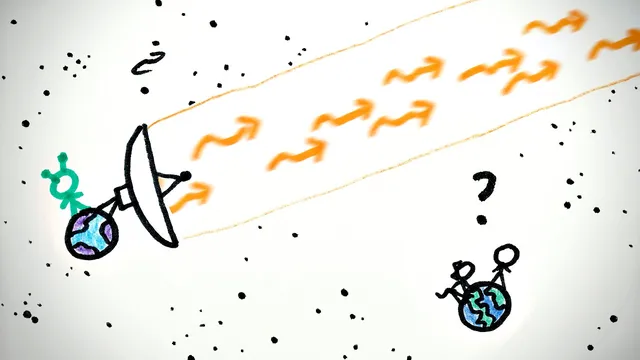
Quantum information can’t be broadcast like radio. Because quantum states are fragile, the receiver must collect more than half of the photons carrying the relevant quantum information to reconstruct it. That forces “narrowcasting”: the sender must focus the signal so that the receiving telescope captures the required majority of photons rather than letting them spread out in all directions. The geometry then becomes brutal. The telescope sizes at both ends must be enormous, with the exact scale depending on distance and the photon wavelength used. For a target like Alpha Centauri, the required transmitting/receiving telescope size is estimated around ~100 km, and larger systems would be needed for more distant stars.
This requirement changes what Earth would observe. If widespread alien civilizations use quantum interstellar communication with huge, precisely aimed telescopes, then only a tiny fraction of their photons would ever land in our comparatively small telescopes. Even if some photons arrive, Earth would still fail the “over 50%” threshold needed to decode the message. The result: alien transmissions could be constantly passing by without producing a detectable, interpretable signal.
There’s also a strategic implication. Any civilization capable of building the oversized telescopes needed for quantum communication would also be able to see that Earth lacks the telescope scale required to receive such messages. If they know their quantum channel would be futile for us, they may not bother sending it in the first place.
The proposed resolution is therefore conditional: quantum communication could be the dominant interstellar method, but its narrowcast, photon-harvesting requirements mean Earth would neither reliably detect the transmissions nor decode them if detection occurred. Remaining open questions include why aliens wouldn’t fall back to easier classical radio-like signals if they realized we can’t receive quantum ones, and why they wouldn’t simply visit if they had the capability to build galaxy-spanning telescope networks. The transcript also flags caveats: superdense coding needs pre-shared entanglement at the receiver or additional quantum bits from the sender, and the hidden matching approach, while proven exponentially faster in the quantum setting, still depends on receiver-side information and isn’t clearly packaged as a universal communication protocol.
Cornell Notes
Quantum communication could offer aliens a way to transmit far more information than classical signals, but it demands extreme “narrowcasting.” Unlike radio, quantum messages can’t be broadcast broadly because the receiver must collect more than 50% of the relevant photons to reconstruct the quantum state. That forces telescope sizes on the order of ~100 km for a system like Alpha Centauri, with larger instruments for greater distances. If alien civilizations use such focused quantum links, most transmissions would pass Earth without delivering enough photons for decoding, and aliens could infer from our small telescopes that sending quantum messages would be futile. The idea potentially explains the Fermi Paradox—though it leaves questions about why classical fallback signals or visits wouldn’t happen.
Why can’t interstellar quantum communication work like radio broadcasting?
How do quantum protocols like superdense coding and hidden matching relate to communication efficiency?
What telescope sizes are implied for quantum communication with nearby stars?
How does the “over 50% photons” rule lead to a Fermi-Paradox-style non-detection?
Why might aliens avoid sending quantum messages to Earth even if they can communicate quantumly?
What caveats limit the straightforward “quantum solves everything” conclusion?
Review Questions
- What specific physical threshold makes quantum communication fundamentally different from radio broadcasting, and how does it affect detectability?
- Why do telescope size requirements become the central bottleneck for interstellar quantum messaging in this scenario?
- How do the caveats about entanglement (superdense coding) and receiver-side information (hidden matching) complicate the idea of a universal quantum communication channel?
Key Points
- 1
Quantum communication can be more information-dense than classical communication, but it doesn’t automatically make alien signals easy to detect.
- 2
Quantum messages can’t be broadcast broadly; the receiver must collect more than 50% of the photons carrying the quantum information to reconstruct the state.
- 3
Narrowcasting plus the >50% photon requirement implies extremely large telescope sizes—about ~100 km for Alpha Centauri in the transcript’s estimate.
- 4
Earth’s smaller telescopes would likely receive too few photons to decode alien quantum transmissions, even if some photons arrive.
- 5
Aliens with the capability for quantum interstellar communication could also observe that Earth lacks the necessary receiving infrastructure, making quantum messaging to us potentially futile.
- 6
Protocol-level caveats matter: superdense coding needs pre-shared entanglement, and hidden matching depends on receiver-side information and isn’t clearly a plug-and-play general communication method.