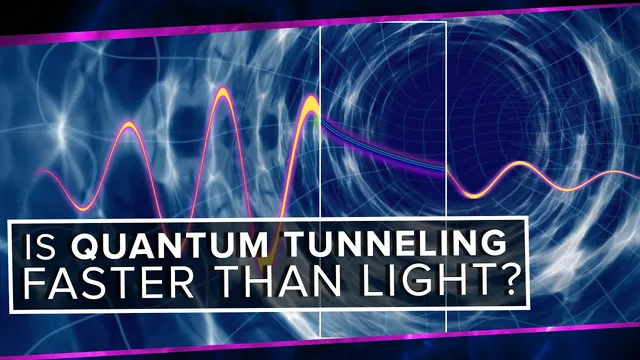
Is Quantum Tunneling Faster than Light? | Space Time | PBS Digital Studios
Based on PBS Space Time's video on YouTube. If you like this content, support the original creators by watching, liking and subscribing to their content.
Quantum tunneling occurs because a particle’s wave function extends into classically forbidden regions, leaving a nonzero (exponentially small) probability tail beyond a barrier.
Briefing
Quantum tunneling can look like faster-than-light travel, but the apparent speedup is confined to the tiny timing uncertainty built into quantum mechanics. The core idea is that a particle’s position isn’t sharply defined until measurement; instead, its wave function spreads over a range of possible locations. When a particle encounters a barrier—like an alpha particle trapped inside a nucleus—its wave function doesn’t abruptly stop at the barrier edge. It falls off exponentially, leaving a minuscule probability “tail” outside the barrier. That tail lets the particle emerge on the other side without the energy needed to classically climb over the wall, producing radioactive decay and enabling processes like fusion in stars.
The episode links this tunneling picture to a long-standing worry: if the particle seems to cross the barrier “instantaneously,” doesn’t that imply motion faster than light? Directly timing such an event is extraordinarily difficult because the relevant timescales are far too short for clocks to resolve. Instead, researchers use an interferometer strategy with single photons. In a Michelson interferometer variant, individual photons travel along two precisely controlled paths. One path includes a very thin reflective barrier. Without tunneling, the barrier would reflect photons essentially 100% of the time; with tunneling, about 1% of photons can “resolve” beyond the barrier because their wave packets extend weakly into the classically forbidden region.
If those rare tunneling photons truly traverse the barrier instantly, they should reach the detector slightly earlier than photons that take the unimpeded route. Detecting that requires extreme path-length matching so that any timing difference shows up as a mismatch in the interference pattern. To achieve the needed precision, the experiment relies on quantum entanglement: the interferometer paths must be tuned to be identical to very high accuracy so entangled states reveal tiny travel-time differences.
Results reported from such experiments indicate that the tunneling photons arrive a tiny bit earlier than their partners—an effect that can be described as “teleporting” through the barrier and therefore faster than light. But the episode stresses why this doesn’t overturn relativity in practice. The earlier arrival occurs only within the quantum uncertainty range set by the particle’s wave packet, which is tied to the de Broglie wavelength and ultimately to the Heisenberg uncertainty principle. Even an unimpeded photon has a spread of possible positions and therefore a spread of arrival times; adding the barrier reshapes the wave packet by selecting the early-arrival portion of that distribution. The apparent speedup is thus a measurement of quantum timing uncertainty, not a usable signal that outruns light.
Scaled up to macroscopic objects, quantum uncertainty becomes negligible, restoring ordinary speed limits. Still, within the quantum realm, tunneling and related effects raise tantalizing questions about causality and how far “instantaneous” behavior can be pushed without breaking the rules of physics.
Cornell Notes
Quantum tunneling arises because a particle’s wave function extends into classically forbidden regions. For an alpha particle in a nucleus, the wave packet reflects from the potential barrier but leaves an exponentially decaying probability tail outside the nucleus, enabling a tiny chance of escape—crucial for radioactive decay. The same mechanism supports fusion and other nuclear processes, and it underpins modern electronics like transistors. Experiments with single photons in a Michelson interferometer variant suggest tunneling photons can arrive slightly earlier than expected, which looks faster than light. That “speedup” is limited to the timing uncertainty set by the de Broglie wavelength and the Heisenberg uncertainty principle, so it doesn’t provide a real faster-than-light signal.
Why does quantum tunneling let particles cross barriers they can’t classically surmount?
How does the de Broglie wavelength connect to position uncertainty and tunneling?
Why is it so hard to test whether tunneling is “instantaneous”?
How do interferometer experiments with photons probe tunneling time differences?
What prevents tunneling from enabling real faster-than-light communication?
Why do macroscopic objects obey ordinary speed limits?
Review Questions
- How does the exponential probability tail outside a potential barrier arise from the wave-packet description of a particle?
- What role do de Broglie wavelength and the Heisenberg uncertainty principle play in interpreting “earlier-than-expected” tunneling arrivals?
- Why does achieving precise interferometer path-length equality require entanglement in these photon experiments?
Key Points
- 1
Quantum tunneling occurs because a particle’s wave function extends into classically forbidden regions, leaving a nonzero (exponentially small) probability tail beyond a barrier.
- 2
An alpha particle’s tunneling probability explains key nuclear phenomena, including radioactive decay, and similar tunneling enables fusion and particle capture in stars.
- 3
The de Broglie wavelength—set by momentum—controls how spread out a particle’s position is, which in turn determines how much probability exists outside a barrier.
- 4
Directly timing tunneling events is extremely challenging due to the tiny timescales involved, so experiments use interferometry with single photons instead.
- 5
Interferometer results that show tunneling photons arriving slightly earlier can be consistent with relativity because the effect stays within quantum timing uncertainty.
- 6
Entanglement helps make the interferometer path lengths match to very high precision, allowing interference to reveal tiny travel-time differences.
- 7
The “faster-than-light” appearance does not translate into a usable faster-than-light signal because wave-packet reshaping selects early-arrival components within the uncertainty range.